17

Find the volume common to two circular cylinders, each with radius r, if the axes of the cylinders intersect at right angles. (using disk/washer)

I saw no example of this problem anywhere.. I saw an example how to solve it without calculus but I'm afraid that'll be deductions on my test.. I have the volume of a cylinder and the method of area between two curves but this is out of my reach.... I don't know what I can try...

J L
  • 1,415

7 Answers7

28

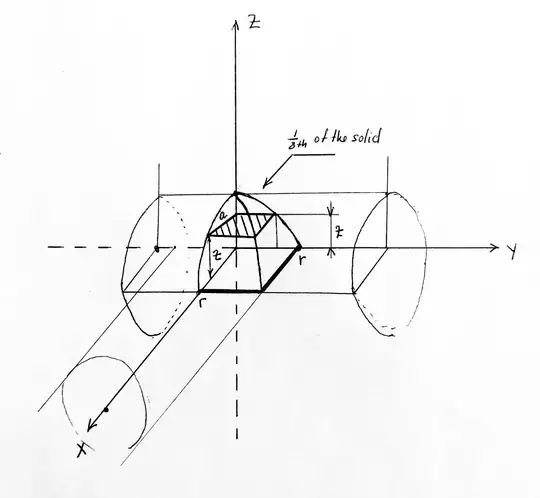
The main challenge in this problem is to predict the solid itself. Take a look at the image below

enter image description here

As we increase the height $z$ of the intersecting plane the section of the solid is a square with a side $a$. Since the solid is created with two cylinders of radius $r$, $a$ and $z$ are related by $$a^2+z^2=r^2$$

The area of the square is $A=a^2$ or in terms of $z$: $$A(z)=a^2=r^2-z^2$$ The method of washers tells us $$V=8\int_0^rA(z)dz=8\int_0^r(r^2-z^2)dz=8\left(r^3-\frac{r^3}{3}\right)=\frac{16}{3}r^3$$

Note that the coefficient $8$ is required since we are considering a $1/8$th part of the solid.

AstroSharp
  • 1,058
  • How did you get to 1/8th of the solid? – Robert Melikyan Oct 23 '22 at 17:16
  • 1
    @RobertMelikyan there are 8 octants in 3D so each octant contains 1/8th of the solid. You can also imagine it on the drawing: 4 chunks on the top (z>0) and 4 chunks under (z<0) – AstroSharp Oct 31 '22 at 23:44
  • much appreciated. I am still confused how you got $a^2 + z^2 = r^2$? I have been drawing it out and I just can't see it :/ – Robert Melikyan Nov 04 '22 at 10:35
  • 1
    @RobertMelikyan check the drawing: segments $a$ and $z$ intersect at a point. The distance from this point to the origin is $r$ because the point is on the surface of one of the cylinders. So $a$ and $z$ become sides of the right triangle. If we apply the Pythagorean theorem,you will get the sum of squares – AstroSharp Nov 11 '22 at 01:12
  • makes sense, I was trying to visualize a triangle and imagining $z$ going from the origin helped with that image. – Robert Melikyan Nov 12 '22 at 13:45
4

this link gives proper visualisation of intersection of 2 cylinders having same radii. Volume is calculated by 2 different methods.

DJ001
  • 5
priya
  • 41
4

Let r bet the radius of both cylinders and their axes are both perpendicular and intersecting. There is a common sphere enveloped by the 2 intersecting cylinders. If we look at the planar section which passes through both cylinder axes we can see a square area common to both cylinders. This square has an area of (2.r.2.r). We can also see a circle which is produced as a result of the plane passing through the enveloped common sphere. This circle has an area of (Pi.r.r).

If the plane is moved away from the cylinders axes, the intersection surface will reduce until the plane exits the cylinders completely. During this transition an ever changing common surface area is produced, but it will always consist of a square with a circle inside it which is tangential to that square at the middle of each side of the square. The ratio of the square to the circle is (4.r.r)/(pi.r.r)= 4/pi.

We know the volume of the common sphere is (4.Pi.r.r.r/3),So by using a similar shape approach, we can deduce that the common volume of the intersecting cylinders will be (4.Pi.r.r.r/3).(4/Pi)= 16.r.r.r/3 There is no Pi in the answer. hope that's useful, and no Calculus either. Lol.

Ronaldo
  • 41
  • Very elegant solution; it brings out the heart of the problem. I had difficulty imagining the shape until I read this solution (and @Andres Mejia's hints), that helped in recognizing the simple symmetry. – cosmo5 Aug 28 '20 at 14:56
  • Wonderful! Thank you so much – Saby123 Aug 25 '23 at 15:52
2

These are some hints: Consider the two following cylinders: $y^2+z^2=1$ and $x^2+z^2=1$. Let $\mathcal{C}$ be the region common to both:

a) Can you explain why the volume is between $\frac{4}{3}\pi$ and $8$?

b)What section is obtained when $\mathcal{C}$ is sliced by a plane that is parallel to the $xy$-plane?

c)Integrate to find the volume.

Andres Mejia
  • 21,467
1

The derivation above looks good. This volume is known as a "Steinmetz Solid." There is a page discussing its properties at Mathworld. That page shows another way to get the volume by integration.

John
  • 109
0

Using prismoidal formula. Area at the Middle of the intersectcion is a square with sides 2r, so the area is 4r^2. Then the area at the top and bottom is 0. The length of the area of intersection is the diameter of cylinder equal to 2r.

Prismoidal formula. V= L*(Atop +4Amid + Abot)/6 V= 2r(0+4*4r^2+0)/6 =(16/3) * r^3

-4

The volume of a Steinmetz solid $(SS)$, formed by the intersection of $2$ cylinders (radii $r$) at right angles is:

$$V = 4r \cdot r \cdot r \left(\frac{\pi}{2} - \frac{1}{3}\right) = 4r^3\left(\frac{\pi}{2} - \frac{1}{3}\right)$$

As the volume of $SS$ is formed by sections of a cylinder, the answer must contain $\pi$.

Zain Patel
  • 17,200
  • 5
  • 29
  • 59
  • 3
    With no derivation and no references, it's hard to guess what object this formula describes. The last sentence of the answer is simply false. – David K Jul 02 '15 at 12:51
  • "The last sentence of the answer is simply false." Do you have any references to support that statement? No way can an expression, which gives the volume of part of a cylinder could be without pi. The Steinmetz solid is made of 4 sections of a cylinder and thus the expression for its volume must contain pi. There are countless websites on the Steinmetz solid showing the volume of 16r^3/3. Some of the sources dated back 50 years. It was wrong then and it is still wrong. My viewing of these sites (and some of them have good credentials), spurred me to make my entry on this site. – Bill Crean Jul 03 '15 at 14:14
  • 1
    As you yourself say, there are sources with good credentials that give $16r^3/3$ as the volume. I think the onus is on you to give a rigorous proof showing why they are wrong. "You can't have part of a cylinder without pi" is nonsense--start with an infinite cylinder and just cut off pieces at will, and you can make the volume anything you like. Show us exactly why this particular cut leaves any $\pi$ in the simplified expression of the volume. – David K Jul 06 '15 at 03:16
  • Are there references for -- or a derivation of -- your formula? – DBS Mar 26 '17 at 01:18