\begin{align}
R &= \{ 0<x<1,-x<y<x,z=\sqrt{1-x^2} \} \\
S &= 8\iint_R dA \\
z &= \sqrt{1-x^2} \\
z_x &= -\frac{x}{\sqrt{1-x^2}} \\
z_y &= 0 \\
dA &= \sqrt{1+z_x^2+z_y^2} \, dx \, dy \\
&= \frac{1}{\sqrt{1-x^2}} \, dx \, dy \\
S &= 8\int_{0}^{1} \int_{-x}^{x} \frac{1}{\sqrt{1-x^2}} \, dy \, dx \\
S &= 8\int_{0}^{1} \frac{2x}{\sqrt{1-x^2}} \, dx \\
&= 16
\end{align}
See also ancient Chinese work, Nine Chapters《九章算術》commented by Liu Hui(劉徽) here.
Addendum
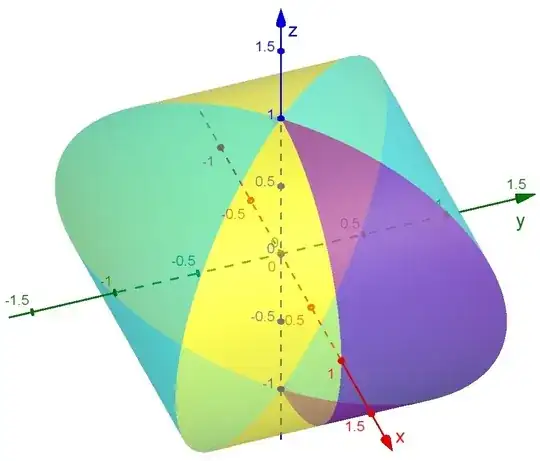 In the figure above, the intersections between two cylinders (yellow and cyan) are two ellipses, namely $$x^2=y^2=1-z^2$$
Consider the purple region $T=\{ 0<y<x<1,x=\sqrt{1-z^2} \}$ which is bounded by a semi-circle in $xz$-plane and a semi-ellipse namely
$$(x,y,z)=(\sin \theta,\sin \theta,\cos \theta)$$
Now unwrapping the cylinder,
$$s=\theta \implies y=\sin s$$
therefore we get a sine curve (green).
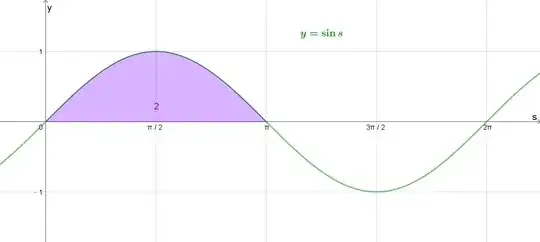
The area of purple region $T$ is
$$\int_0^\pi \sin \theta \, d\theta=2$$
which is $\dfrac{1}{8}$ of the total surface area.


