7

I've been studying A081018 as part of a programming challenge. Skipping some of the introductory material, the crux of the question is that we have the equation

$$S = \frac{x}{1 - x - x^2}$$

and we want to know which values $x \in \mathbb{Q}$ produce nonnegative integer values of $S$.

A081018 (linked above) asserts that all solutions to this problem are of the form $x = \frac{F_{2n}}{F_{2n+1}}$, resulting in $S = F_{2n} F_{2n+1}$ (where $F_n$ is the $n$th Fibonacci number, with $F_0 = 0, F_1 = 1$).

Now, I understand why those $x$ values are solutions to the problem. As a very quick summary, we have

$$S = \frac{\frac{F_{2n}}{F_{2n+1}}}{1 - \frac{F_{2n}}{F_{2n+1}} - \frac{F_{2n}^2}{F_{2n+1}^2}} = \frac{F_{2n}F_{2n+1}}{F_{2n+1}(F_{2n+1} - F_{2n}) - F_{2n}^2} = \frac{F_{2n}F_{2n+1}}{F_{2n+1}F_{2n-1} - F_{2n}^2} = (-1)^{2n} F_{2n} F_{2n+1} = F_{2n} F_{2n+1}$$

Where the penultimate equality is due to the Cassini identity.

However, I'm struggling to see why these are the only solutions. I've tried some basic analysis with the norm in $\mathbb{Q}(\sqrt{5})$ (since the Fibonacci numbers seems to have a particular attachment to $\sqrt{5}$) but came up mostly fruitless. How can we demonstrate that every $x \in \mathbb{Q}$ which produces a nonnegative integer $S$ must be of the form $x = \frac{F_{2n}}{F_{2n+1}}$?

Blue
  • 83,939
  • 1
    The same link contains: https://www.fq.math.ca/Scanned/6-3/lind.pdf From the equation you get the discriminant to be $(S+1)^2+4S^2=b^2$ which can be written as $5S^2+2S+1=b^2$ equivalent to $(5S+1)^2-5b^2=-4$. In the link they solve this diophantine equation. – Phicar Jul 21 '22 at 18:29

2 Answers2

6

it's binary quadratic forms, indefinite. Say $\frac{x}{1-x-x^2} = k$ is a positive integer. We have $x = k - kx - k x^2$ and $k-(k+1)x - k x^2 =0,$ and we demand $x$ rational.

So far, $ k x^2 +(k+1)x - k=0.$ The Quadratic Formula says $$ x = \frac{-1-k \pm \sqrt{(k+1)^2 +(2k)^2}}{2k} $$ so in order to have $x$ rational, we demand $$ (k+1)^2 + (2 k)^2 = w^2 $$

There are two cases, both need a diagram. WHEN $k$ is even, $\gcd( k+1, 2k) = 1.$ Thus we have a primitive Pythagorean triple. The requirement is that there be integers $m,n$ coprime and not both odd, with $2mn=2k, m^2 - n^2 = k+1. $ Thus $mn=k$ and $$ m^2 - mn - n^2 = 1.$$ Negating both sides gives $$ n^2 + nm - m^2 = -1$$ All solutions of this can be shown on Conway's topograph, I usually write the form as $x^2 + xy - y^2 $ because it is Gauss-Lagrange reduced... enter image description here The diagram shows that the value of $x^2 + xy - y^2$ is unchanged by the mapping (same idea as Vieta Jumping)
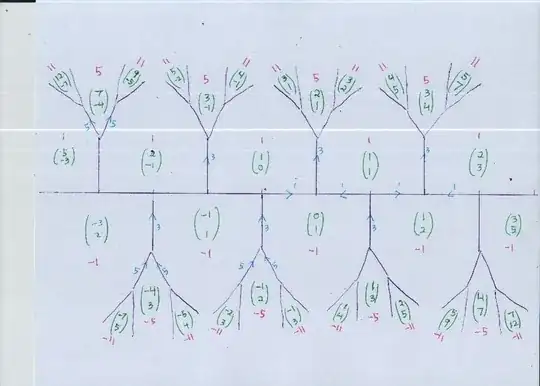
$$ (x,y) \mapsto (x+y, x+2y) $$ and a little fiddling shows that the $(x,y)$ pairs (with $x,y \geq 0$) and $x^2 + xy - y^2 = -1$ are $$ (0,1), (1,2), (3,5), (8,13), (21,34), (55, 89) $$ and so on. Indeed, inverting the mapping to $ (x,y) \mapsto (2x-y, -x+y) $ takes any pair back to $(0,1),$ this giving the proof of Fibonacci-ness

Then we go back to $k=mn$ which is, in the diagram, $k=xy,$ after which the desired rational number (originally called $x$ ) is $$ x = \frac{-1-k \pm \sqrt{(k+1)^2 +(2k)^2}}{2k} $$ The values of $k$ are $$ 0, 2, 15, 104, 714, 4895, $$ with $ k_{n+2} = 7 k_{n+1} - k_n + 1$

SECOND CASE: when $k$ is odd, we may write $k = 2j+1$ and reach $(j+1)^2 +( 2j+1)^2 = w^2.$ The two numbers $j+1, 2j+1$ are coprime, the latter odd, thus $j+1$ is even and $j$ odd. Once again, $j+1 = 2mn$ so that $2j+2 = 4mn, $ while $2j+1 = m^2 - n^2 $ As $2j+1 - (2j+2) = -1,$ we find $$m^2 - 4mn - n^2 = -1$$ I would usually switch to $$ n^2 + 4nm - m^2 = 1. $$ I don't expect I have a diagram ready for this exact form.

As is a requirement for representing $1,$ all $(n,m)$ pairs arise by beginning with $(1,0) $ and applying the automorphism matrix generator to reach mapping $$ (n,m) \mapsto (n+4m, 4n+17m)$$ The first few pairs with both nonnegative are $$ (1,0), (1,4), ( 17, 72), (305, 1292), (5473, 23184), ...$$ Both sequences, $1,1, 17, 305, 5473, ... $ and $0, 4, 72, 1292, 23184$ obey the recurrence $n_{j+2} = 18 n_{j+1} - n_j$ and $m_{j+2} = 18 m_{j+1} - m_j.$ For this one, $k = m^2 - n^2 $ and begins $$ -1, 15, 4895, 1576239, 507544127, 163427632719, 52623190191455, 16944503814015855, ...$$ Here we have recurrence $$ k_{i+2}= 322 k_{i+1} - k_i + 64 $$ If we name $w_i = \sqrt{5k_i^2 + 2 k_i + 1},$ beginning with $k=-1$ we get sequence $$ 2, 34, 10946, 3524578, 1134903170, 365435296162, 117669030460994, $$

$$ w_{i+2}= 322 w_{i+1} - w_i $$

Will Jagy
  • 146,052
1

Here are other questions where the Conway Topograph was relevant, in several I posted a diagram.

Producing the diagram is algorithmic in some ways. I have simple programs to get the numbers right. Professors have asked about software to make these, I don't see why not. It is the final graphics that takes more background than I have.

At the end I also list four books that discuss the topograph. The book by Hatcher is most similar to my choices; on the whole, I put in more information in one diagram than these authors.

Another quadratic Diophantine equation: How do I proceed?

How to find solutions of $x^2-3y^2=-2$?

Generate solutions of Quadratic Diophantine Equation

Why can't the Alpertron solve this Pell-like equation?

Finding all solutions of the Pell-type equation $x^2-5y^2 = -4$

If $(m,n)\in\mathbb Z_+^2$ satisfies $3m^2+m = 4n^2+n$ then $(m-n)$ is a perfect square.

how to solve binary form $ax^2+bxy+cy^2=m$, for integer and rational $ (x,y)$ :::: 69 55

Find all integer solutions for the equation $|5x^2 - y^2| = 4$

Positive integer $n$ such that $2n+1$ , $3n+1$ are both perfect squares

Maps of primitive vectors and Conway's river, has anyone built this in SAGE?

Infinitely many systems of $23$ consecutive integers

Solve the following equation for x and y: <1,-1,-1>

Finding integers of the form $3x^2 + xy - 5y^2$ where $x$ and $y$ are integers, using diagram via arithmetic progression

Small integral representation as $x^2-2y^2$ in Pell's equation

Solving the equation $ x^2-7y^2=-3 $ over integers

Solutions to Diophantine Equations

How to prove that the roots of this equation are integers?

Does the Pell-like equation $X^2-dY^2=k$ have a simple recursion like $X^2-dY^2=1$?

http://math.stackexchange.com/questions/1737385/if-d1-is-a-squarefree-integer-show-that-x2-dy2-c-gives-some-bounds-i/1737824#1737824 "seeds"

Find all natural numbers $n$ such that $21n^2-20$ is a perfect square.

Is there a simple proof that if $(b-a)(b+a) = ab - 1$, then $a, b$ must be Fibonacci numbers? 1,1,-1; 1,11

To find all integral solutions of $3x^2 - 4y^2 = 11$

How do we solve pell-like equations?

Diophantine equation $x^2 + xy − 3y^2 = 17$ <1,1,-3>

http://www.maths.ed.ac.uk/~aar/papers/conwaysens.pdf (Conway)

https://www.math.cornell.edu/~hatcher/TN/TNbook.pdf (Hatcher)

http://bookstore.ams.org/mbk-105/ (Weissman)

http://www.springer.com/us/book/9780387955872 (Stillwell)

Will Jagy
  • 146,052