185

I was wondering about important/famous mathematical constants, like $e$, $\pi$, $\gamma$, and obviously the golden ratio $\phi$. The first three ones are really well known, and there are lots of integrals and series whose results are simply those constants. For example:

$$ \pi = 2 e \int\limits_0^{+\infty} \frac{\cos(x)}{x^2+1}\ \text{d}x$$

$$ e = \sum_{k = 0}^{+\infty} \frac{1}{k!}$$

$$ \gamma = -\int\limits_{-\infty}^{+\infty} x\ e^{x - e^{x}}\ \text{d}x$$

Is there an interesting integral* (or some series) whose result is simply $\phi$?

* Interesting integral means that things like

$$\int\limits_0^{+\infty} e^{-\frac{x}{\phi}}\ \text{d}x$$

are not a good answer to my question.

Mike Pierce
  • 19,406

53 Answers53

140

Potentially interesting:

$$\log\varphi=\int_0^{1/2}\frac{dx}{\sqrt{x^2+1}}$$

Perhaps also worthy of consideration:

$$\arctan \frac{1}{\varphi}=\frac{\int_0^2\frac{1}{1+x^2}\, dx}{\int_0^2 dx}=\frac{\int_{-2}^2\frac{1}{1+x^2}\, dx}{\int_{-2}^2 dx}$$

A development of the first integral:

$$\log\varphi=\frac{1}{2n-1}\int_0^{\frac{F_{2n}+F_{2n-2}}{2}}\frac{dx}{\sqrt{x^2+1}}$$

$$\log\varphi=\frac{1}{2n}\int_1^{\frac{F_{2n+1}+F_{2n-1}}{2}}\frac{dx}{\sqrt{x^2-1}}$$

which stem from the relationship $(x-\varphi^m)(x-\bar\varphi^m)=x^2-(F_{m-1}+F_{m+1})x+(-1)^m$, where $\bar\varphi=\frac{-1}{\varphi}=1-\varphi$ and $F_k$ is the $k$th Fibonacci number. I particularly enjoy:

$$\log\varphi=\frac{1}{3}\int_0^{2}\frac{dx}{\sqrt{x^2+1}}$$ $$\log\varphi=\frac{1}{6}\int_1^{9}\frac{dx}{\sqrt{x^2-1}}$$ $$\log\varphi=\frac{1}{9}\int_0^{38}\frac{dx}{\sqrt{x^2+1}}$$ $$\log\varphi=\frac{1}{12}\int_1^{161}\frac{dx}{\sqrt{x^2-1}}$$

πr8
  • 11,040
  • Wow. Did you come up with this by yourself ? – Saikat Feb 14 '16 at 04:25
  • 13
    @user230452 Unfortunately not! Stems from the fact that $\text{arcsinh}{\frac{1}{2}}=\log\varphi$, and this connection comes by noting that $x^2-x-1=0\implies \frac{x-\frac{1}{x}}{2}=\frac{1}{2}$ – πr8 Feb 14 '16 at 04:28
  • This is somehow really really beautiful! Esthetically speaking :D Thank you for that interesting result! –  Feb 14 '16 at 12:27
  • 4
    What about $$\int_0^{1/2}\left(\frac{x}{\sqrt{x^2+1}}+3\right),dx$$ –  Feb 14 '16 at 18:02
  • 59
    +1 for the understatement, the neat answer and the awesome username. I assume you greet other $\pi r8$s by saying "$Ar^k$" for some $k\geq2$. – David Richerby Feb 14 '16 at 18:23
  • @KimPeek Glad you like it (them)! – πr8 Feb 16 '16 at 13:58
  • @YvesDaoust This is nice, though I am generally partial to cases where the integrand is all together in one piece – πr8 Feb 16 '16 at 13:58
  • 6
    @DavidRicherby Indeed - though I'm humbled enough by the reception this first integral seems to have received that I might be well-advised to go by $\varphi$r$8$ from here onwards ^^. – πr8 Feb 16 '16 at 14:00
  • @πr8: would you prefer $\frac{x+3\sqrt{x^2+1}}{\sqrt{x^2+1}}$ ? –  Feb 16 '16 at 14:03
  • @YvesDaoust Somewhat - basically, the less the function looks like a sum/composition of atypical functions, the more attractive I generally find it. If I were looking to develop your suggestion, I'd personally lean towards $\frac{2}{\varphi}=\int_0^2\frac{x}{\sqrt{x^2+1}}, dx$. Mostly a matter of taste though. – πr8 Feb 16 '16 at 14:08
95

In this answer, it is shown that $$ \int_0^\infty\frac{\sqrt{x}}{x^2+2x+5}\mathrm{d}x=\frac\pi{2\sqrt\phi} $$

robjohn
  • 353,833
  • 8
    Awesome!! A strict link between $\pi$ and $\phi$, I love those things. Thank you! –  Feb 14 '16 at 14:35
  • Brilliant!! Absolutely amazing – Sayan Chattopadhyay Feb 14 '16 at 15:04
  • wow! this is incredible – Andres Mejia Feb 14 '16 at 16:45
  • 4
    So we know $\pi=2e\int_0^{\infty}{\cos(x)\over x^2+1}\text{d}x$ and $e=\sum_{k=0}^{\infty}{1\over k!}$ from the OP, then this answer says $\int_0^\infty{\sqrt{x}\over x^2+2x+5}\text{d}x={\pi\over 2\sqrt{\Phi}}$. My immediate thought was to combine the above to get $\Phi=\left({\sum_{k=0}^{\infty}{1\over k!}\int_0^{\infty}{\cos(x)\over x^2+1}\text{d}x \over \int_0^\infty{\sqrt{x}\over x^2+2x+5}\text{d}x}\right)^2$, which might be considered "interesting". – MichaelS Feb 14 '16 at 22:36
  • So very nice ! Somehow you perhaps can rope in $e$ too. – Narasimham Feb 15 '16 at 15:18
  • Why use complex analysis when one can simply perform $t=\sqrt x$, then write $2=\mathrm d\left(t+\frac{\sqrt5}{t}\right)+ \mathrm d\left(t-\frac{\sqrt5}{t}\right)$? – Integreek Dec 06 '24 at 07:43
66

An identity derived from the Rogers-Ramanujan continued fraction ($R(q)$, not defined here) exhibits a $\phi$ factor:

$$ \frac{1}{(\sqrt{\phi\sqrt{5}})e^{2\pi/5}} = 1+\frac{e^{-2\pi}}{1+\frac{e^{-4\pi}}{1+\frac{e^{-6\pi}}{1+\frac{e^{-8\pi}}{1+\frac{e^{-10\pi}}{1+\frac{e^{-12\pi}}{\cdots}}}}}}$$

artist view of the identity

and one can then obtain a formula like: $$ \ln \left( \sqrt{4\phi+3}-\phi^2\right) = -\frac{1}{5}\int_{e^{-2\pi}}^1 \frac{(1-t)^5(1-t^2)^5(1-t^3)^5 \dots}{(1-t^5)(1-t^{10})(1-t^{15}) \dots}\frac{dt}{t}$$ which beautifully links integrals, $e$, $\phi$ and $\pi$. It is described for instance in Golden Ratio and a Ramanujan-Type Integral. Not very practical though to obtain $\phi$ rational approximations.

In M. D. Hirschhorn, A connection between $\pi$ and $\phi$, Fibonacci Quarterly, 2015, another asymptotic relation is:

$$ \frac{1}{\pi}=\lim_{n\to \infty} 2n {5}^{1/4}\sum_{k=0}^{n}\binom{n}{k}^2\binom{n+k}{k}/\phi^{5n+5/2}$$

53

For $k>0$, we have

$$\bbox[8pt,border:3px #FF69B4 solid]{\color{red}{\large \int_0^\infty \ln \left( \frac{x^2-2kx+k^2}{x^2+2kx\cos \sqrt{\pi^2-\phi}+k^2}\right) \;\frac{\mathrm dx}{x}=\phi}}$$ I hope you find this integral interesting.

Extra: $$\bbox[8pt,border:3px #FF69B4 solid]{\color{red}{\large \int_0^\infty \frac{x^{\frac\pi5-1}}{1+x^{2\pi}} \mathrm dx=\phi}}$$

Venus
  • 10,041
52

$$\int_{-1}^1 dx \frac1x \sqrt{\frac{1+x}{1-x}} \log{\left (\frac{2 x^2+2 x+1}{2 x^2-2 x+1}\right )} = 4 \pi \operatorname{arccot}{\sqrt{\phi}}$$

Ron Gordon
  • 141,538
39

Here's a series:

$$ \phi = 1 + \sum_{n=2}^\infty \frac{(-1)^{n}}{F_nF_{n-1}} $$

where $F_n$ is the $n$th Fibonacci number.

To see this, rewrite the numerator using the identity $(-1)^n=F_{n+1}F_{n-1}-F_n^2$, at which point the summand becomes $$ \frac{F_{n+1}F_{n-1}-F_n^2}{F_nF_{n-1}}=\frac{F_{n+1}}{F_n}-\frac{F_n}{F_{n-1}} $$ and so the sum telescopes: the partial sum ending at $n$ is equal to $$ \frac{F_{n+1}}{F_n}-\frac{F_2}{F_1}=\frac{F_{n+1}}{F_n} - 1 $$ which gives the original expression for the series via the limit $\lim_{n \to \infty} \frac{F_{n+1}}{F_n} = \phi$.

Micah
  • 38,733
  • Was this the first definition of golden ratio or did it have a definition before that ? – Saikat Feb 14 '16 at 04:27
  • @user230452 $\phi = \frac { 1+ \sqrt 5}2$ – Ant Feb 14 '16 at 09:43
  • I mean, didn't that number come from the Fibonacci series itself or did it already have a definition and was found again in the Fibonacci series ? – Saikat Feb 14 '16 at 10:23
  • 8
    @user230452 The golden ratio first arose as a ratio between quantities $a,b$ for which ratio $a:b$ is the same as ratio $a+b:a$. Hence, it came before (or at least independently of) Fibonacci numbers. – Wojowu Feb 14 '16 at 10:32
  • @Wojowu I agree that the original definition is independent of the Fibonacci sequence, though we're really using "independent" in the sense of copyright law rather than anything else. Fundamentally, it's essentially the same definition. – David Richerby Feb 14 '16 at 18:26
  • @DavidRicherby Well, all definitions of golden ratio are essentially the same definition by that line of thought, because they define the same number. – Wojowu Feb 14 '16 at 21:10
  • 3
    @Wojowu My point was just that the Fibonacci sequence is all about situations where you're dealing with $a$, $b$ and $a+b$, and so is the classical definition of the golden ratio. Whereas, for example, $(1+\sqrt{5})/2$ is a completely different way of defining the same number. Anyway, I'm just nit-picking. – David Richerby Feb 14 '16 at 21:26
  • @user230452 the Greeks were very keen on the Golden Ratio. I had always assumed from his name that Fibonacci was much later. https://en.wikipedia.org/wiki/Golden_ratio confirms this. – Level River St Feb 14 '16 at 21:44
37

$$\int_0^{\infty} \frac{x^2}{1+x^{10}} \, \mathrm{d}x = \frac{\pi}{5 \phi}.$$

36

Based on the fact that $\varphi = \frac{1+\sqrt{5}}{2}$:

$$\varphi = \int_4^5 \frac32+\frac1{4\sqrt{x}} \mathrm{d}x$$

Based on the fact that $\varphi = 2\cos(\frac{\pi}{5})$:

$$\varphi = \int_{\tfrac{\pi}{5}}^{\tfrac{\pi}{2}} 2\sin(x) \mathrm{d}x$$

wythagoras
  • 25,726
31

$$\int_0^{\infty} \frac{dx}{(1+x^\phi)^\phi}=1$$

karvens
  • 3,805
  • Astounding beauty –  Apr 24 '16 at 11:04
  • 1
    Another integral involving $\phi$ that might be surprising at first sight :) $$\int_0^\infty\frac1{1+x^2}\frac1{1+x^\phi}dx=\frac\pi4.$$ – Vladimir Reshetnikov May 27 '16 at 19:27
  • @VladimirReshetnikov How would you solve both of your integrals one? My mind's blank, and I'm not able to simplify them adequately. :/ – Panglossian Oporopolist Jun 17 '17 at 04:55
  • $\displaystyle\int\frac{dx}{(1+x^\phi)^\phi}=x , (1+x^\phi)^{1-\phi}\color{gray}{+C}$, that can be checked by differentiation. The second one is really easy. Hint: if you replace $\phi$ with $\phi^2$, it will still have the same value. – Vladimir Reshetnikov Jun 17 '17 at 21:34
25

All the following is based on the simple fact that:

$$\phi=2 \cos \left( \frac{\pi}{5} \right)=2 \sin \left( \frac{3\pi}{10} \right)$$

These integrals are the small sample of what we can build using this identity:

$$\frac{1}{2 \pi} \int_0^{\infty} \frac{dx}{(1+x)x^{0.7}}=\phi-1$$

$$\frac{1}{1.4 \pi} \int_0^{\infty} \frac{dx}{(1+x)^2x^{0.7}}=\phi-1$$

$$\frac{1}{2 \pi} \int_0^{1} \frac{dx}{(1-x)^{0.3}x^{0.7} }=\phi-1$$

$$\frac{5}{3 \pi} \int_0^{1} \frac{x^{0.3}dx}{(1-x)^{0.3} }=\phi-1$$

$$\frac{1}{2 \pi} \int_1^{\infty} \frac{dx}{(x-1)^{0.3}x }=\phi-1$$

$$\frac{1}{0.21 \pi} \int_0^{\infty} \frac{x^{0.3}dx}{(1+x)^{3} }=\phi-1$$

Take any tables of definite integrals, find any one that ends in a trig function and set the parameters to obtain $\phi$.


You can find the following infinite product for $\phi$ here

$$2 \phi=\prod_{k=0}^{\infty}\frac{100k(k+1)+5^2}{100k(k+1)+3^2}$$

It's converging slowly, see the link for the proof using the properties of Gamma function.

By numerical computation at $50000$ terms this infinite product gives only $5$ correct digits for $\phi$, giving $1.618029$ instead of $1.618034$.

Using the infinite product for $\cos(x)$, we get:

$$\frac{\phi}{2}=\prod_{k=1}^{\infty}\left(1- \frac{4}{5^2 (2k-1)^2} \right)$$

This infinite product at $50000$ terms gives $\phi=1.618035$, only $4$ correct digits. This is actually almost the same product, because if we rearrange it we get:

$$\frac{\phi}{2}=\prod_{k=0}^{\infty}\left(\frac{100 k (k+1)+21}{100 k (k+1)+25} \right)$$

I suggest looking at this question for much more interesting product.

Yuriy S
  • 32,728
23

How about this one:

$$\int_0^1 \frac{dx}{\sqrt{x+\sqrt{x+\sqrt{x+\cdots}}}}=\frac{2}{\phi}-\ln \phi$$

There is an infinitely nested radical in the denominator.

A finite one is also possible:

$$\int_0^{1/16} \frac{dx}{\sqrt{x+\sqrt{x}}}=\phi-2\ln (\phi)-\frac12$$

Yuriy S
  • 32,728
20

The length of the logarithmic spiral $\rho=e^{2\theta}$ up to $\theta=0$ is given by

$$\int_{-\infty}^0\sqrt{\rho^2+\dot\rho^2}d\theta=\int_{-\infty}^0\sqrt{1+2^2}e^{2\theta}d\theta=\phi-\frac12.$$

17

Five:Pi:Phi

Coincidence closed form

$$\int_{0}^{\pi\over 2}\mathrm dx \sqrt[5]{\tan(x)}\cdot{\ln(\csc^2(x))\over \sin(2x)}=\color{blue}5\color{red}\pi\color{brown}\phi$$

17

An integral uniting some favourite mathematical constants

$$\int_{-\infty}^{+\infty}\frac{t^2}{(\phi^n t)^2+(F_{2n+1}-\phi F_{2n})(\pi t^2+\zeta(3)t-e^{\gamma})^2}\mathrm dt=1$$

Where,

$\phi$; Golden ratio

$\zeta(3)$; Apery's constant

$\gamma$; Euler-Mascheroni's constant

$e$; Euler Number

$F_{n}$; Fibonacci number

and $\pi=3.14...$

15

I am not taking credit for this. I am just posting this because it answers the question. I give Felix Marin and Olivier Oloa complete credit for these results.

$$\int_0^{\pi/2} \ln(1+4\sin^2 x)\text{ d}x=\pi\log\left(\varphi\right)$$

and

$$\int_0^{\pi/2} \ln(1+4\sin^4 x)\text{ d}x=\pi\log \frac{\varphi+\sqrt{\varphi}}{2}$$

Again, not mine. But they definitely deserve to be here

  • 2
    Beautiful! Thank you for having posted them here. The first one is so beautiful!! –  Apr 02 '16 at 13:42
13

Here is another one

$$\int_{-\infty}^{+\infty}e^{-x^2}\cos (2x^2)\mathrm dx=\sqrt{\phi \pi\over 5}$$

12

$$\int_0^\infty x(2x-1)\,\delta(x^2-x-1)\,dx$$


Update:

As pointed by Yuriy, we must take into account the derivative of the argument of the $\delta$ function. This is why the corrective factor $2x-1$ appears.

More generally,

$$\int_I x|g'(x)|\delta(g(x))\,dx$$ evaluates to the root of $g$ contained in the interval $I$, provided there is only one. The first factor $x$ can be replaced by any function $f(x)$ to yield the value of that function at the root.

  • Beautiful!! Dirac Delta. Very easy and elegant, thank you! –  Feb 14 '16 at 17:43
  • A great idea, actually! We can do it for any algebraic number, it seems – Yuriy S Feb 14 '16 at 19:24
  • @YuriyS: yep, provided you isolate the desired root in an interval. –  Feb 14 '16 at 19:36
  • Actually, Wolframalpha gives another value for this integral: http://www.wolframalpha.com/input/?i=integrate+x+DiracDelta%5Bx%5E2-x-1%5D+from+x%3D0+to+infinity – Yuriy S Feb 14 '16 at 20:19
  • In general $\delta [g(x)]=\sum_k \frac{\delta (x-x_k)}{| g'(x_k)|}$ – Yuriy S Feb 14 '16 at 20:25
  • @YuriyS: quite right, I forgot that. Fortunately, we can fix by multiplying by $|g'(x)|$. –  Feb 14 '16 at 20:48
  • @YuriyS: the method extends to all transcendental numbers that can be expressed as a root of a function, such as $\pi$ or $e$ or $W(2)$... –  Feb 14 '16 at 21:14
12

$$ \int_0^\infty \frac{1}{1+x^{10}}dx=\frac{\phi\pi}{5} $$

12

Here is a collection of the series with reciprocal binomial coefficients.

$$\sum_{n=0}^\infty (-1)^n \left( \begin{matrix} 2n \\ n \end{matrix} \right)^{-1}=\frac{4}{5} \left(1-\frac{\sqrt{5}}{5} \ln \phi \right)$$

$$\sum_{n=1}^\infty \frac{(-1)^n}{n} \left( \begin{matrix} 2n \\ n \end{matrix} \right)^{-1}=-\frac{2\sqrt{5}}{5} \ln \phi$$

$$\sum_{n=1}^\infty \frac{(-1)^n}{n^2} \left( \begin{matrix} 2n \\ n \end{matrix} \right)^{-1}=-2 \ln^2 \phi$$

$$\sum_{n=0}^\infty \frac{(-1)^n}{2n+1} \left( \begin{matrix} 2n \\ n \end{matrix} \right)^{-1}=\frac{4\sqrt{5}}{5} \ln \phi$$

$$\sum_{n=0}^\infty \frac{(-1)^n}{n+1} \left( \begin{matrix} 2n \\ n \end{matrix} \right)^{-1}=\frac{8\sqrt{5}}{5} \ln \phi-4 \ln^2 \phi$$

$$\sum_{n=2}^\infty \frac{(-1)^n}{n-1} \left( \begin{matrix} 2n \\ n \end{matrix} \right)^{-1}=\frac{3\sqrt{5}}{5} \ln \phi-\frac{1}{2}$$

$$\sum_{n=2}^\infty \frac{(-1)^n}{(n-1)^2} \left( \begin{matrix} 2n \\ n \end{matrix} \right)^{-1}=1-\sqrt{5} \ln \phi+ \ln^2 \phi$$

$$\sum_{n=2}^\infty \frac{(-1)^n}{n^2(n^2-1)} \left( \begin{matrix} 2n \\ n \end{matrix} \right)^{-1}=4\ln^2 \phi-\frac{\sqrt{5}}{2} \ln \phi-\frac{3}{8}$$

A one with $\pi$:

$$\sum_{n=0}^\infty \left( \begin{matrix} 4n \\ 2n \end{matrix} \right)^{-1}=\frac{16}{15}+\frac{\sqrt{3}}{27} \pi-\frac{2\sqrt{5}}{25} \ln \phi $$

Source here

Yuriy S
  • 32,728
12

The error in approximating the golden ratio with its convergents can be expressed as an integral.

We can prove the inequalities $$1<\frac{3}{2}<\frac{8}{5}<\cdots<\phi<\cdots<\frac{13}{8}<\frac{5}{3}<2$$

with representations

$$\begin{align} \phi&=1+\int_0^1 \frac{dx}{\sqrt{1+4x}}\\ \\ \phi&=2-\int_0^1 \frac{dx}{\sqrt{5+4x}}\\ \\ \phi&=\frac{3}{2}+\frac{1}{2}\int_0^1 \frac{dx}{\sqrt{16+4x}}\\ \\ \phi&=\frac{5}{3}-\frac{1}{3}\int_0^1 \frac{dx}{\sqrt{45+4x}}\\ \\ \phi&=\frac{8}{5}+\frac{1}{5}\int_0^1 \frac{dx}{\sqrt{121+4x}}\\ \\ \phi&=\frac{13}{8}-\frac{1}{8}\int_0^1 \frac{dx}{\sqrt{320+4x}}\\ \\ &\vdots\\ \end{align}$$

The sequence $1,5,16,45,121,320,\dots $ is very likely https://oeis.org/A004146, the alternate Lucas numbers minus 2.

10

$$ \int_0^1 \frac{1+x^8}{1+x^{10}}dx=\frac{\pi}{\phi^5-8} $$

  • The integral is close to 1 because the high powers in this range can be neglected. As a consequence, the approximation $\pi \approx \phi^5-8$ is obtained. – Jaume Oliver Lafont Dec 07 '24 at 11:29
10

$$\int_{-\infty}^{+\infty}\frac{\mathrm dx}{(1+x+x^2)^2+x^2}=\pi\cdot \sqrt{\frac{\phi}{5}}$$

9

So you said that series are OK, so I will offer a few:

$$\phi=\frac{13}{8}+\sum_{n=0}^\infty \frac{(-1)^{n+1}(2n+1)!}{n!(n+1)!4^{(2n+3)}}$$

$$\phi=2\cos (\pi/5)=2\sum_{k=0}^\infty \frac{((-1)^k (\pi/5)^{2 k}}{(2k)!}$$

$$\phi=\frac{1}{2}+\frac{\sqrt{5}}{2}=\frac{1}{2}+\sum_{n=0}^\infty 4^{-n}\binom{1/2}{n}$$

9

Let $ F_0=0, F_1=1 ; F_{n+1}=F_{n-1}+F_n $ be the Fibonacci numbers

$\zeta(s)$ is the zeta function. Then:

$$ \prod_{n=1}^{\infty}\left[(-1)^{n+1}\phi F_n+(-1)^nF_{n+1}\right]^{n^{-(s+1)}}=\phi^{-\zeta(s)} $$

wythagoras
  • 25,726
9

Consider the sequence

$1,2,2,3,3,4,4,4,...$

where $a_1=1,a_{n+1}\in\{a_n,a_n+1\}$, and $a_n$ is the number of times $n$ occurs in the sequence. Then if we assume that $a_n$ grows asymptotically as $\alpha n^\beta$, we get

$\alpha=\phi^{1/{\phi^2}}$

$\beta=1/\phi$.

I saw this in a textbook problem on asymptotic analysis. It turns out that for all $n$ the asymptotic expression is well within one unit of the actual $a_n$.

Oscar Lanzi
  • 48,208
9

$$\int_0^1\frac{\ln(1+x-x^2)}{1-x}dx=\int_0^1\frac{\ln(1+x-x^2)}xdx=2\ln^2\varphi$$ $$\int_0^1\frac{\ln(1-3x+x^2)\ln x}{x}dx=\frac85 \zeta (3)+\frac{2}{5} \pi ^2 \ln \varphi-2 i \pi \ln^2\varphi$$

Kemono Chen
  • 8,849
8

By Euler's reflection formula, it follows that

$$ \int_0^\infty{x^{s-1}\over1+x}\mathrm dx={\pi s\over\sin(\pi s)}\tag1 $$

Accordingly, we can find an $s$ such that $\sin(\pi s)$ can be associated with $\phi$. As it turns out, we do have some special angle that allows us to do so.

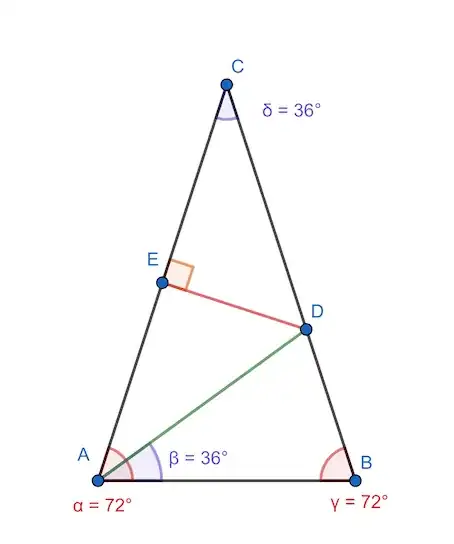
Image

By observing the geometric properties of this triangle, we can deduce the following relationship

$$ \triangle ABC\sim\triangle BDA\cong\triangle DBA $$

which implies

$$ {BC\over AB}={AB\over BD} $$

Now, due to the properties of isosceles triangles, we get

$$ AB=AD=CD\Rightarrow BC=BD+CD=BD+AB $$

Thus, we obtain

$$ 1+{BD\over AB}={AB\over BD} $$

To convenience the derivation, set $AB=1,BD=y$ so that the above identity becomes

$$ 1+y=\frac1y\Rightarrow y^2+y-1=0\Rightarrow y={-1+\sqrt5\over2}=\frac1\phi $$

Again, by the properties of isosceles, we deduce

$$ CE={1+y\over2} $$

As a result, we obtain $\cos36^\circ$ from its definition:

$$ \cos36^\circ={CE\over CD}={CE\over AB}={1+y\over2}={1+\sqrt5\over4}=\frac\phi2 $$

Now, due to the conversion that

$$ 90^\circ-36^\circ=54^\circ={3\pi\over10} $$

we obtain

$$ \sin\left(3\pi\over10\right)=\frac\phi2 $$

Therefore, setting $s=3/10$ in (1), we obtain

$$ \fbox{$\Large\int_0^\infty{x^{-7/10}\over1+x}\mathrm dx={2\pi\over\phi}$} $$

TravorLZH
  • 7,786
7

Not exactly a series, but might also be of interest:

$$1-\frac{1}{\phi}=\frac{1}{\phi^2}=\frac{1}{5} \left(1+\frac{1}{5} \left(1+\frac{1}{5} \left(1+\frac{1}{5} \left(1+\dots \right)^2 \right)^2 \right)^2 \right)^2$$


$$\frac{1}{\phi^4}=\frac{1}{5} \left(1-\frac{1}{5} \left(1-\frac{1}{5} \left(1-\frac{1}{5} \left(1-\dots \right)^2 \right)^2 \right)^2 \right)^2$$

$$\frac{1}{\phi^4}=\frac{1}{9} \left(1+\frac{1}{9} \left(1+\frac{1}{9} \left(1+\frac{1}{9} \left(1+\dots \right)^2 \right)^2 \right)^2 \right)^2$$

Yuriy S
  • 32,728
7

Here is another one $$ \int_0^\infty \frac{1}{5^{\frac{x}{4}}+5^{\frac{1}{2}}-5^0}dx=\phi $$

6

Double integral of $\phi$ $$-\frac{1}{5}\int_{0}^{1}\int_{0}^{1}\frac{\mathrm dx \mathrm dy}{\left(\frac{1}{5}-x+x^2\right)\sqrt{1-y+\frac{y^2}{5}}}=\ln\left(\frac{1}{\phi^4}\right)\ln\left(\frac{\phi^2+1}{\phi^4}\right)$$

Without the natural logarithm $$\int_{0}^{1}\int_{0}^{1}\frac{x^3}{(2x^2-2x+1)^2\left(x-\frac{1}{2}\right)^2\sqrt{(\phi+y^2)^3}}\mathrm dx \mathrm dy=-\frac{1}{\phi^2}$$

Sibawayh
  • 1,463
6

$$\int_0^1 \frac{\tan^{-1}(1+\cos \pi x)}{1+\cos \pi x}dx =\frac1{\sqrt{\phi}}$$

Quanto
  • 120,125
5

Notice that $\frac{2}{1+\sqrt5}=\frac{1}{\phi}$

$$\int_0^1\frac{2}{(1+\sqrt5x)^2}dx=\frac{1}{\phi}$$

5

$$\require{cancel} \require{action} \newcommand{\mapsfrom}{\mathrel{\style{display:inline-block; transform:scale(-1,1);}{\longmapsto}}} \bbox[yellow,10pt]{\large {\mathcal I(\alpha, \sqrt 5) = \int\limits_{0}^{\infty} x^{-\alpha \ln x} x^{\sqrt 5} \ln x \, \mathrm dx = \frac{\mathrm e^{1/\alpha}}{\alpha} \sqrt{\frac{\pi}{\alpha}} \, \phi \,\, \mathrm e^{\phi/\alpha},\qquad \alpha > 0} },$$ and, for the case $\color{red}{\boxed{\color{black}{\alpha = 1}}}$,

$$\bbox[yellow,10pt]{\large {\mathcal I(1, \sqrt 5) = \int\limits_{0}^{\infty} x^{-\ln x} x^{\sqrt 5} \ln x \, \mathrm dx = \mathrm e \sqrt{\pi} \, \phi \,\, \mathrm e^{\phi}}}$$

where $\phi := \dfrac{1+\sqrt 5}{2}$ denotes the Golden Ratio.

Consider the generalized integral

$${\large \mathcal I(\alpha, \beta) = \int\limits_{0}^{\infty} x^{-\alpha \ln x} x^{\beta} \ln x \, \mathrm dx \qquad \alpha > 0, \,\,\, \beta \in \mathbb R}:$$ we will obtain the original integral by taking $\beta = \sqrt 5$.

Since $\ln x$ is the term most present in the integral, we can express the first $x$ in terms of the logarithm $\ln x$ using the relation $x = \mathrm e^{\ln x}$, which is true since $\mathrm e(x)$ and $\ln(x)$ are one the inverse function of each other. So, we have: $$\begin{align} \mathcal I(\alpha, \beta) &= {\large \int\limits_{0}^{\infty} \bigg(\mathrm e^{\ln x}\bigg)^{-\alpha \ln x} x^{\beta} \ln x \, \mathrm dx} \qquad &\alpha > 0, \,\,\, \beta \in \mathbb R \\ &= {\large \int\limits_{0}^{\infty} \mathrm e^{\ln x \, \cdot \, (- \alpha \ln x)} x^{\beta} \ln x \, \mathrm dx} \qquad &\alpha > 0, \,\,\, \beta \in \mathbb R \\ &= {\large \int\limits_{0}^{\infty} \mathrm e^{- \alpha \ln^2 x} x^{\beta} \ln x \, \mathrm dx} \qquad &\alpha > 0, \,\,\, \beta \in \mathbb R \\ \end{align}$$

Since $\ln x$ is the term most present in the integral and most difficult to handle, we apply the $u$-substitution method with the substitution $u = \ln x$. $$\text{u}\text{-substitution} \qquad \begin{array}{cc} &\color{Red}{u = \ln x} & \implies &\color{Blue}{\mathrm du = \dfrac{1}{x} \mathrm dx} \\ &\Big \Updownarrow \, & \quad \,\, &\Big \Updownarrow \\ &\color{Red}{x = \mathrm e^u} &\implies &\color{Blue}{\mathrm dx = \underbrace{\mathrm e^u}_{\color{Red}{\displaystyle x}} \, \mathrm du}. \end{array}$$ The change of variable causes a change in the lower and upper bounds of integration. The function $\ln x$ is not defined in $x=0$ and $x= \infty$ and its domain is $]0, \infty[$: taking the limits $x \to 0^{+}$ ($\ln x$ is defined for positive $x$) and $x \to \infty$ of $u=\ln x$ boils down: $$\begin{align} \text{Lower bound:} \qquad &u_{\text{lower}} = \lim_{x \to 0^{+}} \ln x = - \infty \\ \text{Upper bound:} \qquad &u_{\text{upper}} = \lim_{x \to \infty} \ln x = + \infty. \end{align}$$

The integral $$\mathcal I = {\large \int\limits_{\cancelto{\large{-\infty}}{0}}^{\infty} \mathrm e^{- \alpha \, \overbrace{\color{Red}{\ln^2 x}}^{\displaystyle u^2}} \, {\underbrace{\color{Red}{x}}^{\quad \beta}_{\displaystyle \mathrm e^u}} \, \overbrace{\color{Red}{\ln x}}^{\displaystyle u} \, \underbrace{\color{Blue}{\mathrm dx}}_{\displaystyle \mathrm e^u \, \mathrm du}} \qquad \alpha > 0, \,\,\, \beta \in \mathbb R$$ now becomes $$\begin{align} \mathcal I &= {\large \int\limits_{-\infty}^{\infty} \mathrm e^{- \alpha u^2} \bigg(\mathrm e^u\bigg)^{\beta} u \, \mathrm e^u \, \mathrm du} \qquad \alpha > 0, \,\,\, \beta \in \mathbb R \\ &= {\large \int\limits_{-\infty}^{\infty} \mathrm e^{- \alpha u^2} \mathrm e^{u \beta} u \, \mathrm e^u \, \mathrm du} \qquad \alpha > 0, \,\,\, \beta \in \mathbb R \\ &= {\large \int\limits_{-\infty}^{\infty} \mathrm e^{- \alpha u^2} \mathrm e^{u \beta \, + \, u} \, u \, \mathrm du} \qquad \alpha > 0, \,\,\, \beta \in \mathbb R, \end{align}$$ so $${\large \mathcal I = \int\limits_{-\infty}^{\infty} \mathrm e^{- \alpha u^2 \ + \, u (\beta \, + \, 1)} \, u \, \mathrm du} \qquad \alpha > 0, \,\,\, \beta \in \mathbb R. \tag{INT}\label{INT}$$ The exponent term, $- \alpha u^2 + u (\beta + 1)$, is difficult to handle. The strategy to simplify it and make it easier to handle is to reduce it to a binomial square, since we already have a quadratic term $(u^2)$ and a term in $u$.

The binomial square is of the form $$\begin{align} &\underbrace{(\color{Green}{1^{\text{st}} \, \text{term of the binomial square}} + \color{Orange}{2^{\text{nd}} \, \text{term of the binomial square}})^2}_{\displaystyle \text{original structure}} \\ \\ &\hspace{6cm}= \\ \\ &\hspace{3cm}\underbrace{\toggle{\bbox[20pt, Green]{}}{(\color{Green}{1^{\text{st}} \, \text{term of the binomial square}})^2}\endtoggle \, + \, \toggle{\bbox[20pt, GoldenRod]{}}{\color{brown}{2} \cdot \color{Green}{1^{\text{st}} \, \text{term of the binomial square}} \cdot \color{Orange}{2^{\text{nd}} \, \text{term of the binomial square}}}\endtoggle \, + \, \toggle{\bbox[20pt, Orange]{}}{(\color{Orange}{2^{\text{nd}} \, \text{term of the binomial square}})^2}\endtoggle}_{\displaystyle \text{derived structure}}, \tag{$\spadesuit$}\label{spade} \end{align}$$ where $$\begin{align} \color{Green}{1^{\text{st}} \, \text{term of the binomial square}} &\mapsfrom (\color{Green}{1^{\text{st}} \, \text{term of the binomial square}})^2 \tag{1.1} \label{1.1}\\ \color{Orange}{2^{\text{nd}} \, \text{term of the binomial square}} &\mapsfrom (\color{Orange}{2^{\text{nd}} \, \text{term of the binomial square}})^2 \tag{1.2} \label{1.2} \end{align}$$ with the double product $$ \color{brown}{2} \cdot \color{Green}{1^{\text{st}} \, \text{term of the binomial square}} \cdot \color{Orange}{2^{\text{nd}} \, \text{term of the binomial square}} \tag{1.3} \label{1.3}.$$

$\text{A)}$ Let us start with the first term of the $\text{derived structure}$.

  • $1^{\text{st}}\, \text{term}$: quadratic term. In the expression on the exponent, there is a term comprising $u^2$, so $u^2$ can be taken as the quadratic term of the binomial square we wish to construct. Therefore: $${\color{green}{\boxed{u^2}}} \quad \text{is the $1^{\text{st}}$ term of the sum.}$$ Despite that, it is bound to $\alpha$ by multiplication. Therefore, to isolate it and keep it positive (i.e., to obtain $u^2$), it is necessary to total factoring $-\alpha$ out. So: $$- \alpha u^2 + u (\beta + 1)=- \alpha \underbrace{\left(u^2 - \frac{\beta+1}{\alpha} u\right)}_{\eqref{threestar}}. \tag{$\clubsuit$}\label{club}$$

Thus, we want to take $\left(u^2 - \dfrac{\beta+1}{\alpha} u\right)$ to a form similar to $\eqref{spade}$.

$\text{B)}$ Now, let us analyse the $\text{original structure}$. Since the first term of the $\text{derived structure}$ is $u^2$, by $\eqref{1.1}$ we have $$u^2 \longmapsto u,$$ so $u$ is the first term of the $\text{original structure}$. Therefore: $${\color{green}{\boxed{u \quad \text{is the $1^{\text{st}}$ term of the binomial square}}}}.\tag{B}\label{B}$$

$\text{C)}$ Now, let us proceed by examining the second term of the expression $\left(u^2 - \dfrac{\beta+1}{\alpha} u\right)$, since $${\color{Orange}{\boxed{- \frac{\beta+1}{\alpha}}}} \quad \text{is the $2^{\text{nd}}$ term of the sum.}$$ It is one of the three terms that we want to take to the sum of the three terms that make up the square of a binomial, and it is not quadratic, so it has to be of the form of a double product $2ab$.
Multiplying and dividing the term $- \dfrac{\beta+1}{\alpha} u$ by $2$: $$\frac{- \color{brown}{2} \, (\beta+1) u}{\color{brown}{2} \, \alpha}. \tag{$\ast$}\label{*}$$ Since the term in the double product form must be $$\color{brown}{2} \cdot \color{Green}{1^{\text{st}} \, \text{term of the binomial square}} \cdot \color{Orange}{2^{\text{nd}} \, \text{term of the binomial square}},$$ and the first term of the binomial square is $u$, as per $\eqref{B}$, we can write $\eqref{*}$ as $$ \color{brown}{2} \cdot \color{Green}{u} \cdot \left(\color{Orange}{- \frac{\beta+1}{2 \alpha}}\right).$$ Therefore, $\color{Orange}{- \dfrac{\beta+1}{2 \alpha}}$ has to be the second term of the binomial square, so $${\color{Orange}{\boxed{- \frac{\beta+1}{2 \alpha} \quad \text{is the $2^{\text{nd}}$ term of the binomial square}}}}.\tag{C}\label{C}$$

Therefore, the binomial square under consideration is: $$ (\color{Green}{1^{\text{st}} \, \text{term of the binomial square}} + \color{Orange}{2^{\text{nd}} \, \text{term of the binomial square}})^2 \\ $$

$$\begin{align} &= \left[\color{Green}{u}+ \left(\color{Orange}{- \frac{\beta+1}{2 \alpha}}\right)\right]^2 \\ &= \color{Green}{u^2} + \color{brown}{2} \cdot \color{Green}{u} \cdot \left(\color{Orange}{- \frac{\beta+1}{2 \alpha}}\right) + \left(\color{Orange}{- \frac{\beta+1}{2 \alpha}}\right)^2 \\ &= \color{Green}{u^2} - \color{Orange}{\frac{\beta+1}{\alpha}} \color{Green}{u} + \left(\color{Orange}{\frac{\beta+1}{2 \alpha}}\right)^2 \end{align}$$ so $$\left(u - \frac{\beta+1}{2 \alpha}\right)^2 = u^2 - \frac{\beta+1}{\alpha}u + \left(\frac{\beta+1}{2 \alpha}\right)^2. \tag{$\star$}\label{star}$$ The sum we want to take to a form similar to the binomial square is $$\text{Sum} = u^2 - \frac{\beta+1}{\alpha} u. \tag{$\star \star$}\label{twostar}$$

We can see that $\eqref{star}$ and $\eqref{twostar}$ are very similar, differing only by a constant $\left(\dfrac{\beta+1}{2\alpha}\right)^2$. Therefore, to make $\eqref{twostar}$ expressible in terms of $\eqref{star}$ without changing its expression, we add and subtract $\left(\dfrac{\beta+1}{2\alpha}\right)^2$ to $\eqref{twostar}$: $$\begin{align} \text{Sum} &= u^2 - \frac{\beta+1}{\alpha} u \color{Orange}{+ \left(\frac{\beta+1}{2\alpha}\right)^2 - \left(\frac{\beta+1}{2\alpha}\right)^2} \\ &= \underbrace{\left[u^2 - \frac{\beta+1}{\alpha}u + \left(\frac{\beta+1}{2 \alpha}\right)^2\right]}_{\eqref{star} \,\, := \displaystyle \left(u - \frac{\beta+1}{2 \alpha}\right)^2} - \left(\frac{\beta+1}{2\alpha}\right)^2, \end{align}$$ so $$\left(u^2 - \frac{\beta+1}{\alpha} u\right) = \left(u - \frac{\beta+1}{2 \alpha}\right)^2 - \left(\frac{\beta+1}{2\alpha}\right)^2 \tag{$\star\star\star$}\label{threestar}.$$ Substituting $\eqref{threestar}$ into $\eqref{club}$, we obtain $$- \alpha u^2 + u (\beta + 1)=- \alpha \left[\left(u - \frac{\beta+1}{2 \alpha}\right)^2 - \left(\frac{\beta+1}{2\alpha}\right)^2\right] \tag{$\clubsuit\clubsuit$}\label{twoclub}.$$ Substituting $\eqref{twoclub}$ into $\eqref{INT}$: $${\large \mathcal I = \int\limits_{-\infty}^{\infty} \mathrm e^{- \alpha \left[\left(u \, - \, \frac{\beta \, + \, 1}{2 \alpha}\right)^2 - \left(\frac{\beta \, + \, 1}{2\alpha}\right)^2\right]} \, u \, \mathrm du} \qquad \alpha > 0, \,\,\, \beta \in \mathbb R.$$ We have: $$\begin{align} \mathcal I &= \large{\int\limits_{-\infty}^{\infty} \mathrm e^{- \alpha \left[\left(u \, - \, \frac{\beta \, + \, 1}{2 \alpha}\right)^2 - \left(\frac{\beta \, + \, 1}{2\alpha}\right)^2\right]} \, u \, \mathrm du} \qquad &\alpha > 0, \,\,\, \beta \in \mathbb R \\ &= \large{\int\limits_{-\infty}^{\infty} \mathrm e^{- \alpha \left[\left(u \, - \, \frac{\beta \, + \, 1}{2 \alpha}\right)^2 \right] + \alpha \left(\frac{\beta \, + \, 1}{2\alpha}\right)^2} \, u \, \mathrm du} \qquad &\alpha > 0, \,\,\, \beta \in \mathbb R \\ &= \large{\int\limits_{-\infty}^{\infty} \mathrm e^{- \alpha \left[\left(u \, - \, \frac{\beta \, + \, 1}{2 \alpha}\right)^2 \right]} \cdot \mathrm e^{\alpha \left(\frac{\beta \, + \, 1}{2\alpha}\right)^2} \, u \, \mathrm du} \qquad &\alpha > 0, \,\,\, \beta \in \mathbb R \\ &= \mathrm e^{\alpha \left(\frac{\beta \, + \, 1}{2\alpha}\right)^2} \large{\int\limits_{-\infty}^{\infty} \mathrm e^{- \alpha \left[\left(u \, - \, \frac{\beta \, + \, 1}{2 \alpha}\right)^2 \right]} \, u \, \mathrm du} \qquad &\alpha > 0, \,\,\, \beta \in \mathbb R \\ &= \mathrm e^{\frac{1}{\alpha} \left(\frac{\beta \, + \, 1}{2}\right)^2} \large{\int\limits_{-\infty}^{\infty} \mathrm e^{- \alpha \left[\left(u \, - \, \frac{\beta \, + \, 1}{2 \alpha}\right)^2 \right]} \, u \, \mathrm du} \qquad &\alpha > 0, \,\,\, \beta \in \mathbb R. \\ \end{align}$$ Since $\left(u - \dfrac{\beta + 1}{2 \alpha}\right)$ is the most difficult term to handle, we apply the $u$-substitution method with the substitution $z = u - \dfrac{\beta + 1}{2 \alpha}$. $$\text{z}\text{-substitution} \qquad \begin{array}{cc} &\color{Violet}{z = u - \dfrac{\beta + 1}{2 \alpha}} & \implies &\color{Purple}{\mathrm dz = \mathrm du} \\ &\Big \Updownarrow \, & \quad \,\, &\Big \Updownarrow \\ &\color{Violet}{u = z+\dfrac{\beta + 1}{2 \alpha}} &\implies &\color{Purple}{\mathrm du = \mathrm dz}. \end{array}$$ The change of variable doesn't cause a change in the lower and upper bounds of integration. Taking the limits $u \to -\infty$ and $x \to \infty$ of $z=u-\dfrac{\beta + 1}{2 \alpha}$ boils down: $$\begin{align} \text{Lower bound:} \qquad &z_{\text{lower}} = \lim_{u \to -\infty} \left(u-\dfrac{\beta + 1}{2 \alpha}\right) = - \infty \\ \text{Upper bound:} \qquad &z_{\text{upper}} = \lim_{u \to \infty} \left(u-\dfrac{\beta + 1}{2 \alpha}\right) = + \infty. \end{align}$$ The integral $$\large{\mathrm e^{\frac{1}{\alpha} \left(\frac{\beta \, + \, 1}{2}\right)^2} \int\limits_{-\infty}^{\infty} \mathrm e^{- \alpha \overbrace{\left[{\color{Violet}{\left(u \, - \, \frac{\beta \, + \, 1}{2 \alpha}\right)^2}}\right]}^{\displaystyle z^2}} \, \underbrace{\color{Violet}{u}}_{z \, + \, \frac{\beta \, + \, 1}{2 \alpha}} \, \underbrace{\color{Purple}{\mathrm du}}_{\mathrm dz}} \qquad \alpha > 0, \,\,\, \beta \in \mathbb R$$ now becomes $$\begin{align} \mathcal I &= {\large{\mathrm e^{\frac{1}{\alpha} \left(\frac{\beta \, + \, 1}{2}\right)^2}}\int\limits_{-\infty}^{\infty}} \mathrm e^{- \alpha z^2}\left(z+\frac{\beta + 1}{2 \alpha}\right) \, \mathrm dz \qquad &\alpha > 0, \,\,\, \beta \in \mathbb R \\ &= {\large{\mathrm e^{\frac{1}{\alpha} \left(\frac{\beta \, + \, 1}{2}\right)^2}\int\limits_{-\infty}^{\infty}}} \left[\mathrm e^{- \alpha z^2} \cdot z + \mathrm e^{- \alpha z^2} \cdot \frac{\beta+1}{2\alpha}\right] \, \mathrm dz \qquad &\alpha > 0, \,\,\, \beta \in \mathbb R \\ &= {\large{\mathrm e^{\frac{1}{\alpha} \left(\frac{\beta \, + \, 1}{2}\right)^2}}}\left[{\large{\int\limits_{-\infty}^{\infty}}} \mathrm e^{- \alpha z^2} \cdot z \, \mathrm dz + {\large{\int\limits_{-\infty}^{\infty}}} \mathrm e^{- \alpha z^2} \cdot \frac{\beta+1}{2\alpha}\, \mathrm dz \right] \qquad &\alpha > 0, \,\,\, \beta \in \mathbb R \\ &= {\large{\mathrm e^{\frac{1}{\alpha} \left(\frac{\beta \, + \, 1}{2}\right)^2}}}\left[\underbrace{{\large{\int\limits_{-\infty}^{\infty}}} z \, \mathrm e^{- \alpha z^2} \, \mathrm dz}_{\displaystyle \mathcal I_1} \, + \, \underbrace{{\large{\int\limits_{-\infty}^{\infty}}} \frac{\beta+1}{2\alpha} \mathrm e^{- \alpha z^2} \, \mathrm dz}_{\displaystyle \mathcal I_2} \right] \qquad &\alpha > 0, \,\,\, \beta \in \mathbb R \tag{$\diamondsuit$}\label{diamond}, \end{align}$$ with $$\mathcal I_1 := {\large{\int\limits_{-\infty}^{\infty}}} z \, \mathrm e^{- \alpha z^2} \, \mathrm dz \tag{I1} \label{I1}$$ and $$\mathcal I_2 := {\large{\int\limits_{-\infty}^{\infty}}} \frac{\beta+1}{2\alpha} \mathrm e^{- \alpha z^2} \, \mathrm dz \tag{I2} \label{I2}$$.

Evaluation of $\eqref{I1}$:

Let $f(z) = z \, \mathrm e^{- \alpha z^2}, \quad \alpha \gt 0$. We note that $$\begin{align} f(z) &= z \, \mathrm e^{- \alpha z^2}, \qquad \alpha \gt 0 \\ &= -\left[-z \, \mathrm e^{- \alpha z^2}\right], \qquad \alpha \gt 0\\ &= -\left[-z \, \mathrm e^{- \alpha (-z)^2}\right], \qquad \alpha \gt 0 \\ &= - \underbrace{\left[(-z) \, \mathrm e^{- \alpha (-z)^2}\right]}_{\displaystyle f(-z)}, \qquad \alpha \gt 0 \\ &= - f(-z), \end{align}$$ so $f(z) = - f(-z)$, or $-f(z) = f(-z)$, which is the definition of an odd function. So: $$f(z) = z \, \mathrm e^{- \alpha z^2}, \,\, \alpha \gt 0 \quad \text{is an odd function}.$$ Now, let us state the following

Theorem. Let $f(z)$ be an odd function with a primitive on the open interval $]−a, a[$, where $a \in \mathbb{R}^{+}, a \in \overline{\mathbb{R}}$, with $\overline{\mathbb{R}} = \mathbb R \cup \left\{-\infty, + \infty \right\}$. Then: $${\large{\int\limits_{-a}^{a}}f(z) \, \mathrm dz} = 0$$

Choosing $a = + \infty$, we have $${\large{\int\limits_{-\infty}^{+\infty}}} f(z) \, \mathrm dz = 0 \qquad \text{with} \,\, f(z) \,\, \text{odd function}.$$

Since $f(z) = z \, \mathrm e^{- \alpha z^2}, \,\, \alpha \gt 0$ is an odd function, we have $${\large{\int\limits_{-\infty}^{+\infty}}} z \, \mathrm e^{- \alpha z^2} \, \mathrm dz = 0, \qquad \alpha \gt 0.$$

So: $$\boxed{\mathcal I_1 := {\large{\int\limits_{-\infty}^{+\infty}}} z \, \mathrm e^{- \alpha z^2} \, \mathrm dz = 0}, \qquad \alpha \gt 0. \tag{I1*}\label{I1*}$$

Evaluation of $\eqref{I2}$:

$$\begin{align} \mathcal I_2 :&= {\large{\int\limits_{-\infty}^{\infty}}} \frac{\beta+1}{2\alpha} \mathrm e^{- \alpha z^2} \, \mathrm dz, \qquad &\alpha > 0, \,\,\, \beta \in \mathbb R \\ &= \frac{\beta+1}{2\alpha} {\large{\int\limits_{-\infty}^{\infty}}} \mathrm e^{- \alpha z^2} \, \mathrm dz, \qquad &\alpha > 0, \,\,\, \beta \in \mathbb R \\ &= \frac{\beta+1}{2\alpha} {\large{\int\limits_{-\infty}^{\infty}}} \mathrm e^{- (\sqrt\alpha)^2 \, z^2} \, \mathrm dz, \qquad &\alpha > 0, \,\,\, \beta \in \mathbb R \\ &= \frac{\beta+1}{2\alpha} {\large{\int\limits_{-\infty}^{\infty}}} \mathrm e^{- (\sqrt\alpha \, z)^2} \, \mathrm dz, \qquad &\alpha > 0, \,\,\, \beta \in \mathbb R \\ &= \frac{\beta+1}{2\alpha} {\large{\int\limits_{-\infty}^{\infty}}} \mathrm e^{- (\sqrt\alpha \, z)^2} \color{Red}{\frac{\color{Red}{\sqrt a}}{\color{Red}{\sqrt a}}} \, \mathrm dz, \qquad &\alpha > 0, \,\,\, \beta \in \mathbb R \\ &= \frac{\beta+1}{2\alpha} \cdot \frac{1}{\sqrt{\alpha}} {\large{\int\limits_{-\infty}^{\infty}}} \mathrm e^{- (\sqrt\alpha \, z)^2} \sqrt \alpha, \qquad &\alpha > 0, \,\,\, \beta \in \mathbb R \\ &= \frac{\beta+1}{2} \cdot \frac{1}{\alpha \, \sqrt\alpha} \underbrace{{\large{\int\limits_{-\infty}^{\infty}}} \sqrt \alpha \, \mathrm e^{- (\sqrt\alpha \, z)^2}}_{\displaystyle \text{Gaussian integral}}, \qquad &\alpha > 0, \,\,\, \beta \in \mathbb R \\ &= \frac{\beta+1}{2} \cdot \frac{1}{\alpha \, \sqrt\alpha} \cdot \toggle{\bbox[Red, 10pt]{\text{Gaussian Integral}}}{\sqrt \pi}\endtoggle, \qquad &\alpha > 0, \,\,\, \beta \in \mathbb R \\ &= \frac{\beta+1}{2} \cdot \frac{1}{\alpha \, \sqrt\alpha} \cdot \sqrt \pi, \qquad &\alpha > 0, \,\,\, \beta \in \mathbb R \\ &= \frac{\sqrt \pi}{\alpha \, \sqrt\alpha} \cdot \frac{\beta+1}{2}, \qquad &\alpha > 0, \,\,\, \beta \in \mathbb R \end{align}.$$

So: $$\boxed{\mathcal I_2 := {\large{\int\limits_{-\infty}^{\infty}}} \frac{\beta+1}{2\alpha} \mathrm e^{- \alpha z^2} \, \mathrm dz = \frac{\sqrt \pi}{\alpha \, \sqrt\alpha} \cdot \frac{\beta+1}{2}}, \qquad \alpha > 0, \,\,\, \beta \in \mathbb R. \tag{I2*}\label{I2*}$$

Substituting $\eqref{I1*}$ and $\eqref{I2*}$ into $\eqref{diamond}$: $$\begin{align} \mathcal I(\alpha, \beta) &= {\large{\mathrm e^{\frac{1}{\alpha} \left(\frac{\beta \, + \, 1}{2}\right)^2}}}\left[\underbrace{0}_{\displaystyle \mathcal I_1} + \underbrace{\frac{\sqrt \pi}{\alpha \, \sqrt\alpha} \cdot \frac{\beta+1}{2}}_{\displaystyle\mathcal I_2}\right], \qquad &\alpha > 0, \,\,\, \beta \in \mathbb R \\ &= {\large{\mathrm e^{\frac{1}{\alpha} \left(\frac{\beta \, + \, 1}{2}\right)^2}}} \cdot \frac{\sqrt \pi}{\alpha \, \sqrt\alpha} \cdot \frac{\beta+1}{2}, \qquad &\alpha > 0, \,\,\, \beta \in \mathbb R. \end{align}$$ So: $$\mathcal I(\alpha, \beta) = {\large{\mathrm e^{\frac{1}{\alpha} \left(\frac{\beta \, + \, 1}{2}\right)^2}}} \frac{\sqrt \pi}{\alpha \, \sqrt\alpha} \frac{\beta+1}{2}, \qquad \alpha > 0, \,\,\, \beta \in \mathbb R. $$

Since we obtain the original integral by taking $\beta = \sqrt 5$, substituting this value into the previous expression:

$$\begin{align} \mathcal I(\alpha, \sqrt 5) &= {\large{\mathrm e^{\frac{1}{\alpha} \left(\frac{\sqrt 5 \, + \, 1}{2}\right)^2}}} \cdot \frac{\sqrt \pi}{\alpha \, \sqrt\alpha} \cdot \frac{\sqrt 5+1}{2}, \qquad &\alpha > 0 \\ &= {\large{\mathrm e^{\frac{1}{\alpha} \left(\underbrace{\frac{\sqrt 5 \, + \, 1}{2}}_{\displaystyle \phi}\right)^2}}} \frac{\sqrt \pi}{\alpha \, \sqrt\alpha} \underbrace{\frac{\sqrt 5+1}{2}}_{\displaystyle \phi}, \qquad &\alpha > 0 \\ &= {\large{\mathrm e^{\frac{1}{\alpha} \phi^2}}} \frac{\sqrt \pi}{\alpha \, \sqrt\alpha} \phi, \qquad &\alpha > 0. \tag{FI} \label{FI}\\ \end{align}$$

It can be shown that if $\phi := \dfrac{\sqrt 5+1}{2}$, then $\phi^2 = \phi +1.$ Substituting $\phi +1$ into $\eqref{FI}$, we obtain: $$\begin{align} \mathcal I(\alpha, \sqrt 5) &= {\large{\mathrm e^{\frac{1}{\alpha} \phi^2}}} \frac{\sqrt \pi}{\alpha \, \sqrt\alpha} \phi, \qquad &\alpha > 0 \\ &= {\large{\mathrm e^{\frac{1}{\alpha}(\phi +1)}}} \frac{\sqrt \pi}{\alpha \, \sqrt\alpha} \phi, \qquad &\alpha > 0 \\ &= {\large{\mathrm e^{\left(\frac{\phi}{\alpha}+\frac{1}{\alpha}\right)}}} \frac{\sqrt \pi}{\alpha \, \sqrt\alpha} \phi, \qquad &\alpha > 0 \\ &= {\large{\mathrm e^{\frac{\phi}{\alpha}} \cdot \mathrm e^{\frac{1}{\alpha}}}} \frac{\sqrt \pi}{\alpha \, \sqrt\alpha} \phi, \qquad &\alpha > 0 \\ &= \frac{\mathrm e^{1/\alpha}}{\alpha} \frac{\sqrt{\pi}}{\sqrt{\alpha}} \, \phi \,\, \mathrm e^{\phi/\alpha},\qquad &\alpha > 0 \\ &= \frac{\mathrm e^{1/\alpha}}{\alpha} \sqrt{\frac{\pi}{\alpha}} \, \phi \,\, \mathrm e^{\phi/\alpha},\qquad &\alpha > 0. \end{align}$$ So: $$\bbox[10px,#f3f3f3, border:5px dotted #251874]{\large {\mathcal I(\alpha, \sqrt 5) = \int\limits_{0}^{\infty} x^{-\alpha \ln x} x^{\sqrt 5} \ln x \, \mathrm dx = \frac{\mathrm e^{1/\alpha}}{\alpha} \sqrt{\frac{\pi}{\alpha}} \, \phi \,\, \mathrm e^{\phi/\alpha},\qquad \alpha > 0}}.$$

Substituting $\alpha = 1$ into the previous expression: $$\mathcal I(1, \sqrt 5) = \frac{\mathrm e^{1/1}}{1} \sqrt{\frac{\pi}{1}} \, \phi \,\, \mathrm e^{\phi/1},$$ i.e. $$\mathcal I(1, \sqrt 5) = \mathrm e \sqrt{\pi} \, \phi \,\, \mathrm e^{\phi}.$$ Finally: $$\bbox[10px,#f4f7f8, border:5px dashed #376521]{\large {\mathcal I(1, \sqrt 5) = \int\limits_{0}^{\infty} x^{-\ln x} x^{\sqrt 5} \ln x \, \mathrm dx = \mathrm e \sqrt{\pi} \, \phi \,\, \mathrm e^{\phi}}}.$$

KDP
  • 1,263
M. A.
  • 1,774
  • Whilst this is impressive and looks great, you triggered the automatic "excessively long" flag and crashed my browser a couple of times. Please would you shorten it? Maybe remove the proposition and the bells & whistles? – Shaun Dec 01 '24 at 21:07
  • 1
    @Shaun Sorry about that, that was not my intention. I will see what I can do to shorten my answer. Thank you for the feedback. – M. A. Dec 01 '24 at 21:51
  • 2
    Lovely! But rendering this answer is taking lot of time , maybe eliminating any graphical illustration will help.. – Amrut Ayan Dec 02 '24 at 07:30
  • the theorem regarding the integral of an odd function over a symmetric domain need the hp of convergence if the domain is not bounded – Sine of the Time Dec 02 '24 at 14:20
  • @SineoftheTime Yes, you're right. I am just considering Cauchy principal value. I will edit my answer. – M. A. Dec 02 '24 at 14:33
4

-I remember really liking this one:

$$\int_0^1 \int_0^1 \frac{\text{dx dy}}{\varphi^6-x^2y^2}=\frac{\pi^2-18\log^2\varphi}{24\varphi^3}$$

I most liked it because it was specific to $\varphi$

-Also, we can note this M.SE result (with some interpolation)

$$\int_0^1 \frac{\log (1+x^{\alpha+\sqrt{\alpha^2-1}})}{1+x}\text{dx}=$$$$\frac{\pi^2}{12}\left(\frac{\alpha}{2}+\sqrt{\alpha^2-1}\right)+\log(\varphi)\log(2)\log(\sqrt{\alpha+1}+\sqrt{\alpha-1})\log(\text{something})$$

Perhaps someone can help me fill in $\text{"something"}$

4

This one is a bit messy.

$$ \int_0^\infty \frac{1}{(\sqrt5^x)^{2^{-(\sqrt5-1)}}+\sqrt5-1}dx=2^{\phi^{-3}}\cdot\phi $$

4

$$\int_0^\infty \frac{1}{1+x^{\frac{10}{3}}}dx=\frac{3\pi}{5\phi}$$

4

$$\int_{0}^{\phi}(1-x+x^2)^{1/\phi}(1-\phi^2x+\phi^3x^2)\mathrm dx=2^{\phi}\cdot\phi$$

A bit over-crowed in term of $\phi$

4

Connecting three well-known constants together: $$\int_{-\infty}^{+\infty}\sin^2\left(\frac{x}{\phi+\frac{1}{\phi}}\right)\cdot \frac{\mathrm dx}{4x^4+5x^2}=\frac{\pi}{e}\cdot\frac{1}{\left(\phi+\frac{1}{\phi}\right)^3}$$

Sibawayh
  • 1,463
4

$\textrm{ Let }y=\frac{1}{1+x^{2 \pi}}, \textrm{ then }x=\left(\frac{1}{y}-1\right)^{\frac{1}{2 \pi}} \textrm{ and }d x=-\frac{1}{2 \pi}(1-y)^{\frac{1}{2 \pi}-1} y^{-\frac{1}{2 \pi}-1} d y.$

Putting back changes the integral to a Beta function

$\displaystyle \begin{aligned} \int_0^{\infty} \frac{x^{\frac{\pi-5}{5}}}{1+x^{2 \pi}} d x &=\frac{1}{2 \pi} \int_0^1 y^{-\frac{1}{10}}(1-y)^{-\frac{9}{10}} d y \\ &=\frac{1}{2 \pi} B\left(\frac{9}{10}, \frac{1}{10}\right) \end{aligned} \tag*{} $

Using the reflection property of Beta function: $B(x, 1-x)=\pi \csc(\pi x) \textrm{ for all } x \notin \mathbb{Z}$ yields

$\displaystyle \boxed{ \int_0^{\infty} \frac{x^{\frac{\pi-5}{5}}}{1+x^{2 \pi}} d x =\frac{1}{2 \pi} \pi \csc \left(\frac{\pi}{10}\right) =\frac{\sqrt{5}+1}{2}=\phi} \tag*{} $

Lai
  • 31,615
4

$$\color{blue}{\lim_{n\to\infty}\int_{\sqrt [n]{(2n-1)!! F_n}}^{\sqrt [n+1]{(2n+1)!! F_{n+1}}} \frac{(f(x-\sqrt [n]{(2n-1)!! F_n}))^{g\left(\sqrt [n+1]{(2n+1)!! F_{n+1}}-x\right)} \, dx}{(f(\sqrt [n+1]{(2n+1)!! F_{n+1}}-x))^{g\left(x-\sqrt [n]{(2n-1)!! F_n}\right)}+(f(x-\sqrt [n]{(2n-1)!! F_n}))^{g\left(\sqrt [n+1]{(2n+1)!! F_{n+1}}-x\right)}}=\frac{\phi}{e}}$$

Where,

$F_n$ is the nth Fiboncacci number

$\phi$ is the Golden ratio

$e$ is the Euler number

$g:R\to R$ and $f:R \to (1,\infty)$, both f and g are continuous

proof


These are some fancy integrals involving the golden ratio,

$$\color{red}{\int_0^\infty \arctan\left(\frac{2x}{4+x^2}\right)\frac{2x}{4+x^2}\,dx=\pi\ln(\phi)\tag1}$$

$$\color{green}{\int_0^\infty \frac{\ln(3 - 2 \cos(4t ))}{1+8t^2} \,dt=\frac{\pi}{2\sqrt2}\ln\left(\phi-\frac{1}{\phi}e^{-\sqrt2}\right)\tag2}$$

$$\color{purple}{\int_0^\frac{\pi}{2} \arctan(2\sin^2x) \,dx=\int_0^\frac{\pi}{2} \arctan(2\cos^2x) \,dx=\frac{\pi}{2} \cot^{-1} (\phi)\tag3}$$

$$\color{brown}{\int_0^\infty \arctan\left(\frac{4\sin^2x}{3+2\cos^2x}\right)\,dx=\pi \cot^{-1} (\phi^3)\tag4}$$

$$\color{orange}{\int_0^1 \left(\frac{1-x^\phi}{1-x}\right)^{\frac{1}{\phi}}\frac{(1-x)+(1-2x^\phi)+(x-x^\phi)\phi}{(1-x)^2}\,dx=\phi^\phi\tag5}$$

$$\color{brown}{\int_0^1\int_0^1 \frac{1}{\ln(xy)\sqrt{\phi-xy}}\,dx\,dy=2\left(\sqrt{\frac{1}{\phi}}-\sqrt{\phi}\right)\tag6}$$

$${\displaystyle \color{blue}{\int _{0}^{\pi /2}{\frac {\ln(\sin ^{2}(x))\sqrt[{5}]{\tan x}}{\sin(2x)}}\mathrm {d} x= -5\pi \phi \tag7}}$$

$$\int _{0}^{\infty}\frac{x^\frac{1}{\phi}}{(1+x^\phi)^2}\tan^{-1}(x)\,dx=\frac{\pi}{4\phi}\tag8$$

$$\color{red}{\int_{-\infty}^\infty \frac{e^{-x^2}\sin^2(x^2)}{x^2}\,dx=\sqrt{\pi}(\sqrt{\phi}-1)\tag9}$$

$$\color{green}{\int_0^\infty \frac{x^\phi}{\phi^x}\,dx=\frac{\phi!}{(\ln(\phi))^{\phi+1}}\tag{10}}$$

$$\color{blue}{\int_0^{-2} \frac{x}{\sqrt{e^x+(x+2)^2}}\,dx=-6\ln\phi\tag{11}}$$

$$\color{orange}{\int_0^\frac{\pi}{2} \ln(1+4\sin^2x)\,dx=\pi\ln\phi\tag{12}}$$

$$\color{green}{\int_0^\frac{\pi}{2} \ln(1+4\sin^4x)\,dx=\pi\ln\left(\frac{\phi+\sqrt{\phi}}{2}\right)\tag{13}}$$

$$\color{purple}{\int_0^1 \frac{\tan^{-1}(1+\cos\pi x)}{1+\cos\pi x}\,dx=\sqrt{\frac{1}{{\phi}}}\tag{14}}$$

Amrut Ayan
  • 8,887
  • $(13)$ can also be written as $\pi\left(\coth^{-1}\sqrt\phi-\ln2\right)$ and appears while evaluating $\displaystyle\int_{-1}^1\sqrt{\frac{1+x}{1-x}}\ln(2x^2\pm2x+1)\frac{\mathrm dx}x$. – Integreek May 20 '25 at 13:42
3

$$\int_0^1 \frac{200\sqrt5(1-x^2)-300(1-x)^2}{ \left[5\sqrt5(1+x)^2-15(1-x^2)+2\sqrt5(1-x)^2 \right]^2}dx=(2\phi+1)(\phi+2)$$

3

$$\int_0^1 \frac{2}{\left(1+\phi x^2\right) \sqrt{1-x^2}} \, dx=\frac{\pi }{\phi }$$

3

Here is another one:

$$\int_{0}^{1}(2x-1)\left(\frac{1}{x(1-x)}+\frac{\phi\pi}{(1+x)(2-x)}+\frac{\phi \pi^2}{(2+x)(3-x)}+\frac{\phi \pi^3}{(2+x)(3-x)}+\cdots\right)-\frac{1}{\ln(1-x)}+\frac{x^{e-1}}{\ln x} \mathrm dx=1$$

Sibawayh
  • 1,463
3

$\gamma=0.57721...$; Euler constant

$\phi$; golden ratio

$$\int_{0}^{1}\int_{0}^{1}\frac{x}{1-xy}\cdot\frac{\ln\left(xy^{1/\phi}\right)}{\ln(xy)}\mathrm dxdy=1-\frac{\gamma}{\phi^2}$$

$$\int_{0}^{1}\int_{0}^{1}\frac{x}{1-xy}\cdot\frac{\ln\left(xy^{\phi}\right)}{\ln(xy)}\mathrm dxdy=1+\frac{\gamma}{\phi}$$

$$\int_{0}^{1}\int_{0}^{1}\frac{x}{1-xy}\cdot\frac{\ln\left(xy^{\phi^2}\right)}{\ln(xy)}\mathrm dxdy=1+\phi\gamma$$

Sibawayh
  • 1,463
3

$$\bbox[cyan, 10pt]{\large \mathcal I = \int\limits_0^\infty \frac{1}{\sqrt[4]{5^x}+\sqrt 5 -1} \,\, \mathrm dx = \phi} ,$$ where $\phi := \dfrac{1+\sqrt 5}{2}$ denotes the Golden Ratio.

Consider

$$\begin{align} \mathcal I &= \large \int\limits_0^\infty \frac{1}{\sqrt[4]{5^x}+\sqrt 5 -1} \,\, \mathrm dx \\ &= {\large\int\limits_0^\infty \frac{1}{5^{x/4} +\sqrt 5 -1} \,\, \mathrm dx} \qquad &\text{(writing $\sqrt[4]{5^x}$ as $5^{x/4}$)}\\ &= {\large \int\limits_0^\infty \frac{1}{5^{x/4} + \left(\sqrt 5 -1 \right)} \,\, \mathrm dx} \qquad &\text{(grouping $\sqrt5 -1$)}\\ &= {\large \int\limits_0^\infty \frac{1}{5^{x/4} \left[1 + \left(\sqrt 5 -1 \right) \cdot \dfrac{1}{5^{x/4}}\right]} \,\, \mathrm dx} \qquad &\text{(factoring $5^{x/4}$ out at the denominator)}\\ &= {\large \int\limits_0^\infty \frac{1}{5^{x/4} \left[1 + \left(\sqrt 5 -1 \right) \cdot 5^{-x/4}\right]} \,\, \mathrm dx} \qquad &\text{(writing $\dfrac{1}{5^{x/4}}$ as $5^{-x/4}$ at the denominator)} \\ &= {\large \int\limits_0^\infty \frac{5^{-x/4}}{\left[1 + \left(\sqrt 5 -1 \right) \cdot 5^{-x/4}\right]} \,\, \mathrm dx} \qquad &\text{(writing $\dfrac{1}{5^{x/4}}$ as $5^{-x/4}$ at the numerator)}\tag{I}\label{I}. \end{align}$$

At this point, the $u$-substitution method can be used, placing the new variable equal to the term most difficult to handle. Since the most difficult term to handle is the denominator, let us set $u = \text{denominator} = 1 + \left(\sqrt 5 -1 \right) \cdot 5^{-x/4}$. So: $$u \text{-substitution} \qquad \color{Red}{u= 1 + \left(\sqrt 5 -1 \right) \cdot 5^{-x/4}}.$$ The differential $\mathrm du$ is obtained by differentiating $u$ with respect to the independent variable $x$. Analysing $u$, we note that it contains a composite function $g(f(x)) = 5^{-x/4}$, according to the following diagram:

$$\color{brown}{x} \,\,\, \xrightarrow{\Large{f(\color{brown}{x}) \, = \, -\color{brown}{x}/4}} \,\,\, -\frac{\color{brown}{x}}{4} \,\,\, \xrightarrow{\Large{g \big(f(x)\big) \, = \, 5^{-{\color{brown}{x}}/4}}} \,\,\, 5^{-{\color{brown}{x}}/4}.$$

The derivative of the composite function $g \big(f(x)\big) = 5^{-x/4}$ can be calculated using the [chain rule][3] $\dfrac{\partial}{\partial x} \bigg[g \big(f(x)\big)\bigg] = \dfrac{\mathrm d}{\mathrm dx} g \big(f(x)\big) \cdot \dfrac{\mathrm d}{\mathrm dx} f(x)$: $$\begin{align} \frac{\partial}{\partial x} \left[5^{-x/4}\right] \qquad &= \qquad \underbrace{{\dfrac{\mathrm d}{\mathrm dx} \left[5^{f(x)}\right]}}_{\displaystyle \color{GoldenRod}{\text{derivative of external function}}} \quad \cdot \quad \underbrace{\dfrac{\mathrm d}{\mathrm dx} \bigg(-\frac{x}{4}\bigg)}_{\displaystyle \color{magenta}{\text{derivative of internal function}}} \\ &= \qquad \color{GoldenRod}{5^{f(x)} \ln 5} \cdot \color{magenta}{\left(-\frac{1}{4}\right)} \\ &= \qquad \color{GoldenRod}{5^{-x/4} \ln 5} \cdot \color{magenta}{\left(-\frac{1}{4}\right)} \\ &= \qquad -\frac{1}{4} \cdot \ln 5 \cdot 5^{-x/4}, \end{align}$$ so $$\frac{\partial}{\partial x} \left[5^{-x/4}\right] = -\frac{1}{4} \cdot \ln 5 \cdot 5^{-x/4}.$$

Since $u = 1 + \left(\sqrt 5 -1 \right) \cdot 5^{-x/4}$, then $$\begin{align} \mathrm du &= \frac{\mathrm d}{\mathrm dx} \bigg[1 + \left(\sqrt 5 -1 \right) \cdot 5^{-x/4}\bigg] \mathrm dx \\ &= \left\{\frac{\mathrm \partial}{\partial x}(1) + \frac{\mathrm \partial}{\partial x}\bigg[\left(\sqrt 5 -1 \right) \cdot 5^{-x/4}\bigg]\right\} \mathrm dx \\ &= \left\{\cancelto{0}{\frac{\mathrm \partial}{\partial x}(1)}+ \frac{\mathrm \partial}{\partial x}\bigg[\left(\sqrt 5 -1 \right) \cdot 5^{-x/4}\bigg]\right\} \mathrm dx \\ &= \left\{0+ \frac{\mathrm \partial}{\partial x}\bigg[\left(\sqrt 5 -1 \right) \cdot 5^{-x/4}\bigg]\right\} \mathrm dx \\ &= \frac{\mathrm \partial}{\partial x}\bigg[\left(\sqrt 5 -1 \right) \cdot 5^{-x/4}\bigg] \mathrm dx \\ &= \left(\sqrt 5 -1 \right)\frac{\mathrm \partial}{\partial x}\bigg[5^{-x/4}\bigg] \mathrm dx \\ &= \left(\sqrt 5 -1 \right) \cdot \bigg[-\frac{1}{4} \cdot \ln 5 \cdot 5^{-x/4}\bigg] \mathrm dx \\ &= -\frac{\sqrt 5-1}{4} \ln 5 \cdot 5^{-x/4} \, \mathrm dx, \end{align}$$ so: $$\color{Blue}{\mathrm du = -\frac{\sqrt 5-1}{4} \ln 5 \cdot 5^{-x/4} \, \mathrm dx}.$$ Finally, the $u$-substitution method yields: $$u \text{-substitution} \qquad \color{Red}{u= 1 + \left(\sqrt 5 -1 \right) \cdot 5^{-x/4}} \implies \color{Blue}{\mathrm du = -\frac{\sqrt 5-1}{4} \ln 5 \cdot 5^{-x/4} \, \mathrm dx}.$$

The change of variable causes a change in the lower and upper bounds of integration. The function $a^x$, with $a \in \mathbb R$ is defined in $x=0$ but it is not defined in $x = \infty$, since its domain is $[0,\infty[$ : substituting $x=0$ into and taking the limit $x \to \infty$ of $u=1 + \left(\sqrt 5 -1 \right) \cdot 5^{-x/4}$ boils down:

$$\begin{align} \text{Lower bound:} \\ u_{\text{lower}} &= 1 + \left(\sqrt 5 -1 \right) \cdot 5^{-0/4} \\ &= 1 + \left(\sqrt 5 -1 \right) \cdot 5^{0} \\ &= 1 + \left(\sqrt 5 -1 \right) \cdot 1 \\ &= 1 + \left(\sqrt 5 -1 \right) \\ &= 1 + \sqrt 5 -1 \\ &= \cancel{1} + \sqrt 5 \cancel{-1} \\ &= \sqrt 5 \\ \\ \text{Upper bound:} \\ u_{\text{upper}} &= \lim_{x \to \infty} \bigg[1 + \left(\sqrt 5 -1 \right) \cdot 5^{-x/4}\bigg] \\ &= \lim_{x \to \infty} 1 + \lim_{x \to \infty}\bigg[\left(\sqrt 5 -1 \right) \cdot 5^{-x/4}\bigg] \\ &= 1 + \lim_{x \to \infty}\bigg[\left(\sqrt 5 -1 \right) \cdot 5^{-x/4}\bigg] \\ &= 1 + \left(\sqrt 5 -1 \right)\lim_{x \to \infty}\bigg[5^{-x/4}\bigg] \\ &= 1+ \left(\sqrt 5 -1 \right) \cdot 0 \\ &= 1 + 0 \\ &= 1, \end{align}$$ since $\lim\limits_{x \to \infty}a^{-x} = 0$ when $a > 1$.
So: $$\begin{align} \text{Lower bound:} \qquad &u_{\text{lower}} = \sqrt 5 \\ \text{Upper bound:} \qquad &u_{\text{upper}} = 1. \end{align}$$

Multiplying and dividing $\eqref{I}$ by $-\dfrac{\sqrt 5-1}{4} \ln 5$, we obtain $$\begin{align} \mathcal I &= \large \int\limits_0^\infty \frac{\color{Purple}{-\frac{\sqrt 5-1}{4} \ln 5}}{\color{Purple}{-\frac{\sqrt 5-1}{4} \ln 5}}\frac{5^{-x/4}}{\left[1 + \left(\sqrt 5 -1 \right) \cdot 5^{-x/4}\right]} \,\, \mathrm dx \\ &= \large \frac{1}{-\dfrac{\sqrt 5-1}{4} \ln 5} \,\, \int\limits_0^\infty -\frac{\sqrt 5-1}{4} \ln 5 \cdot \frac{5^{-x/4}}{\left[1 + \left(\sqrt 5 -1 \right) \cdot 5^{-x/4}\right]} \,\, \mathrm dx \\ &=\large - \frac{4}{\left(\sqrt 5 -1\right) \ln 5}\,\, \int\limits_0^\infty -\frac{\sqrt 5-1}{4} \ln 5 \cdot \frac{5^{-x/4}}{\left[1 + \left(\sqrt 5 -1 \right) \cdot 5^{-x/4}\right]} \,\, \mathrm dx. \end{align}$$ So, the integral $$\mathcal I = \large - \frac{4}{\left(\sqrt 5 -1\right) \ln 5}\,\, \int\limits_ \cancelto{\sqrt 5}{0}^\cancelto{1}{\infty} \frac{\overbrace{\color{Blue}{-\frac{\sqrt 5-1}{4} \ln 5 \cdot 5^{-x/4} \, \mathrm dx}}^{\displaystyle \mathrm du}}{\underbrace{\color{Red}{\left[1 + \left(\sqrt 5 -1 \right) \cdot 5^{-x/4}\right]}}_{\displaystyle u}}$$ becomes $$\begin{align} \mathcal I &= \large - \frac{4}{\left(\sqrt 5 -1\right) \ln 5}\,\, \int\limits_{\sqrt 5}^{1} \frac{\mathrm du}{u} \\ &= \large - \frac{4}{\left(\sqrt 5 -1\right) \ln 5}\,\, \left[-\int\limits_{1}^{\sqrt 5} \frac{\mathrm du}{u}\right] \\ &= \large \frac{4}{\left(\sqrt 5 -1\right) \ln 5} \,\, \int\limits_{1}^{\sqrt 5} \frac{\mathrm du}{u} \\ &= \large \frac{4}{\left(\sqrt 5 -1\right) \ln 5} \,\, \Bigg[\ln u\Bigg]_{1}^{\sqrt 5} \\ &= \large \frac{4}{\left(\sqrt 5 -1\right) \ln 5} \,\, \bigg[\ln \sqrt 5 - \ln 1 \bigg] \\ &= \large \frac{4}{\left(\sqrt 5 -1\right) \ln 5} \,\, \Bigg[\ln \sqrt 5 - \cancelto{0}{\ln 1}\Bigg] \\ &= \large \frac{4}{\left(\sqrt 5 -1\right) \ln 5} \,\, \bigg[\ln \sqrt 5 - 0\bigg] \\ &= \large \frac{4}{\left(\sqrt 5 -1\right) \ln 5} \,\, \ln \sqrt 5 \\ &= \large \frac{4}{\left(\sqrt 5 -1\right) \ln 5} \,\, \ln 5^{1/2} \\ &= \large \frac{4}{\left(\sqrt 5 -1\right) \ln 5} \cdot \frac{1}{2} \, \ln 5 \\ &= \large \frac{\cancel{4}2}{\left(\sqrt 5 -1\right) \bcancel{\ln 5}} \cdot \frac{1}{\bcancel{2}} \cancel{\ln 5} \\ &= \large \frac{2}{\sqrt 5 -1} \\ \\ &= \large \frac{2}{\sqrt 5 -1} \cdot \frac{\color{grey}{\sqrt 5 +1}}{\color{grey}{\sqrt 5 +1}} \\ \\ &= \large \frac{2 \, \left(\sqrt 5 +1\right)}{\left(\sqrt 5 -1 \right)\left(\sqrt 5 +1\right)} \\ \\ &= \large \frac{2 \, \left(\sqrt 5 +1\right)}{\left(\sqrt 5\right)^2 - 1^2} \\ \\ &= \large \frac{2 \, \left(\sqrt 5 +1\right)}{5-1} \\ \\ &= \large \frac{2 \, \left(\sqrt 5 +1\right)}{4} \\ \\ &= \large \frac{\cancel{2} \, \left(\sqrt 5 +1\right)}{\bcancel{4} 2} \\ \\ &= \large{\frac{\sqrt 5 +1}{2}} \\ \\ : &= \large \phi. \end{align}$$

So, finally: $$\bbox[10px,#f3f3f9, border:5px outset #251819]{\large \mathcal I = \int\limits_0^\infty \frac{1}{\sqrt[4]{5^x}+\sqrt 5 -1} \,\, \mathrm dx = \phi}.$$

M. A.
  • 1,774
3

I am posting this integral here just because it answers the question. I give the full credits of this result to @Quanto.

$$\int\frac{\sqrt{x^2-2x+5}}{x^2-14x+5}\mathrm dx=\sinh^{-1}\left(\frac{x-1}2\right)-\phi\coth^{-1}\left(\left(\frac{\phi(x-\sqrt5)}{\sqrt{x^2-2x+5}}\right)^{\text{sgn}(x^2-6x+5)}\right)-\frac1\phi\tanh^{-1}\left(\left(\frac{x+\sqrt5}{\phi\sqrt{x^2-2x+5}}\right)^{\text{sgn}(x^2-6x+5)}\right)+C$$

Integreek
  • 8,530
2

$$\int_{0}^{1}{1-x^{\phi}\over 1-x}+{x(1-\phi x^{1\over \phi}+{1\over \phi}x^{\phi})\over (1-x)^2}\mathrm dx=\phi$$

2

$$\int_{0}^{1}\mathrm dx \ln(x)\ln\left[\frac{x^\phi(-\ln(x))^{\phi^3}}{[1-\ln(x)]^{\phi^2}}\right]=\gamma \phi^3+\phi$$

$\gamma=0.57721...;Euler -constant$

$\phi=1.618...; Golden-ratio$

Sibawayh
  • 1,463
2

$$\int_0^{2\pi}\frac{dx}{1+4\sin^2x}=\frac{2\pi\phi}{\phi+2}\;\;\;\;\Rightarrow\;\;\;\;\phi=\frac{4\pi}{2\pi-\int_0^{2\pi}\frac{dx}{1+4\sin^2x}}-2$$

cnikbesku
  • 2,870
2

An integral based on $\phi=\frac{\sqrt5+1}2$:

$$\int_0^2\frac{x}{\sqrt{x^2+1}}+1\mathrm dx=2\phi$$

Integreek
  • 8,530
1

Here is a double integral that is based on $\sinh^{-1}0.5=\ln\phi$: $$\int_0^\frac1{\sqrt{2}}\int_0^1\frac{y^2+1}{(x^2+y^2+1)^\frac32}\mathrm dx\mathrm dy=\ln\phi$$

Integreek
  • 8,530
0

enter image description here

This is my attempt to find another integral representation for Golden ratio using some special function as shown in the above image !!!!!!!

-1

I am not sure if this is of value to you, but here’s a definite integral with $\phi$ in the bounds and $\pi$ in the answer:

$$\int_\frac{1}\phi^\phi \frac{\mathrm dx}{\sqrt{4-x^2}}=\frac\pi5$$

This is because $\sin\frac{\pi}{10}=\cos\frac{2\pi}5=\frac1{2\phi},\,\sin\frac{3\pi}{10}=\cos\frac\pi5=\frac{\phi}2$.

Integreek
  • 8,530