Emmanuel José García

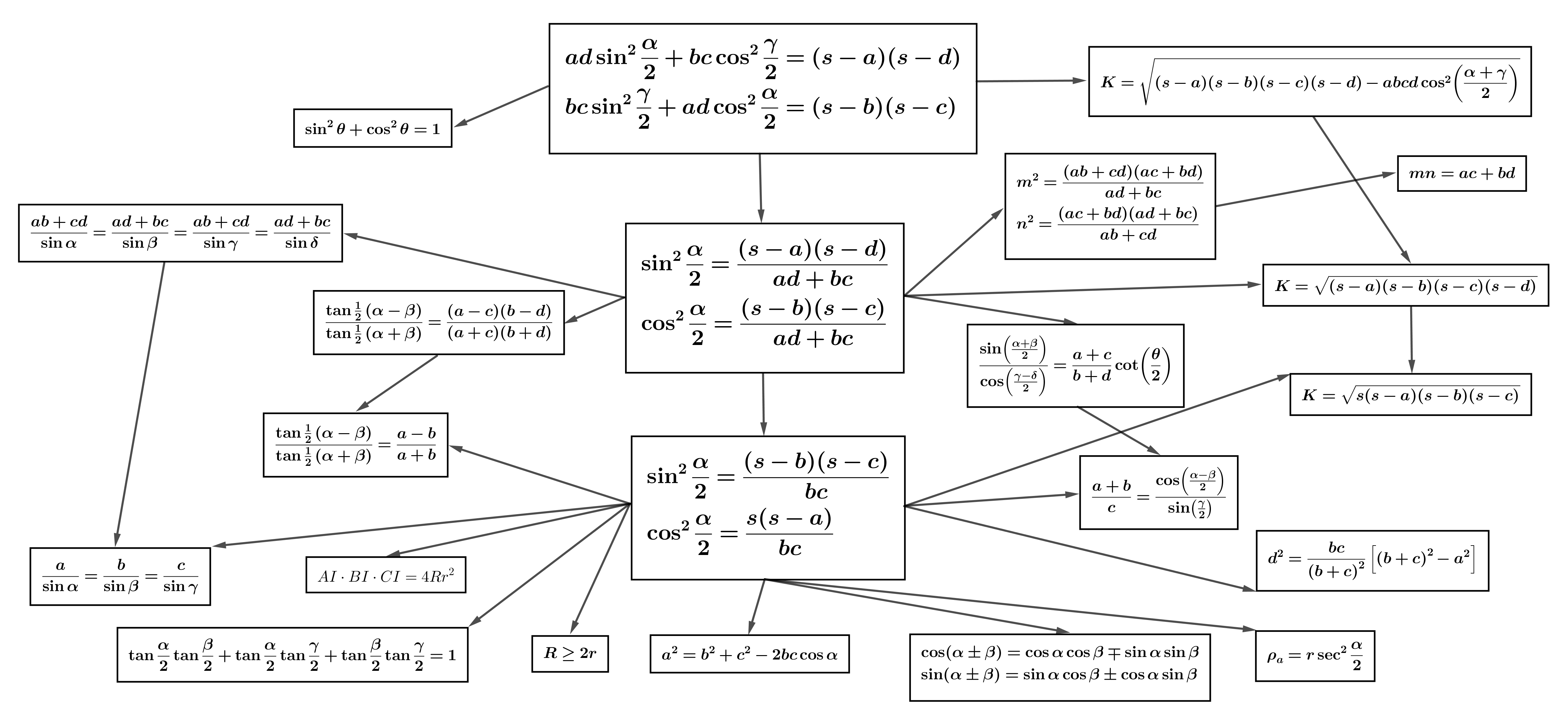
The half-angle formulas are central!
This essay explores the theoretical importance of half-angle formulas, revealing their often-overlooked significance and numerous applications in mathematics. The essay introduces novel generalizations and applications, offering fresh insights into established mathematical concepts, ultimately inviting readers to ponder the hidden potential and ubiquity of these formulas in mathematical contexts.
And as a picture is worth a thousand words...
Meet the Unified Substitution Method (USM) for integration: $$e^{i\alpha}=\tan\left(\frac{\beta}{2}\right).$$
The USM incorporates, extends, justifies, and surpasses Euler's substitutions. In Euler's substitutions, the choice of signs based on the domain must be made manually, whereas in the USM, the supporting theorems prescribe which sign to use according to the domain. Moreover, the USM shows that Weierstrass substitutions and the use of complex exponentials for integration are merely two sides of the same coin. The USM not only unifies these two techniques into one, but also generalizes them.
Perhaps I should add that the author of the USM was unaware of the use of Euler's substitutions and complex exponentials in integration at the time of discovering this method. The author discovered a family of trigonometric formulas for quadratic equations which were the ones that gave rise to the USM.
After discovering the central role that half-angle formulas play in relation to classical metric geometry and integral calculus, the natural question that arises is, why on earth are these formulas so useful? And my answer is symmetry, the same underlying concept in Galois theory or Noether's theorems.