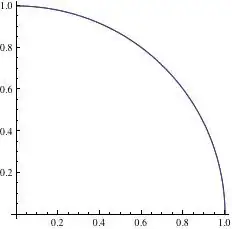
The complete answer may be hard, but contrary to the OP, I see no difficulty in stating the question and generalizing the concept of equi-oscillation to the two-dimensional case. Let $V_n$ denote the affine space of all pairs $v=(x_n,y_n)$ of polynomials each of degree $\leq n$ with $v(0)=(1,0)$ and $v(1)=(0,1)$ . Note that $V_n$ has dimension $2(n-1)$. For $v=(x_n,y_n)\in V$ put
$$
|| v ||=\sup_{t\in[0,1]} \bigg| x_n(t)^2+y_n(t)^2-1\bigg|
$$
Then define $\mu_n={\sf inf}(|| v |||, v \in V_n)={\sf min}(|| v |||, v \in V_n)$. Say that a $v\in V_n$ is optimal if $||v||=\mu_n$.
Definition Let $\varepsilon>0$. We say that a pair $v=(x_n,y_n)\in V_n$ is $\varepsilon$-oscillating if there is an increasing sequence of $1+{\sf dim}(V_n)$ elements $t_1<t_2< \ldots<t_{1+{\sf dim}(V_n)}$ in $[0,1]$ such that the sequence $w_i=x_n(t_i)^2+y_n(t_i)^2-1$ is alternating (i.e. $w_{i+1}=-w_i$ for all $i$) and $|w_i|=\varepsilon$ for all $i$.
Note that $1+{\sf dim}(V_n)=2n-1$ above.
Conjecture 1 A $v\in V_n$ is optimal if and only if it is $\mu_n$-oscillating.
Conjecture 2 There is a unique optimal solution for each $n$.
Those conjectures are true when $n=2$. Indeed, in this case a generic $v\in V_2$ can
be written $$v(a,b,t)=(1-t+at(1-t),t+bt(1-t))$$. Let us also put
$$
F(a,b,t)=1-t+at(1-t))^2+(t+bt(1-t))^2-1 \tag{1}
$$
Let $\theta$ be the largest real root of $T=X^4+4X^3-8X^2+8X-4$, so that $\theta$ is approximately
$0,85 \ldots$. I claim then that $v(\theta,\theta,.)$ is the unique optimal solution.
Let $G(t)=F(\theta,\theta,t)$ and
$$\mu=G(1/2)=\frac{\theta^2}{8}+\frac{\theta}{2}-\frac{1}{2} \approx 0,015 \tag{3} $$
We then have the identities
$$
\mu-G(t)=\big(t-\frac{1}{2}\big)^2 \bigg(\frac{\theta^2}{2}+2\theta-2+2\theta^2t(1-t) \bigg) \tag{4}
$$
$$
\mu+G(t)=2\theta^2 \bigg(t(1-t)-\frac{\theta-1}{2\theta^2} \bigg)^2 \tag{5}
$$
Note that the polynomial $Q(t)=t(1-t)-\frac{\theta-1}{2\theta^2}$ has two roots in $[0,1]$,
$\alpha$ and $1-\alpha$ where $\alpha \approx 0,12 \ldots$. This shows that $G$ is $\mu$-oscillating.
Let $(a,b)$ be any pair such that $||v(a,b,.)|| \leq \mu $. Then
$$
F(a,b,\alpha) \geq -\mu, \ F(a,b,\frac{1}{2}) \leq \mu, \ F(a,b,1-\alpha) \geq -\mu \tag{6}
$$
Those three inequalities alone will suffice to force $(a,b)=(\theta,\theta)$, showing
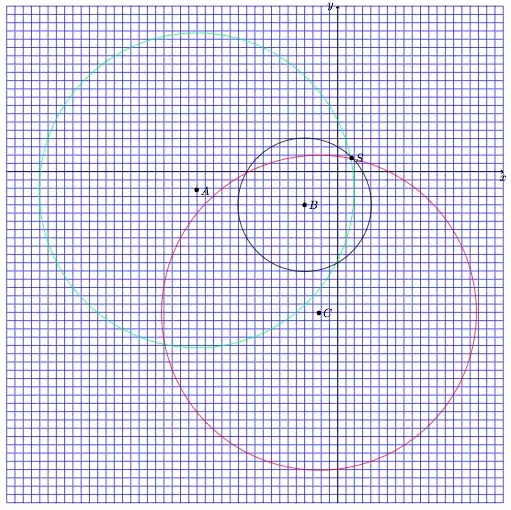
optimality and unicity. Indeed, consider in the plane points $A,B,C,S$ with the following
coordinates :
$$
A(-\frac{1}{\alpha},-\frac{1}{1-\alpha}), \ B(-2,-2), \ C(-\frac{1}{1-\alpha},-\frac{1}{\alpha}), \
S(\theta,\theta)
$$
Also, consider the disk $D_A$ with center $A$ and radius $\frac{\sqrt{\mu}}{\alpha(1-\alpha)}$,
the disk $D_B$ with center $B$ and radius $4\sqrt{1+\mu})$, and the disk $D_C$ with
center $C$ and radius $\frac{\sqrt{\mu}}{\alpha(1-\alpha)}$.
Then a pair $(a,b)$ satisfies (6) iff the point with such coordinates is inside $D_C$
but outside $D_A$ and $D_B$. The figure below shows that $S$ is the only such point, qed.