$\def\E{\operatorname E} \def\F{\operatorname F} \def\I{\operatorname I}$Quantile Function
Mathematica already had inversebetaregularized $\I^{-1}_z(a,b)$ which is a quantile function for the beta distribution. Although the question is about solving E$(x,m)=a$, there are Mathematica closed forms solving $\E(x,m)+c\F(x,m)=a$
- With the second lemniscate constant L$_2$:
$$\E(x,2)=a\implies x=\frac12\sin^{-1}\left(\sqrt{\text I^{-1}_{\frac a{\text L_2}}\left(\frac12,\frac34\right)}\right),0\le a\le\text L_2$$
which is correct.
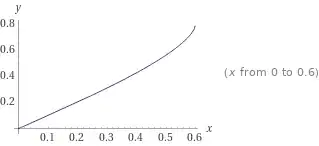
- Note Elliptic D$(x,m)$:
$$\E(x,-1)-\F(x,-1)=\operatorname D(x,-1)=a\implies x=\sin^{-1}\left(\sqrt[4]{\text I^{-1}_{\frac a{\text L_2}}\left(\frac34,\frac12\right)}\right),0\le a\le \text L_2$$
which is correct.
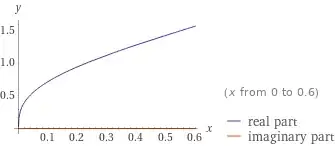
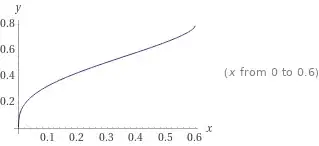
3.
$$\E(x,2)-\frac12\sin(2x)\cos^\frac32(2x)=a\implies x=\frac12\sin^{-1}\left(\sqrt{\I^{-1}_{\frac a{\text L_2}}\left(\frac32,\frac34\right)}\right),0\le a\le \text L_2$$
which also works
- Using the Baxter constant B:
$$\operatorname E(z,\sqrt[-3]{-1})-\left(\frac12+\frac i{2\sqrt3}\right)\operatorname F(z,\sqrt[-3]{-1}) =a\implies z=\sin^{-1}\left(\frac{\sqrt[12]{-1}}{\sqrt[4]3}\sqrt{1-\sqrt[3]{\operatorname I^{-1}_{1-\sqrt[4]3\sqrt[3]4\sqrt[12]{-1}\text Ba}\left(\frac23,\frac12\right)}}\right),0\le \sqrt[12]{-1}a\le \frac1{\sqrt[4]3\sqrt[3]4\text B}$$
shown here
Real part:
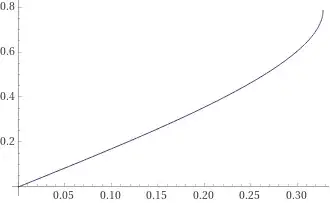
Imaginary part:
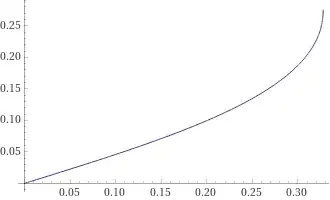
There are also other special cases, but they are very specific and may not have applications. The $\text I^{-1}_z(a,b)$ function also expresses many special cases of Jacobi elliptic functions. Also use the periodic nature of the elliptic integrals to find values outside of the $a$ restriction.
Series Solution
The simplest recurrence relation for the coefficients seems to be from inverting:
$$f(z)=\E(\sin^{-1}(\sqrt z),m)=\frac12\int_0^z\sqrt{\frac{mt-1}{t(t-1)}}dt\implies y(z)=f^{-1}(z)$$
The differential equation and $f(z)’s$ series are:
$$y’=2\sqrt{\frac{y(y-1)}{my-1}}\iff4y=4y^2+y’^2-my’^2y\\f(z)=\sqrt z+O(z^\frac32)\implies y=\sum_{n=1}^\infty a_nz^{2n},a_1=1$$
Substituting and equating powers of $z^{2n}$ using Kronecker delta, we get:
$$\sum_{n=1}^\infty a_n x^{2n}=\sum_{k=1}^\infty\sum_{j=1}^\infty a_ka_jx^{2k+2j}+\sum_{k=1}^\infty\sum_{j=1}^\infty a_ka_jkjx^{2k+2j-2}-m\sum_{k=1}^\infty\sum_{j=1}^\infty\sum_{p=1}^\infty a_ka_ja_pkjx^{2k+2j+2p-2}\\ a_n=\sum_{k=1}^\infty\sum_{j=1}^\infty a_ka_j\delta_{n,k+j}+\sum_{k=1}^\infty\sum_{j=1}^\infty a_ka_jkj\delta_{n,k+j-1}-m\sum_{k=1}^\infty\sum_{j=1}^\infty\sum_{p=1}^\infty a_ka_ja_pkj\delta_{n,k+j+p-1} $$
Next, we apply $\delta_{n,m}$’s sifting property. Now $a_n$ depends on $a_n$, so subtract the $k=1$ causing it and substitute $k\to k+1$ to get:
$$\bbox[2px,border:2px solid blue]{\E(y,m)=z\implies \sin^2(y)=\sum_{n=1}^\infty a_n z^{2n};(1-2n)a_n=a_{n-1}+\sum_{k=1}^{n-2}a_{n-k}(a_k+a_{k+1}(k+1)(n-k))-m\sum_{k=1}^{n-1}\sum_{j=1}^{n-k}a_ka_ja_{n-k-j+1}kj\\=\left\{1,\frac{m-1}3,\frac{m-1}{45}(11m-2),\frac{m-1}{315}(74m^2-29m+1),\frac{m-1}{14175}(3548m^3-2220m^2+249m-2),\frac{m-1}{467775}(136883m^4-117818m^3+24474m^2-1016m+2),\dots\right\}}$$
which matches $f(x)$’s series reversion. A series directly inverting $\E(x,m)$ requires expanding a $\sin^2(y)$ as a series which requires finding another recurrence. The series works for $z,m\in\Bbb C$. The series here can be used to expand the formulas in the “Quantile Function” section too.


Also the paper Numerical computation of inverse complete elliptic integrals of first and second kinds by T Fukushima.
– Loreno Heer Jan 28 '15 at 16:07