33

I was asked to find out the simplicial homology groups of the torus $T=S^1\times{}S^1$ embedded in $R^3$. I triangulated the torus like this :
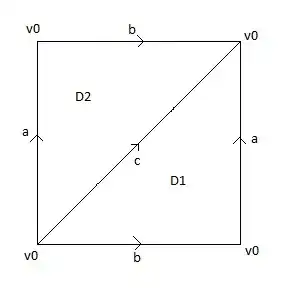
This was my first try

Here the $0$-simplices are $\{v_0\}$. $1$-simplices are $\{a,b,c\}$ and the $2$-simplices are $\{D_1,D_2\}$. And I found out the homology groups : $H_0(T)=\mathbb{Z}, H_1(T)=\mathbb{Z}^2,H_2(T)=\mathbb{Z}$

But my teacher said it was wrong, because the triangulation is not correct. According to her it should be:
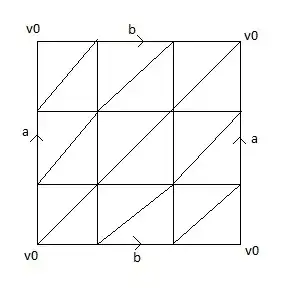
Correct triangulation

I don't understand what is wrong with my triangulation of the torus $T$. Can someone please clarify this to me? Thanks! (Excuse the crude pictures!)

ChesterX
  • 2,364
  • 11
    Your triangulation is actually a pseudo triangulation. Namely, you identify vertices of the same triangle. So you're not dealing with a simplicial complex at the end, but with a CW-complex (which is fine by the way if you know about cellular homology). – Pece Oct 01 '14 at 05:19
  • @Pece So I cannot have a $1$-simplex attached to the same $0$-simplex? i.e. "loops" are not allowed in simplicial triangulation? – ChesterX Oct 01 '14 at 06:05
  • 3
    It depends on what you call a triangulation. Judging by the answer of your teacher, it's probably a simplicial complex, in which case all the faces of a simplex are required to be different (simply because if a simplex is embedded in a real vector space, all its faces are different). – Najib Idrissi Oct 01 '14 at 06:27

1 Answers1

27

As said by @Pece, your computation is correct, because homology can be computed with quite general kinds of complexes.

But it sounds like your teacher wants you to understand the definition of a simplicial complex, and is probably using a definition of a triangulation which requires it to be a simplicial complex.

In a simplicial complex, every simplex is required to be embedded, but none of your 1-simplices $a$, $b$, and $c$ are embedded, because each has its two endpoints attached to the same $0$-simplex $v_0$.

Also, the intersection of any pair of simplices is required to be a simplex, but your 2-simplices $D_1,D_2$ intersect in $a \cup b \cup c$.

Lee Mosher
  • 135,265
  • 1
    Now I see where I went wrong : I completely overlooked the fact about the intersection! Also can you please elaborate what you meant by "every simplex is required to be embedded"? – ChesterX Oct 01 '14 at 16:17
  • 3
    @ChesterX: Each $k$-simplex in a simplicial complex $X$ may be regarded as the image of a continuous map $\Delta^k \to X$, where $\Delta^k$ denotes the "standard" $k$-simplex in $\mathbb{R}^{k+1}$, and this continuous map is required to be an injection, i.e. an embedding. Notice that in the concept of a "pseudo triangulation" mentioned in the comment of Pece, the requirement of injection is weakened. – Lee Mosher Oct 01 '14 at 16:52
  • What prevents the 2×2 squares with the triangles within as the subgraph of the figure in the question from being a triangulation? – Hans Apr 13 '24 at 01:58
  • The question is not about that figure, nor any subgraph of that figure. The question is about the torus which is a quotient of that figure, by using the familiar side identifications. – Lee Mosher Apr 13 '24 at 02:00