50

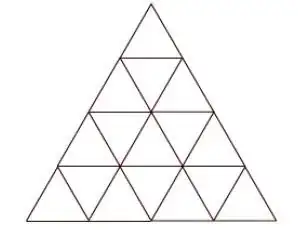
I saw this question today, it asks how many triangles are in this picture.

enter image description here

I don't know how to solve this (without counting directly), though I guess it has something to do with some recurrence.

How can count the number of all triangles in the picture ?

amWhy
  • 210,739
Belgi
  • 23,614

7 Answers7

27

Say that instead of four triangles along each edge we have $n$. First count the triangles that point up. This is easy to do if you count them by top vertex. Each vertex in the picture is the top of one triangle for every horizontal grid line below it. Thus, the topmost vertex, which has $n$ horizontal gridlines below it, is the top vertex of $n$ triangles; each of the two vertices in the next row down is the top vertex of $n-1$ triangles; and so on. This gives us a total of

$$\begin{align*} \sum_{k=1}^nk(n+1-k)&=\frac12n(n+1)^2-\sum_{k=1}^nk^2\\ &=\frac12n(n+1)^2-\frac16n(n+1)(2n+1)\\ &=\frac16n(n+1)\Big(3(n+1)-(2n+1)\Big)\\ &=\frac16n(n+1)(n+2)\\ &=\binom{n+2}3 \end{align*}$$

upward-pointing triangles.

The downward-pointing triangles can be counted by their by their bottom vertices, but it’s a bit messier. First, each vertex not on the left or right edge of the figure is the bottom vertex of a triangle of height $1$, and there are $$\sum_{k=1}^{n-1}=\binom{n}2$$ of them. Each vertex that is not on the left or right edge or on the slant grid lines adjacent to those edges is the bottom vertex of a triangle of height $2$, and there are

$$\sum_{k=1}^{n-3}k=\binom{n-2}2$$ of them. In general each vertex that is not on the left or right edge or on one of the $h-1$ slant grid lines nearest each of those edges is the bottom vertex of a triangle of height $h$, and there are

$$\sum_{k=1}^{n+1-2h}k=\binom{n+2-2h}2$$ of them.

Algebra beyond this point corrected.

The total number of downward-pointing triangles is therefore

$$\begin{align*} \sum_{h\ge 1}\binom{n+2-2h}2&=\sum_{k=0}^{\lfloor n/2\rfloor-1}\binom{n-2k}2\\ &=\frac12\sum_{k=0}^{\lfloor n/2\rfloor-1}(n-2k)(n-2k-1)\\ &=\frac12\sum_{k=0}^{\lfloor n/2\rfloor-1}\left(n^2-4kn+4k^2-n+2k\right)\\ &=\left\lfloor\frac{n}2\right\rfloor\binom{n}2+2\sum_{k=0}^{\lfloor n/2\rfloor-1}k^2-(2n-1)\sum_{k=0}^{\lfloor n/2\rfloor-1}k\\ &=\left\lfloor\frac{n}2\right\rfloor\binom{n}2+\frac13\left\lfloor\frac{n}2\right\rfloor\left(\left\lfloor\frac{n}2\right\rfloor-1\right)\left(2\left\lfloor\frac{n}2\right\rfloor-1\right)\\ &\qquad\qquad-\frac12(2n-1)\left\lfloor\frac{n}2\right\rfloor\left(\left\lfloor\frac{n}2\right\rfloor-1\right)\;. \end{align*}$$

Set $\displaystyle m=\left\lfloor\frac{n}2\right\rfloor$, and this becomes

$$\begin{align*} &m\binom{n}2+\frac13m(m-1)(2m-1)-\frac12(2n-1)m(m-1)\\ &\qquad\qquad=m\binom{n}2+m(m-1)\left(\frac{2m-1}3-n+\frac12\right)\;. \end{align*}$$

This simplifies to $$\frac1{24}n(n+2)(2n-1)$$ for even $n$ and to

$$\frac1{24}\left(n^2-1\right)(2n+3)$$ for odd $n$.

The final figure, then is

$$\binom{n+2}3+\begin{cases} \frac1{24}n(n+2)(2n-1),&\text{if }n\text{ is even}\\\\ \frac1{24}\left(n^2-1\right)(2n+3),&\text{if }n\text{ is odd}\;. \end{cases}$$

Brian M. Scott
  • 631,399
26

Tabulating numbers

Let $u(n,k)$ denote the number of upwards-pointing triangles of size $k$ included in a triangle of size $n$, where size is a short term for edge length. Let $d(n,k)$ likewise denote the number of down triangles. You can tabulate a few numbers to get a feeling for these. In the following table, row $n$ and column $k$ will contain two numbers separated by a comma, $u(n,k), d(n,k)$.

$$ \begin{array}{c|cccccc|c} n \backslash k & 1 & 2 & 3 & 4 & 5 & 6 & \Sigma \\\hline 1 &  1, 0 &&&&&&  1 \\ 2 &  3, 1 &  1,0 &&&&&  5 \\ 3 &  6, 3 &  3,0 &  1,0 &&&& 13 \\ 4 & 10, 6 &  6,1 &  3,0 & 1,0 &&& 27 \\ 5 & 15,10 & 10,3 &  6,0 & 3,0 & 1,0 && 48 \\ 6 & 21,15 & 15,6 & 10,1 & 6,0 & 3,0 & 1,0 & 78 \end{array} $$

Finding a pattern

Now look for patterns:

  • $u(n, 1) = u(n - 1, 1) + n$ as the size change added $n$ upwards-pointing triangles
  • $d(n, 1) = u(n - 1, 1)$ as the downward-pointing triangles are based on triangle grid of size one smaller
  • $u(n, n) = 1$ as there is always exactly one triangle of maximal size
  • $d(2k, k) = 1$ as you need at least twice its edge length to contain a downward triangle.
  • $u(n, k) = u(n - 1, k - 1)$ by using the small $(k-1)$-sized triangle at the top as a representant of the larger $k$-sized triangle, excluding the bottom-most (i.e. $n$th) row.
  • $d(n, k) = u(n - k, k)$ as the grid continues to expand, adding one row at a time.

Using these rules, you can extend the table above arbitrarily.

The important fact to note is that you get the same sequence of $1,3,6,10,15,21,\ldots$ over and over again, in every column. It describes grids of triangles of same size and orientation, increasing the grid size by one in each step. For this reason, those numbers are also called triangular numbers. Once you know where the first triangle appears in a given column, the number of triangles in subsequent rows is easy.

Looking up the sequence

Now take that sum column to OEIS, and you'll find this to be sequence A002717 which comes with a nice formula:

$$\left\lfloor\frac{n(n+2)(2n+1)}8\right\rfloor$$

There is also a comment stating that this sequence describes the

Number of triangles in triangular matchstick arrangement of side $n$.

Which sounds just like what you're asking.

References

If you want to know how to obtain that formula without looking it up, or how to check that formula without simply trusting an encyclopedia, then some of the references given at OEIS will likely help you out:

MvG
  • 44,006
10

edit: I tried to write this as a generalization of the simpler case of counting the small triangles, but clearly didn't anticipate the problems that would arise. My proposed solution doesn't work, as it counts straight lines as well as triangles. It can be corrected in a number of different ways, but this just complicates a method which is already inefficient.


Label each corner of each triangle and consider them to be nodes on a graph. You can then write the adjacency matrix for that graph. Because the graph has such a regular structure, the matrix can be worked out easily enough, and scales up nicely. IMPORTANT: two nodes are "adjacent" if they are connected by a straight line, not just a line segment.

Adjacency matrices have the cool property that if you take their product, it tells you how many ways there are to get from one point to another. If you take the cube of the matrix, the diagonal entries will tell you how many ways there are to get from a point back to itself in three moves (i.e. form a triangle).

From there, you just need to take the trace of this matrix, and divide the result by six (since each triangle is counted six times; twice for each corner.)

edit: divide by six, not three.

hasnohat
  • 3,962
  • 1
  • 19
  • 26
  • I don't understand how the number of paths are the number of triangles. can you please explain ? – Belgi Sep 28 '12 at 09:17
  • The ij entry of the cube of the matrix tells you how many ways there are to get from node i to node j in three moves. As such, the entries on the diagonal correspond to closed loops of size 3. The only way to get a closed loop of size three is if you draw a triangle. – hasnohat Sep 28 '12 at 09:21
  • 2
    Actually as you describe it, you won't get the right result, but too much. This is because you count all cyclic paths of length $3$ this way, which includes cases where the path visits three points on a line; also all actual triangles it counts are counted $6$ times, one for each permutation of its vertices. Concretely you find $432$ for the case displayed, while the correct answer is $16+7+3+1=27$ (grouping triangles by size). – Marc van Leeuwen Sep 28 '12 at 11:36
  • I get 96 from the trace of the cube of the adjacency matrix and 96/6=16 is (correctly) the number of triangles of side-length 1.But there are other triangles as well, and I don't see how to count those easily using this method. – Mark Bennet Sep 28 '12 at 12:13
  • Ah... I guess that doesn't work, then. Thanks, Marc, for pointing that out. – hasnohat Sep 28 '12 at 13:53
  • It will work if you subtract the “all on one line” cases. There are $3\sum_{i=1}^{n+1}\binom{i}{3}=3\binom{n+2}{4}$ such cases. After applying this correction, your method will yield correct results, although it's still rather bulky compared to the closed formulas given by other answers. – MvG Sep 28 '12 at 18:42
  • You sure got a lot of votes, even if those people didn't bother to check your solution! – GeoffDS Sep 28 '12 at 21:33
  • I know! I feel rather guilty about that... – hasnohat Sep 28 '12 at 21:41
6

Let $T_n$ denote the number of triangles when the side-length of the large triangle is $n\geq0$. Then $T_0=0$, $T_1=1$. To obtain a recurssion formula for the $T_n$ we have to distinguish even and odd $n$.

Assume $n=2m$, and let us add a $(2m+1)$'th row of triangles at the bottom. Then each "old" triangle will appear in $T_{2m+1}$, furthermore each "old" gridpoint is a vertex of a triangle with base at the bottom of the new figure, and finally the new bottom gridpoints $z$ serve as vertices of new bottom-up triangles whose sizes are between $1$ and the distance of $z$ from the lower corners of the figure. It follows that

$$T_{2m+1}=T_{2m}+\sum_{k=0}^{2m} (k+1)+2\sum_{k=1}^m k\ ,\qquad(*)$$

and similarly we obtain

$$T_{2m+2}=T_{2m+1}+\sum_{k=0}^{2m+1} (k+1)+2\sum_{k=1}^m k + (m+1)\ .$$

Plugging $T_{2m+1}$ from the first formula into the second we get

$$T_{2m+2}=T_{2m}+2\sum_{k=0}^{2m} (k+1) +(2m+2)+4\sum_{k=1}^m k +(m+1)=T_{2m}+6m^2+11m +5\ .$$

This implies $$T_{2m}=(m-1)m(2m-1)+11{(m-1)m\over2}+5m={1\over2}(4m^3+5m^2 +m)\ ,$$ and using $(*)$ we obtain $$T_{2m+1}={1\over2}(4m^3+11m^2+9m+2)\ .$$ (This coincides with Brian M. Scott's results.)

1

A lot of complicated answers for a simple problem. That's fine, but we're just trying to solve this simple problem here, not the full generalization of it. Just go by size.

Triangles of size 1 (as in 1 small triangle): 16 Triangles of size 16: 1 (the big triangle) Triangles of size 9: 3, this is pretty clear

This leaves only triangles of size 4, which is probably the only tricky part of the problem. I guess every triangle is either going to have a point at the top and be flat on the bottom, or be flat on the top and have a point on the bottom. Once you recognize this, there's nothing tricky about this part either. There are 6 with the point on top, and 1 with the point on the bottom. So the total is

$$16 + 1 + 3 + 6 + 1 = 27$$

GeoffDS
  • 11,410
-1
// C snippet for counting tri 
//ak13
#include<stdio.h>
int main()

{

unsigned long long int  i,n,s,t,k;

 scanf("%llu",&t);

       for(;t>0;t--)
      {
         scanf("%llu",&n);
         s=0;
         k=0;
        for(i=0;i<=n;i+=2)
            s=s+(i*(i+1))/2;
        for(i=1;i<=n;i+=2)
           k=k+(i*(i+1))/2;
         if(n%2==0)
            k*=2;
         else
            s*=2;
       printf("%llu\n",s+k);

      }
return 0;

}
MvG
  • 44,006
-2

The total is $28$. It's $16+8+3+1$ triangles of each size grouping.

Stefan Hansen
  • 26,160
  • 7
  • 62
  • 95