29

I want to prove:

For an integrable function $f(x)$ and periodic with period $T$, for every $a \in \mathbb{R}$, $$\int_{0}^{T}f(x)\;dx=\int_{a}^{a+T}f(x)\;dx.$$

I tried to change the values and define $y=a+x$ so that $dy=dx$ and the limits of the integrals are as we want, but I'm not sure how to use the fact that $f(x)$ is periodic.

Thanks a lot!

Jozef
  • 7,198
  • 2
    Dear Jozef: The simplest, I think, is to do the computation by using a primitive (or anti-derivative) $F$ of $f$. (At the end you can make $F$ disappear.) Also, compute "LHS minus RHS". – Pierre-Yves Gaillard Dec 26 '11 at 15:36
  • 1
    Let $N$ be such integer that $N\cdot T \in \langle a,a+T \rangle$. Does dividing the integral as $\int_a^{a+T}=\int_a^{NT}+\int_{NT}^{a+T}$ help? – Martin Sleziak Dec 26 '11 at 15:37

6 Answers6

30

$$ \begin{align} \int_a^{a+T}f(x)\,\mathrm{d}x-\int_0^{T}f(x)\,\mathrm{d}x &=\left(\color{red}{\int_a^{T}f(x)\,\mathrm{d}x}+\int_T^{a+T}f(x)\,\mathrm{d}x\right)\\ &-\left(\int_0^{a}f(x)\,\mathrm{d}x+\color{red}{\int_a^{T}f(x)\,\mathrm{d}x}\right)\\ &=\int_T^{a+T}f(x)\,\mathrm{d}x-\int_0^{a}f(x)\,\mathrm{d}x\\ &=\int_0^{a}f(x+T)\,\mathrm{d}x-\int_0^{a}f(x)\,\mathrm{d}x\\ &=\int_0^{a}(f(x+T)-f(x))\,\mathrm{d}x\\ &=\int_0^{a}0\,\mathrm{d}x\\ &=0 \end{align} $$

robjohn
  • 353,833
26

If $F$ is a primitive of $f$, then

$$\int_{a}^{a+T}f(x)\ dx-\int_{0}^{T}f(x)\ dx$$ $$=F(a+T)-F(a)-F(T)+F(0)$$ $$=\Big(F(a+T)-F(T)\Big)-\Big(F(a)-F(0)\Big)$$ $$=\int_T^{a+T}f(x)\ dx-\int_0^af(x)\ dx$$ $$=0.$$

One checks the last equality by making the obvious change of variable, and by using the periodicity.

EDIT 1. What I wrote above is how I remember the computation. Of course, it can be written like that: $$ \int_{a}^{a+T}f(x)\ dx-\int_{0}^{T}f(x)\ dx=\int_T^{a+T}f(x)\ dx-\int_0^af(x)\ dx=0. $$

EDIT 2. Formal justification of the first equality in the above display: $$ \int_0^af(x)\ dx+\int_{a}^{a+T}f(x)\ dx=\int_{0}^{T}f(x)\ dx+\int_T^{a+T}f(x)\ dx. $$

(This formula should appear somewhere...)

12

$\int_a^{a+T}f(t)dt=\int_a^Tf(t)dt+\int_T^{a+T}f(t)dt,$ and in the last integral, making the substitution $x=t-T$, we get for $a\in [0,T)$, since $f$ is $T$-periodic $$\int_a^{a+T}f(t)dt=\int_a^Tf(t)dt+\int_0^{a}f(x+T)dx=\int_a^Tf(t)dt+\int_0^{a}f(x)dx=\int_0^T f(t)dt.$$ For $a\in\mathbb R$, take $n\in\mathbb Z$ such that $a+nT\in [0,T)$. Then $$\int_a^{a+T}f(t)dt=\int_{a+nT}^{a+(n+1)T}f(x-nT)dx=\int_{a+nT}^{a+(n+1)T}f(x)dx=\int_0^Tf(t)dt$$ using the previous case.

Davide Giraudo
  • 181,608
12

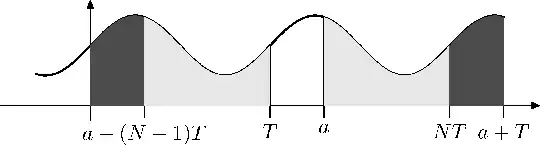
Here's a picture illustrating the basic idea. (Compare the areas marked with the same color.)

periodic function

$NT$ denotes the integer multiple of $T$ which belongs to the interval $\langle a,a+T \rangle$. (In this example $N=2$.)


In case someone wants to see metapost source for the picture, it is figure 5 from here.

3

Here is a simple way using the periodicity of the function and the antiderivative: $$F(x+n\cdot T) = F(x); \ n\in \mathbb{Z}$$ $$ \int^{a+T}_a f(x)dx = F(a+T)-F(a)= F(a) - F(a) = 0 = F(T)-F(0)=\int^T_0 f(x)dx $$

The periodicity carries over from the function to the antiderivative, which is easily seen if you take a look at the fourier series of the periodic function.

3

$$\begin{align} \int_{a}^{a+T}f(x)\ dx&= \int_{T}^{a+T}f(x)\ dx +\int_{a}^{T}f(x)\ dx\\&\overset{y=x-T}{=} \color{red}{\int_{0}^{a}f(y+T)\ dx} +\int_{a}^{T}f(x)\ dx\\&\overset{periodic}{=} \color{red}{\int_{0}^{a}f(y)\ dx} +\int_{a}^{T}f(x)\ dx\\&=\int_0^Tf(x)\ dx. \end{align}$$

Guy Fsone
  • 25,237