79

Consider the following 2-variable function:

$$f(x,y) = \frac{x^2y}{x^4+y^2}$$

I would like to find the limit of this function as $(x,y) \rightarrow (0,0)$.

I used polar coordinates instead of solving explicitly in $\mathbb R^2 $, and it went as the following:

$$ x = r \cos \theta, \qquad y = r\sin\theta $$

Hence,

$$\lim_{(x,y) \to (0,0)} \frac{x^2y}{x^4 + y^2} = \lim_{r \to 0}\frac{r^2\cos^2\theta(r\sin\theta)}{r^4\cos^4\theta + r^2\sin^2\theta}$$

This simplifies to,

$$ \lim_{r \to 0} \frac{r^3 \cos^2\theta\sin\theta}{r^2(r^2\cos^4\theta + \sin^2\theta)}$$

Simplifying $r^3/r^2$, we finally get;

$$\lim_{r \to 0} \frac{r (\cos^2\theta\sin\theta)}{r^2\cos^4\theta + \sin^2\theta}$$

Now from the above, we find that as $r \to 0$ the limit is $0$.

I wanted to verify this answer so I checked on Wolfram Alpha. Explicitly without changing to polar coordinates, it said that the limit does not exist at $(0,0)$ and rightly so. Then how is it that with polar coordinates, the limit exists and is $0$? Am I doing something wrong in this method?

Also, what should I do in this situation, and when should I NOT use polar coordinates to find limits of multi-variable functions?

Nosrati
  • 30,522
mesllo
  • 1,490
  • 12
    It's odd - this conflicts with what I was taught last semester, that converting to polar is a foolproof way of proving a limit exists. –  Apr 15 '14 at 07:46
  • 1
    I think @heropup's answer is more than convincing :) – mesllo Apr 15 '14 at 08:10
  • @MyGlasses Did you know that the SE search engine can't read TeX? Consequently TeXifying the title doesn't help that much. – Jyrki Lahtonen Apr 14 '17 at 10:14
  • @JyrkiLahtonen I think these edits I have done so far, help us to find related and also duplicate in right panel (related panel). But if my work about these edits is un-useful, I will stop it. tell me please. – Nosrati Apr 14 '17 at 10:27
  • I think the most important point is that when $r$ goes to zero, it's not uniform about $\theta$. It's easy to prove that when $r$ goes to zero, the limit exists and is equal, Also, $\delta$ is only related to $\epsilon$, independent of $\theta$, then limit exists. – DaNan Jul 07 '24 at 09:41

4 Answers4

87

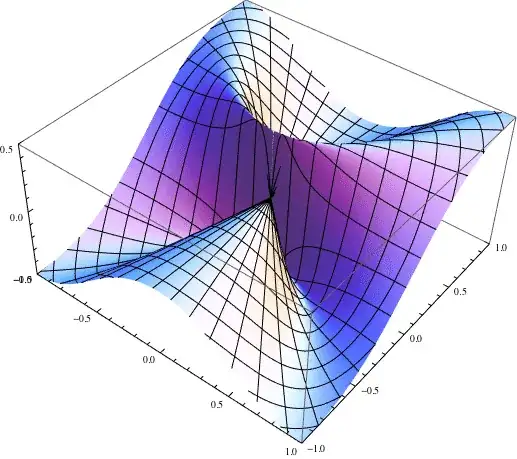
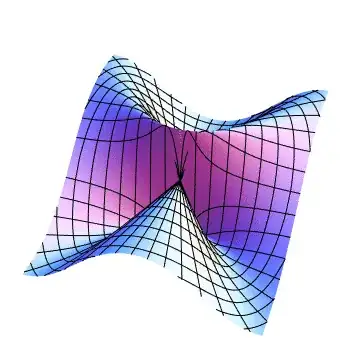
The limit is not defined because in order for the limit to exist, the value of the function for every possible path to $(0,0)$ must tend to the same finite value. When $y = x^2$, you have not necessarily shown that the limit is in fact $0$. When you transformed to polar coordinates and then took the limit as $r \to 0$, you are assuming that $\theta$ is a fixed constant. Therefore, you are looking only at paths that follow a straight line to the origin.

enter image description here enter image description here

Mathematica code:

F[x_, y_] := x^2 y/(x^4 + y^2)
op = ParametricPlot3D[{r Cos[t], r Sin[t], F[r Cos[t], r Sin[t]]},
     {r, 0, Sqrt[2.1]}, {t, -Pi, Pi}, PlotPoints -> 40, MaxRecursion -> 8,
     Mesh -> {10, 48}, PlotRange -> {{-1, 1}, {-1, 1}, {-1/2, 1/2}}, 
     SphericalRegion -> True, Axes -> False, Boxed -> False];
an = Show[op, ViewPoint -> {{Cos[2 Pi #], Sin[2 Pi #], 0}, {-Sin[2 Pi #], 
     Cos[2 Pi #], 0}, {0, 0, 1}}.{1.3, -2.4, 2}] & /@ (Range[40]/40);
heropup
  • 143,828
  • 1
    But in this case, isn't the limit tending to zero whatever value theta has, since r is not dependent on theta? – mesllo Apr 14 '14 at 14:42
  • 12
    $r$ might not depend on $\theta$, but $\theta$ is most certainly allowed to depend on $r$. For if not, then the only paths that can be considered as $r \to 0$ would be those paths that move in a straight line to $(0,0)$, and as the choice of $y = x^2$ shows, such straight-line paths do not suffice. If $\theta$ varies with $r$, the calculation of the limit is no longer necessarily $0$. – heropup Apr 14 '14 at 14:46
  • 3
    My initial reasoning was that any value of theta will not matter since we have r multiplied with an expression containing all the theta values, and r is tending to zero. I thought that whatever there is in that expression will not matter since it will be zero regardless, because it is multiplied with r. – mesllo Apr 14 '14 at 15:06
  • 3
    @James If you fix $\theta$, the path you're taking to the origin is a straight line. There are many more paths than straight lines! (Great pictures, by the way!) –  Apr 14 '14 at 15:53
  • 2
    @James If you allow θ->0 as r->0, you see that the "expression containing all the theta values"->0/0. This presents a problem and you would need to resolve it to show that f->0. – Aaron Dufour Apr 14 '14 at 17:56
  • @heropup: Can I ask how you made this plot? – ldog Apr 14 '14 at 18:52
  • Is that an ancient version of Maple you created those graphs on? – DJClayworth Apr 14 '14 at 19:43
  • OMG, I will upvote you just for the images if you'll tell us what you used to make them... – RBarryYoung Apr 14 '14 at 21:14
  • 4
    The images were created in Mathematica 9. – heropup Apr 15 '14 at 00:55
  • @heropup I've never seen a proof (nor have I cared to find one) that polar substitution works, I always found such substitutions to be dubious at best. Still, I'm afraid I'm missing something here. Are you claiming that polar substitution is a broken method? – Git Gud Nov 14 '14 at 14:00
  • 1
    @GitGud No, I'm not claiming that; it is no more "broken" than any other coordinate transformation would be. If the limit exists, then a transformation could show it; e.g., $$\lim_{(x,y) \to (0,0)} \frac{\sin(x^2 + y^2)}{x^2+y^2}$$ for a trivial example. If the limit does not exist, then obviously no transformation could show it does. – heropup Nov 14 '14 at 15:51
  • 1
    @heropup But usually people want to prove the limit exists (and find it) and they use coordinate transformations for this purpose.So they take a limit which they don't know if exists or not and use some substitution to (supposedly) find the limit and prove its existence. In this sense, you're saying it's wrong, right? Of course that if the limit exists, then any sublimit will exist and it will equal the first limit. – Git Gud Nov 14 '14 at 17:49
  • 2
    I think I see what you're getting at. Well, if such a transformation is used, we have to look at the rigor of the argument: in the above case, it is wrong because as we know, treating $\theta$ as a constant while taking $r \to 0$ will fail to consider curved paths to the origin. On the other hand, the same argument would work for the limit I wrote in my previous response to you, because the $\theta$ drops out. So it's really not about the general method so much as the details of the approach that matters. – heropup Nov 14 '14 at 18:02
  • So basically if the function after a polar transformation ends up being independent of $\theta$, then it's OK? – Git Gud Nov 14 '14 at 18:09
  • 2
    In that case, yes, it will work since that would demonstrate the function is radially symmetric. There are other (non-radially symmetric) cases that will work too, but again, it comes down to specific arguments, and sometimes a different approach would be more effective. – heropup Nov 14 '14 at 18:17
  • @heropup OK, thank you. I'm more and more sure I do well in not messing with those. – Git Gud Nov 14 '14 at 18:18
  • @heropup Can you also help me this question? I haven't understood that problem yet. – Eric Dec 04 '16 at 14:28
  • @GitGud Haha I have pretty much felt the same, but I think I have a resolution after reading user2566092's answer. Basically if after substitution, you can write the function as $a(r) b(\theta)$ where $b$ is bounded on $[0, 2 \pi]$ and $a(r) \to 0$ as $r \to 0$, then you can conclude that the original limit is zero. – Blue Feb 18 '21 at 20:29
26

You haven't taken into account what happens if $\theta$ is variable as a function of $r$ when $r$ goes to $0$. Choose $\theta$ so that $\sin \theta = r$, i.e. $\theta$ is approximately $r$ and you will get $\cos \theta$ is about 1 for small $r$, and then the limit will not be zero, so the limit doesn't exist.

If you want to use polar coordinates to show that a limit exists, particularly in the case where you want to show the limit is $0$ as $r \to 0$, then if you factor out a positive power of $r$ then you need to bound the remaining factor by either a constant or a multiple of a negative power of $r$ that is lower than the positive power you factored out. In your case you can't do this because when $\sin \theta = r$ you can't produce such a bound for the expression after you factor out $r$. If you had something like $r/(\cos^4 \theta + \sin^4 \theta)$ then you could bound $1/(\cos^4 \theta + \sin^4 \theta)$ by a constant for all $\theta$ and so you would then get that the limit is indeed $0$ as $r \to 0$.

user2566092
  • 26,450
22

Let $\alpha >0$, and consider the path $\gamma_\alpha(t) = (t,\alpha t^2)$. Then we have $f \circ \gamma_\alpha (t) = {\alpha t^4 \over t^4+ \alpha^2 t^4 }$, and the limit as $t \to 0$ is ${\alpha \over 1+\alpha^2}$ (in fact, it is constant along this path).

The limit exists along all of these paths, but is different. If the limit exists, its value must be independent of how $(x,y) \to 0$.

copper.hat
  • 178,207
19

The OP asks:

  1. What am I doing wrong with this method?

  2. When should I not use polar coordinates to find limits of multivariable functions?

The answer to the second question is somewhat unsatisfactory: If you find a limit, then you can. If you don't find a limit, then you can't.


So now, let's just leave that behind us and focus on the first question: "What am I doing wrong with this method?"

For this I will just consider the case where we have cartesian coordinates. The analogy with polar coordinates should be evident.

The mistake you made actually has nothing to do with "polar coordinates" per se, but with "limits". To this end, I'll first repeat the definition of the limit of a two-variable function here:

Suppose we have a function \begin{align}f:\mathbb R\times \mathbb R\supset U&\to \mathbb R\\ (x,y)&\mapsto f(x,y)\end{align} For a point $(a,b)\in\mathbb R$ we say that $\lim\limits_{(x,y)\to (a,b)}f(x,y)=L$, if and only if, $$\forall \varepsilon>0\,\exists \delta >0: \big(\Vert (x,y)-(a,b)\Vert<\delta \implies \vert f(x,y)-L\vert<\epsilon\big).\tag{*}$$ In words $(*)$ says that $f(x,y)$ will be close to $L$, whenever the point $(x,y)$ is sufficiently close to the point $(a,b)$.

Now comes your mistake: We have not defined what $\lim\limits_{x\to a}f(x,y)$ should mean. To say something about the limt of $f(x,y)$ we need to manipulate points in $\mathbb R^2$. But $x\to a$ means we are considering points in $\mathbb R$ which lie close to $a$ (which is definitely not a point in $\mathbb R^2$).

So this is a problem. If we would want to evaluate $\lim\limits_{x\to a}f(x,y)$, we would first have to define what this means. So let's do that:

Define $\ell_a\subset \mathbb R^2$ as the line $x=a$, i.e. $\ell_a =\left\{(x,y)\in\mathbb R^2\mid x=a\right\}$. Also introduce the notation: $d\big(\ell_a,(x,y)\big)=\text{distance between $(x,y)$ and $\ell_a$}$.

Now we say that $\lim\limits_{x\to a}f(x,y)=L(y)$, if and only if, $$\forall\varepsilon>0\,\exists\delta>0: \Big(d\big(\ell_a,(x,y)\big)\tag{**}<\delta \implies\vert f(x,y)-L(y)\vert<\varepsilon\Big).$$ In words $(**)$ says that $f(x,y)$ will be close to $L$, whenever the point $(x,y)$ is sufficiently close to the line $x=a$.

Notice the difference of the definitions in $(*)$ and $(**)$. The first tells us what happens if we are close to some point, the second tells us what happens if we are close to some line. Also, $(**)$ only says that we can get close to $L(y)$, which is some funtion of $y$. In general, proving that $\lim\limits_{x\to a}f(x,y)=L(y)$ is not at all easy and quite often not usesful.


To sum up: The problem is that $\lim\limits_{r\to 0}\frac{r\cos^2\theta\sin\theta}{r^2\cos^4\theta+\sin^2\theta}$ is actually a rather stange and unuseful thing. If ever, it needs to be used with caution. This in particular means that it cannot be evaluated by simply substituting $r$ by $0$.

As an extra I would like to leave you with a funtion $f(r,\theta)$ for which $\lim\limits_{r\to 0}f(r,\theta)$ is of more use: $$\lim_{r\to 0}\frac {r\cos^2\theta \sin\theta}{r^2\cos^4\theta +1}=0\text{, because}$$

$$0<r<\delta\implies \left\vert\frac {r\cos^2\theta \sin\theta}{r^2\cos^4\theta +1}\right\vert<\left\vert\frac {r\cos^2\theta \sin\theta}{1}\right\vert=r\left\vert \cos^2\theta\sin\theta\right\vert<\delta\underbrace{\left\vert \cos^2\theta\sin\theta\right\vert}_{\text{bounded}}.\\\text{The singular cases where $\cos^2\theta \sin\theta=0$ are easily seen to be compatible.}$$

This rimes with its graph:
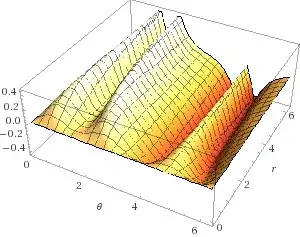
Graph of the aforementioned function

gebruiker
  • 6,272