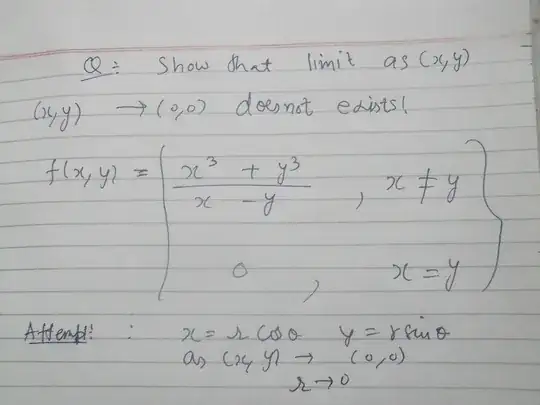
Show that the limit as $(x,y)\to (0,0)$ does not exist for the function $$ f(x,t)=\begin{cases}\frac{x^3+y^3}{x-y},\quad & x\ne y \\ 0,\quad & x=y\end{cases} $$
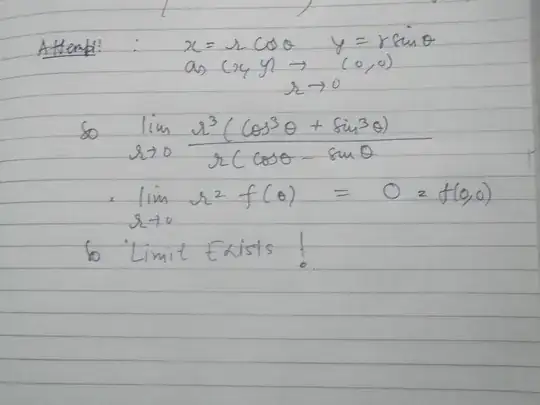
My solution is below, but it appears to be inconsistent with the problem. What is wrong?
Show that the limit as $(x,y)\to (0,0)$ does not exist for the function $$ f(x,t)=\begin{cases}\frac{x^3+y^3}{x-y},\quad & x\ne y \\ 0,\quad & x=y\end{cases} $$
My solution is below, but it appears to be inconsistent with the problem. What is wrong?

Your conversion to polar coordinates does not prove the limit exists, because in doing so, you are assuming that as $r \to 0^+$, that $\theta$ is a fixed constant with respect to the change in $r$, thus you are only considering a subset of all possible paths tending toward $(0,0)$--specifically, the subset of all straight-line paths to the origin.
See this post for a similar problem, and more information: Limit is found using polar coordinates but it is not supposed to exist.
So, the prove that the limit does not exist, it suffices to discover two distinct paths to $(0,0)$, each suitably parametrized, such that the limit along these paths are unequal to each other.

