4

Consider an ellipse centered at the origin with width $2a$ and height $2b$. Choose points $A$, $B$, $C$ independently and uniformly distributed on the perimeter of the ellipse, and create $\triangle ABC$. What is the expected area of $\triangle ABC$ given $a$ and $b$?

$\hspace{4.5cm}$
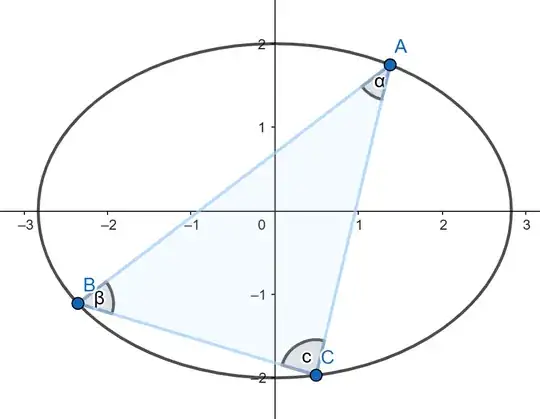
This problem is distantly related to another problem problem, asking about the probability that the triangle is acute. In this post, I am interested in the expected area. For the case of the unit circle, where $a=b = 1$, the expected area evalautes to $\frac{3}{2\pi} \approx 0.47746$. The article Circle Triangle Picking provides a detailed derivation of this result. My question is what if we generalize this for the case of an ellipse.

The part I am struggling with is the "distributed on the perimeter of the ellipse." With a circle, the randomly choosing a point on the perimeter is equivalent to randomly choosing an angle $\theta \in [0, 2\pi)$. The problem with the ellipse is that this method uniformly distributes the points on the perimeter of the ellipse uniformly with respect to $\theta$, not along the perimeter itself. This post deals with generating random points on the perimeter of an ellipse; however, I am unsure how to include this detail.


The naive attempt would be to assume uniformly distributed points on the perimeter are uniformly distributed with respect to the $\theta$ (central angle of ellipse). If the question were phrased "$\cdots $ independently and uniformly distributed with respect to the central angle" (e.g, $\theta_i$ is chosen uniformly in $[0, 2\pi)$, and the parametrization of points $A,B,C$ are $(a\cos\theta_i, b\sin\theta_i)$), the question could be solved via the integral

$$\mathbb{E}(\text{Area of } \triangle ABC) = \frac{1}{8\pi^3}\int_{0}^{2\pi} \int_{0}^{2\pi} \int_{0}^{2\pi} A(\theta_1, \theta_2, \theta_3) d\theta_1 d\theta_2 d\theta_3$$

Where $A(\theta_1, \theta_2, \theta_3)$ is the area function (from determinant formula) given the parametrized coordinates $A,B,C$.

\begin{align*} A(\theta_1, \theta_2, \theta_3) = &\frac12 |a\cos\theta_1(b\sin\theta_2-b\sin\theta_3)\\ &+a\cos\theta_2(b\sin\theta_3-b\sin\theta_1)\\ &+a\cos\theta_3(b\sin\theta_1-b\sin\theta_2)| \end{align*}

The integral correctly evaluates the expected area for the case of the circle. How can we adjust (or completely change) this solution to resolve the problem of the perimeter of the ellipse. Any input/form is greatly appreciated.

  • 3
    Uniformly in the sense of the length of the ellipse perimeter? Uniformly from the angle of the line from the center? There isn't an apparent definition of uniform here. You need a parametrization of the ellipse $\gamma$ defined on $[0,1].$ For example, the integral you have is the angle uniformity, which is far from the most obvious. – Thomas Andrews Jan 21 '25 at 23:42
  • Yes, uniform in the sense of the length of the ellipse's perimeter. – Maxime Jaccon Jan 21 '25 at 23:45
  • That isn't what your integral gives. – Thomas Andrews Jan 21 '25 at 23:46
  • 3
    But a parameterization that is uniform by length is very hard. You need a parameterization $\gamma(t)$ on $[0,1]$ needs $|\gamma'(t)|$ constant, equal to the perimeter of the ellipse. But even the perimeter of an ellipse is hard - there is no closed form for it, so it seems unlikely to get a good parameterization. So the naive $(x,y)=(a\cos2\pi t,b\sin2\pi t)$ might be the easiest way. – Thomas Andrews Jan 21 '25 at 23:53

1 Answers1

2

This is not a complete solution, but a hint to go further. You can assume $\theta_1\in[0,\pi/2]$, $\theta_2\in[\theta_1,\theta_1+2\pi]$ and $\theta_3\in[\theta_2,\theta_1+2\pi]$.

Now to recover a correct parametrization, just multiply your integrand by the velocity of your points: $$\mathbb E(\text{area})=\int_0^{\pi/2}\int_{\theta_1}^{\theta_1+2\pi}\int_{\theta_2}^{\theta_1+2\pi}\left(\prod_{i=1}^3\sqrt{a^2\sin^2(\theta_i)+b^2\cos^2(\theta_i)}\right)A(\theta_1,\theta_2,\theta_3)\mathrm d\theta_3\mathrm d\theta_2\mathrm d\theta_1$$ Since the triangle $\triangle ABCS$ is now oriented, you can get rid of absolute values and obtain a sum of 6 inner integrals of the form (with $j\neq k$): $$\int_{\theta_2}^{\theta_1+2\pi}\sqrt{a^2\sin^2(\theta_3)+b^2\cos^2(\theta_3)}\cos(\theta_j)\sin(\theta_k)\mathrm d\theta_3$$ If $j=3$ then it gives $$\begin{align*}&\sin(\theta_k)\int_{\sin(\theta_2)}^{\sin(\theta_1)}\sqrt{(a^2-b^2)u^2+b^2}\mathrm du = \sin(\theta_k)\int_{\sinh^{-1}(c\sin(\theta_2)/b)}^{\sinh^{-1}(c\sin(\theta_1)/b)} \frac{b^2}c\sqrt{\sinh(t)^2+1}\cosh(t)\mathrm dt\\ &= \sin(\theta_k)\frac{b^2}{4c}\left[\sinh(2t)+2t\right]_{\sinh^{-1}(c\sin(\theta_2)/b)}^{\sinh^{-1}(c\sin(\theta_1)/b)}\end{align*}$$ If $k=3$ then it gives $$\begin{align*}&-\cos(\theta_j)\int_{\cos(\theta_2)}^{\cos(\theta_1)}\sqrt{b^2-(a^2-b^2)u^2}\mathrm du = -\cos(\theta_j)\int_{\sin^{-1}(c\cos(\theta_2)/b)}^{\sin^{-1}(c\cos(\theta_1)/b)} \frac{b^2}c\sqrt{1-\sin(t)^2}\cos(t)\mathrm dt\\ &= \cos(\theta_j)\frac{b^2}{4c}\left[\sin(2t)+2t\right]_{\sin^{-1}(c\cos(\theta_2)/b)}^{\sin^{-1}(c\cos(\theta_1)/b)}\end{align*}$$ If $\{j,k\}=\{1,2\}$, there is no analytic form of the integral, but maybe you can swap integral signs to go further.