So, I (very randomly) happen to have been playing with this exact problem a few days ago. Here is my approach. Focusing first on the set of lines from the $y$-axis down to the $x$-axis, we have the following.
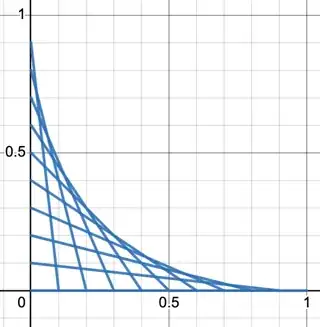
Each line that goes from $(t,0)$ to $(0,1-t)$ has the equation
$$ y = \frac{t-1}{t} x + 1-t = x - \frac{1}{t}x +1 - t$$
for $t\in [0,1]$. Then we want to know what line (i.e. which $t$), for a given $x$ has a maximum $y$ value. Thus, we need to optimize with respect to $t$.
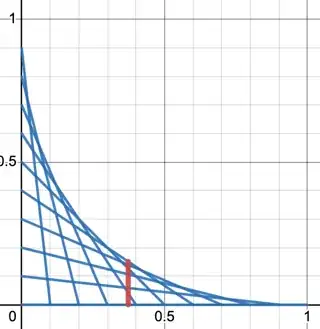
$$\frac{dy}{dt} = \frac{1}{t^2}x-1$$
Setting this equal to zero, to find critical points, we get $t = \sqrt{x}$, and this is a maximum! Thus,
$$ y = x - \frac{1}{\sqrt{x}}x +1 - \sqrt{x} = x-2\sqrt{x} +1$$
is the curve that is the maximized line at each $x$ value. (As is stated in other answers, this is equivalent to $\sqrt{x}+\sqrt{y}=1$)

Now that we have the curve, we just need to integrate properly. Noticing that the curves in your original image intersect at $x, y = \frac{1}{2}$. And symmetry tells us that the $x$ value where $y$ is $\frac{1}{2}$ is the same as the $y$ value where $x$ is $\frac{1}{2}$, which is $\left(1-\sqrt{\frac{1}{2}} \right)^2$.
So to find the area of the shaded region inside all four of the transformed versions of this curve, we can find the area of the purple region in the image below and multiply by four.
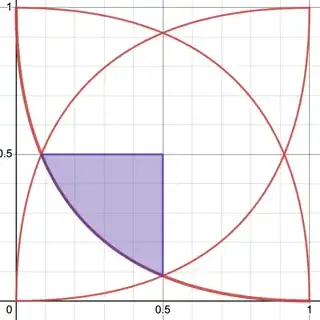
This will be done by solving (with wolfram alpha, since this is not the interesting part) $$\int_{\left(1-\sqrt{\frac{1}{2}} \right)^2}^\frac{1}{2} \frac{1}{2} - \left( x-2\sqrt{x} +1\right) dx = \frac{1}{6} (4 \sqrt{2}-5)$$
And so the total area is $\frac{2}{3} (4 \sqrt{2}-5)\approx 0.4379$. This is also what Intelligenti pauca got, when they used only geometry, beautifully.


