The curve "created" by the segments is called the envelope of the lines, and is defined as the curve which is tangent to all the lines. I'll show that this curve is a parabola, with focus $C=(5,5)$ and directrix with equation $x+y=0$. I won't use calculus, but a geometric argument.
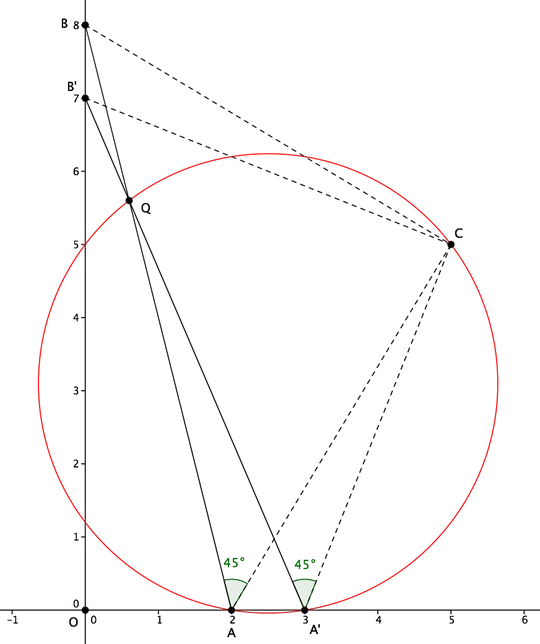
Consider then a line $AB$ with $A=(a,0)$ and $B=(0,10-a)$ and note that $CAB$ is a right isosceles triangle. Draw then a line $A'B'$ with $A'=(a',0)$ and $B'=(0,10-a')$, intersecting $AB$ at point $Q$.
$CA'B'$ is also a right isosceles triangle, implying that
$$
\angle QAC=\angle QA'C'=45°.
$$
As a consequence, points $AA'CQ$ lie on the same circle.
I want to find the position $P$ of point $Q$ in the limit $A'\to A$, because such $P$ is a point on the envelope. As $A'\to A$, circle $A'AC$ approaches the circle through $C$ which is tangent to the $x$-axis at $A$ (blue in figure below). Point $P$ is then the intersection between that circle and line $AB$.
The construction of the center $G$ of this circle and then of point $P$ is straightforward, also because $\angle CGP=2\angle CAP=90°$.
You can check that:
$$
G=\left(a,{(5-a)^2+25\over10}\right);
\quad
P=\left({a^2\over10},{(10-a)^2\over10}\right).
$$
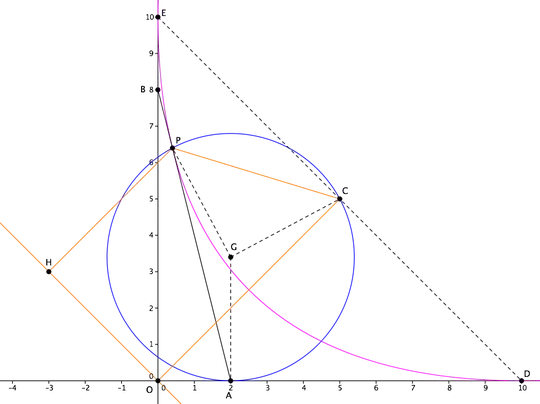
Finally, we can check that $PC=PH$, where $H$ is the projection of $P$ on the line $x+y=0$ (this check is left to the reader – note that $H$ is the reflection of $C$ about the midpoint of $AB$), thus proving that $P$ lies on the parabola with focus $C$ and directrix with equation $x+y=0$. The parabola touches the cartesian axes at $D=(10,0)$ and $E=(0,10)$, its axis is line $OC$ and its vertex is $V=(5/2,5/2)$.
The requested area can also be computed without calculus, using Archimedes' theorem, as the difference between triangle $ODE$ and the segment of parabola $VDE$:
$$
area={1\over2}10\cdot10-{4\over3}\cdot{1\over2}\cdot
10\sqrt2\cdot{5\over2}\sqrt2={50\over3}.
$$


