4

The following Laman graph braces a square without triangles. Stated another way, this is a unit-distance rigid graph without 3-cycles. It seems to be the smallest example of a triangle-free braced polygon. This happens to be a subgraph of the unit sticks cube graph.

braced square

What other regular polygons have triangle-free rigid constructions?

Ed Pegg
  • 21,868
  • 1
    Do you have a reference? Clearly, a lot of work has gone into these. – marty cohen Dec 22 '20 at 21:58
  • 1
    Ummm.... how do you know these brace a hexagon? Just drawing them doesn't show it. – David G. Stork Dec 22 '20 at 22:02
  • 1
    I get that the H-O-Fish graph is not infinitesimally rigid, but it might be finitely rigid. Also, the vertices I get from Mathematica 12.1.0 with GraphData[g,"VertexCoordinates"]] for O-Graph40 aren't unit distance. Is there a different embedding? – WRSomsky Dec 24 '20 at 19:58

2 Answers2

4

Any rigid framework, hence all regular polygons, can be converted to a triangle-free equivalent. Simply chaining copies of the $12$-vertex triangle-free braced square shown in the question (which I discovered) along the two collinear edges gives a rigid line segment of arbitrary whole number length without triangles:

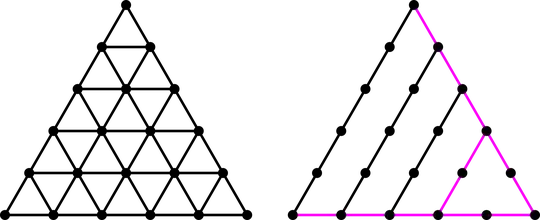
Then any triangular grid can be mimicked without triangles as follows (all straight fuchsia edges are made with the graph chaining construction above, all black edges are single sticks):
For example, to brace the hexagon without triangles:
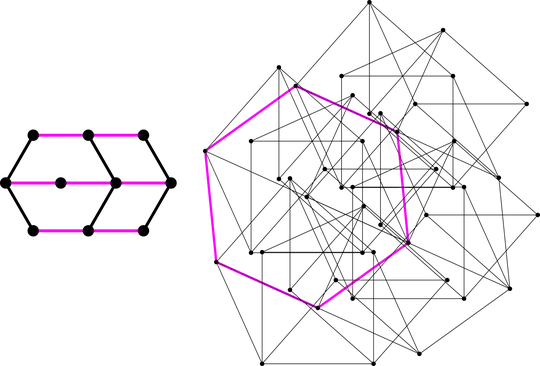

However, the above hexagon bracing is quite big. Another approach to triangle-free bracing is the virtual edge: in any embedding of the cubical graph with one edge removed, the distance between the two degree-$2$ vertices (incident to the missing edge) must always be $1$. This leads to the following triangle-free rigid regular hexagon in $16$ vertices and $29$ edges (Shibuya commit proof):

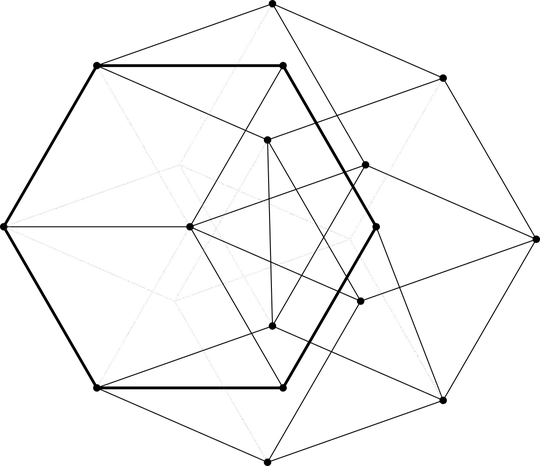
The two versions shown above are graph-theoretically isomorphic; their coordinates have the same minimal polynomials. In particular, using the parametrisation in Shibuya, the $x$-coordinate of vertex $7$ satisfies $$12x^2-6(\alpha+2)x+(\alpha^2+4\alpha+1)=0,\ \alpha=\sqrt[3]3$$ $$(864x^6-2592x^5+2808x^4-1296x^3+342x^2-207x+83=0)$$ (Thanks Hulpke for pointing me to the GAP function DecomPoly that allowed me to get the first polynomial.) The faint lines in the second version show that the rigid graph is related to the order-$4$ hypercube graph.

Parcly Taxel
  • 105,904
  • Brilliant. And it seems this is actually the first polygon braced without triangles. – Ed Pegg Dec 26 '20 at 18:40
  • "There are coincident vertices in the final graph, but no triangles." You can do it without coincident vertices. Take a normal hexagon bracing, braced on the outside, and scale it up to size 2. Then add the size 1 hexagon at the center. Similarly, scale up a square bracing to size 3. – Ed Pegg Dec 28 '20 at 13:33
  • 1
    @EdPegg I came up with that exact graph too. Did you cheat and look at my Shibuya repo? I am going to publish this. – Parcly Taxel Jan 04 '21 at 03:23
  • Came from you, William Somsky and Eric Weisstein, actually. https://mathworld.wolfram.com/BracedPolygon.html Came from you via the graph I posted to your cube sticks question, and I took another look. – Ed Pegg Jan 04 '21 at 04:06
  • Looks like you found the 12 vertex square bracing 10 hours before I found it independently based on a William Somsky 13 vertex graph and program, when I asked him to look at cube-sticks graph. – Ed Pegg Jan 04 '21 at 14:51
  • @EdPegg The commit into Shibuya that introduced the $12$-vertex braced square is here (3 January 22:13 UTC+8). I was trying to find the smallest rigid triangle-free unit-distance graph, not necessarily containing a square. Is the braced square optimal in that sense or is there something smaller? There are no such graphs on $9$ or fewer vertices. – Parcly Taxel Jan 04 '21 at 15:06
  • Smallest rigid triangle-free unit-distance graph? Good question. Answer; it will come from an algebraic space with a relatively small discriminant. I don't know which discriminant, though. The 3D question is also interesting. – Ed Pegg Jan 04 '21 at 16:04
  • I believe you can drop one edge of your hexagon graph (the one not part of the two reduced-cube graphs) and you end up with a flexible over-all triangle-free graph that still braces the hexagon rigidly! – WRSomsky Jan 04 '21 at 20:33
  • According to Somsky, " if you drop the 4-13 edge from the hexagon graph, you get a curious entity. I believe the resulting graph is not rigid itself as a whole, but the hexagon will be rigid!" – Ed Pegg Jan 04 '21 at 20:55
  • 1
    @EdPegg This is to be expected. You can drop the 8-9 edge too and the hexagon is still rigid. – Parcly Taxel Jan 05 '21 at 03:59
  • @ParclyTaxel Side query from a brony: As the Princess of Science per your profile, do you prefer your Nom-de-Net, ParclyTaxel, to be referred to as "he" or "she"? – WRSomsky Jan 05 '21 at 20:06
  • @WRSomsky I am a male in real life and should be referred to as "he". The Princess of Science moniker refers to my MLPFIM OC, also called Parcly Taxel, who is a she. – Parcly Taxel Jan 05 '21 at 21:25
  • @ParclyTaxel Good enough. I know some folks who use alternate pronouns for their on-line personas, so just wanted to check. "He", it is. – WRSomsky Jan 05 '21 at 21:35
1

As an addendum to Parcly Taxel's answer, his hexagon bracings are a subset of a whole 2DOF family of hexagonal bracings. Here are two especially symmetric members of this family. (The dotted lines indicate unit-separations that are not included as edges.)

enter image description here enter image description here

WRSomsky
  • 686
  • 4
  • 9