21

Let $a,b,c$ are non-negative numbers, such that $a+b+c = 3$.

Prove that $\sqrt{a} + \sqrt{b} + \sqrt{c} \ge ab + bc + ca$


Here's my idea:

$\sqrt{a} + \sqrt{b} + \sqrt{c} \ge ab + bc + ca$

$2(\sqrt{a} + \sqrt{b} + \sqrt{c}) \ge 2(ab + bc + ca)$

$2(\sqrt{a} + \sqrt{b} + \sqrt{c}) - 2(ab + bc + ca) \ge 0$

$2(\sqrt{a} + \sqrt{b} + \sqrt{c}) - ((a+b+c)^2 - (a^2 + b^2 + c^2) \ge 0$

$2(\sqrt{a} + \sqrt{b} + \sqrt{c}) + (a^2 + b^2 + c^2) - (a+b+c)^2 \ge 0$

$2(\sqrt{a} + \sqrt{b} + \sqrt{c}) + (a^2 + b^2 + c^2) \ge (a+b+c)^2$

$2(\sqrt{a} + \sqrt{b} + \sqrt{c}) + (a^2 + b^2 + c^2) \ge 3^2 = 9$

And I'm stuck here.

I need to prove that:

$2(\sqrt{a} + \sqrt{b} + \sqrt{c}) + (a^2 + b^2 + c^2) \ge (a+b+c)^2$ or

$2(\sqrt{a} + \sqrt{b} + \sqrt{c}) + (a^2 + b^2 + c^2) \ge 3(a+b+c)$, because $a+b+c = 3$

In the first case using Cauchy-Schwarz Inequality I prove that:

$(a^2 + b^2 + c^2)(1+1+1) \ge (a+b+c)^2$

$3(a^2 + b^2 + c^2) \ge (a+b+c)^2$

Now I need to prove that:

$2(\sqrt{a} + \sqrt{b} + \sqrt{c}) + (a^2 + b^2 + c^2) \ge 3(a^2 + b^2 + c^2)$

$2(\sqrt{a} + \sqrt{b} + \sqrt{c}) \ge 2(a^2 + b^2 + c^2)$

$\sqrt{a} + \sqrt{b} + \sqrt{c} \ge a^2 + b^2 + c^2$

I need I don't know how to continue.

In the second case I tried proving:

$2(\sqrt{a} + \sqrt{b} + \sqrt{c}) \ge 2(a+b+c)$ and

$a^2 + b^2 + c^2 \ge a+b+c$

Using Cauchy-Schwarz Inequality I proved:

$(a^2 + b^2 + c^2)(1+1+1) \ge (a+b+c)^2$

$(a^2 + b^2 + c^2)(a+b+c) \ge (a+b+c)^2$

$a^2 + b^2 + c^2 \ge a+b+c$

But I can't find a way to prove that $2(\sqrt{a} + \sqrt{b} + \sqrt{c}) \ge 2(a+b+c)$

So please help me with this problem.

P.S

My initial idea, which is proving:

$2(\sqrt{a} + \sqrt{b} + \sqrt{c}) + (a^2 + b^2 + c^2) \ge 3^2 = 9$

maybe isn't the right way to prove this inequality.

Eric Wofsey
  • 342,377
Stefan4024
  • 36,357
  • You could try doing something with infinitesimal calculus to show that the minimum of $2(\sqrt{a} + \sqrt{b} + \sqrt{c}) + (a^2 + b^2 + c^2)$ occurs only when there is some other specific relationship between $a$, $b$, and $c$. – AJMansfield Mar 20 '13 at 23:19

4 Answers4

16

I will use the following lemma (the proof below):

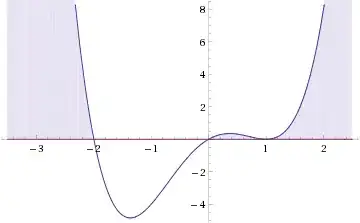
$$2x \geq x^2(3-x^2)\ \ \ \ \text{ for any }\ x \geq 0. \tag{$\clubsuit$}$$

Start by multiplying our inequality by two

$$2\sqrt{a} +2\sqrt{b} + 2\sqrt{c} \geq 2ab +2bc +2ca, \tag{$\spadesuit$}$$

and observe that

$$2ab + 2bc + 2ca = a(b+c) + b(c+a) + c(b+c) = a(3-a) + b(3-b) + c(3-c)$$

and thus $(\spadesuit)$ is equivalent to

$$2\sqrt{a} +2\sqrt{b} + 2\sqrt{c} \geq a(3-a) + b(3-b) + c(3-c)$$

which can be obtained by summing up three applications of $(\clubsuit)$ for $x$ equal to $\sqrt{a}$, $\sqrt{b}$ and $\sqrt{c}$ respectively:

\begin{align} 2\sqrt{a} &\geq a(3-a), \\ 2\sqrt{b} &\geq b(3-b), \\ 2\sqrt{c} &\geq c(3-c). \\ \end{align}

$$\tag*{$\square$}$$


The lemma

$$2x \geq x^2(3-x^2) \tag{$\clubsuit$}$$

is true for any $x \geq 0$ (and also any $x \leq -2$) because

$$2x - x^2(3-x^2) = (x-1)^2x(x+2)$$

is a polynomial with roots at $0$ and $-2$, a double root at $1$ and a positive coefficient at the largest degree, $x^4$.

$\hspace{60pt}$poly

I hope this helps ;-)

dtldarek
  • 37,969
  • How do you rearrange? Explain that step, because $$(\sqrt{a} + \sqrt{a})^2 + (2\sqrt{b})^2 + 4c = 4(a+b+c)$$

    How do we know that $$a^2 + b^2 + c^2 + 2\sqrt{a} + 2\sqrt{b} + 2\sqrt{c} + 3 \geq (\sqrt{a} + \sqrt{a})^2 + (2\sqrt{b})^2 + 4c$$ ?

    – Stefan4024 Mar 21 '13 at 00:04
  • @Stefan4024 That step was wrong, check out the new proof. – dtldarek Mar 21 '13 at 08:02
  • 1
    Good work!!! Thanks you a lot. It was so good explained that even a kid from first grade will get it. :D – Stefan4024 Mar 21 '13 at 10:24
8

From the given inequality $\sqrt{a} + \sqrt{b} + \sqrt{c} \ge ab + bc + ca$ observe that $$2(ab+bc+ac)=(a+b+c)^2-a^2-b^2-c^2$$ We can rewrite the original inequality as
$$a^2+2\sqrt{a}+ b^2+2\sqrt{b}+ c^2+2\sqrt{c}\ge9$$ since $(a+b+c)=3$. Using AM-GM set the LHS up as follows: $$a^2+\sqrt{a}+\sqrt{a}\ge3\sqrt[3]{a^2 \sqrt{a}\sqrt{a}}=3a$$ $$b^2+\sqrt{b}+\sqrt{b}\ge3\sqrt[3]{b^2 \sqrt{b}\sqrt{b}}=3b$$ $$c^2+\sqrt{c}+\sqrt{c}\ge3\sqrt[3]{c^2 \sqrt{c}\sqrt{c}}=3c$$ Adding the three inequalities yields $$a^2+b^2+c^2+2(\sqrt{a}+\sqrt{b}+\sqrt{c}) \ge 3(a+b+c) =9 $$ with equality if an only if $a$=$b$=$c$=$1$.

3

Since $ab+ac+bc=\frac{(a+b+c)^2-a^2-b^2-c^2}{2}=\frac{9-a^2-b^2-c^2}{2}$, we need to prove that $$\sum_{cyc}\left(\sqrt{a}+\frac{a^2}{2}-\frac{3}{2}\right)\geq0$$ or $$\sum_{cyc}(a^2+2\sqrt{a}-3)\geq0$$ or $$\sum_{cyc}(\sqrt{a}-1)(a\sqrt{a}+a+\sqrt{a}+3)\geq0$$ or

$$\sum_{cyc}\left((\sqrt{a}-1)(a\sqrt{a}+a+\sqrt{a}+3)-3(a-1)\right)\geq0$$ or $$\sum_{cyc}(\sqrt{a}-1)^2\sqrt{a}(\sqrt{a}+2)\geq0.$$ Done!

1

Hint:

What lower bound does AM-GM give you when you consider $a^2 + \sqrt{a} + \sqrt{a}$?

Your hope that $\sum \sqrt{a} \ge \sum a = 3$ is false, by using Cauchy Schwarz: $9 = 3(\sum a) \ge (\sum \sqrt{a})^2$. In fact, when $a+b+c = 3$, we have $$\sum a^2 \ge \sum a = 3 \ge \sum \sqrt{a}$$ all by Cauchy-Schwarz, so your hope to split the inequality up is thwarted. This also signals us that we should try to "mix" $a^2$ and $\sqrt{a}$ together in some way, hence the hint.