Oh, this looks like fun! Allow me to run with orlandpm's notation scheme by proposing a corresponding (natural language) naming scheme.
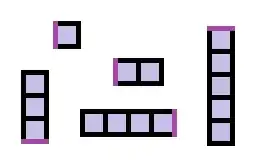
The simplest polyominoes $_1A,_2A,_3A,_4A,_5A,_6A,_7A,_8A,_9A,_{10}A,_{11}A,_{12}A,_{13}A,\dots$ we call henpo, dipo, tripo, tetrapo, pentapo, hexapo, heptapo, octapo, enneapo, decapo, hendecapo, dodecapo, triskaidecapo, and so on. Here we combine a Greek numeral prefix with "po", taken from the Greek "potami" meaning river (and nicely dovetailing with the word "polyomino").
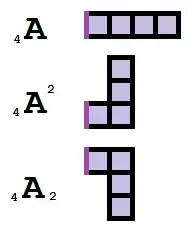
For polyominoes which are straight but for a single bend, such as $_4A^2$ and $_4A_2$, we append a numeral prefix and either "ar" (for a left turn) or "dex" for a right turn. The three tetrominoes below would be named tetrapo, tetrapodiar, and tetrapodidex. (Collapse two consecutive "a"s to one, so that $_8A_4$ would be octapotetrar rather than "octapotetraar".)
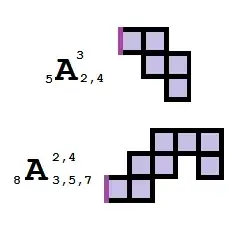
If there are multiple bends, we keep appending. The first polyomino below can be called "pentapodidextriartetradex". I propose that if a turn occurs directly after a previous turn, then the numeral prefix can be omitted. Thus the first polyomino below would preferably be called pentapodidexardex. Similarly, the second polyomino is called octapodiardexardexheptadex.
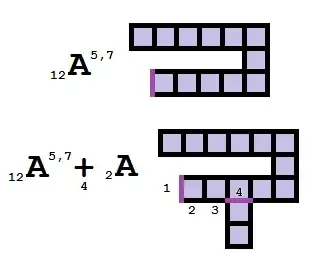
If the polyomino has branches, we concatenate the names of the subpolyominos, with two additional changes. First indicate what base polyomino we are attaching subsidiary polyominoes to by changing the base's "po" to its long-form "pota". Second, we indicate the location of the attachment with a numeral prefix and "sy" (from "synapto", attach). The first polyomino below is dodecapopentarheptar, while the second one is dodecapotapentarheptartetrasydipo.
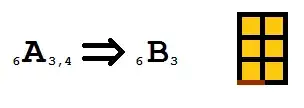
For blocks $_{mn}B_m$, we use the area's numeral prefix followed by "lim" (from "limni", lake), then the height's numeral prefix followed by "ups" ("upsos", height). (Some might have preferred "yps". We replace "au" by "u".) For example, a $4\times3$ block would be dodecalimtetrups, while a $6\times2$ block would be dodecalimhexups. For numbers with only one nontrivial factorization (that is, products of two primes or squares or cubes of primes), the height and "ups" should be omitted: the $_6B_3$ below is called hexalim rather than "hexalimtriups". (Its river-form name $_6A_{3,4}$ would have been "hexapotridexdex".) If a block is the base polyomino for attachments, we change "lim" to the long-form "limni".
The first two polyominoes below are hexalimnitetrasytetrapo and hexalimnitetrasytetrapohexasytripodiar. I think the third one should be ${}_6B_3 ( {}\mathop{+}_4 {}_4A\ ( {}\mathop{+}_9 {}_1A \ ) )$ rather than ${}_6B_3 ( {}\mathop{+}_4 {}_4A\ ( {}\mathop{+}_2 {}_1A \ ) )$; hence its name would be "hexalimnitetrasytetrapotaenneasyhenpo". If a single block is the polyomino being attached, the "henpo" should be omitted, so that the third polyomino below is simply hexalimnitetrasytetrapotaenneasy.

Note a difference between the second and third names: in the second name, we had the long form "limni" but the short form "po", indicating that both subsidiary polyominoes are attached to the first one. In the third name, we had the long form "limni" and the long form "pota", indicating that the last polyomino is attached to the middle one rather than the initial one. In general, each new polyomino is attached to the most recent one with a long form; this rule indicates the default parenthesization.
It is sometimes necessary to parenthesize explicitly, even with the above rule. For example, we cannot yet distinguish the names of ${}_4B_2 ( {}\mathop{+}_1 {}_5A\ ( {}\mathop{+}_3 {}_1A\ {}\mathop{+}_5 {}_1A\ ))$ and ${}_4B_2 ( {}\mathop{+}_1 {}_5A\ ( {}\mathop{+}_3 {}_1A\ ) {}\mathop{+}_5 {}_1A\ )$. The former is called tetralimnihensypentapotatrisypentasy, since by default the final block (the omitted "henpo" in "pentasyhenpo") is attached to the most recent long-form "pentapota". To override this default parenthesization, we can surround an inner expression with "ex" and "ter". So the latter polyomino, ${}_4B_2 ( {}\mathop{+}_1 {}_5A\ ( {}\mathop{+}_3 {}_1A\ ) {}\mathop{+}_5 {}_1A\ )$, is called tetralimnihensyexpentapotatrisyterpentasy, to indicate that the "pentapotatrisy" and the omitted "henpo" are being hensy-attached and pentasy-attached to the base "tetralimni".
For rings defined by the polyominos they surround, we can use the suffix "ni" (from "nisi", island). The polyomino below is called tripodidexni. If other polyominos are attached to an island one, the long form "nisi" is used in place of "ni".

Here are the names of all the pentominoes, listed by row in the order drawn below.
- pentapodidex, pentapodiar, pentapodidexar
- I think the notations of the first two pentominoes have been switched with each other. By the pictures, the names are tetrapotadiarpentasy and tetrapotadidexheptasy, followed by pentapodiardex.
- The first notation is wrong: it should be ${}_4A_2 ( {}\mathop{+}_8 {}_1A\ )$ and named tetrapotadidexoctasy. Following are pentapodidexardex and tripotatrisyheptasy.
- pentapotridex, pentapodidextetradex, tetralimnidisy
- pentapodidextetrar, pentapodiartetradex, tetralimnihensy
- The first one is tetrapotatrisy. The second one should be ${}_4A ( {}\mathop{+}_4 {}_1A\ )$, hence named tetrapotatetrasy. The last one is plain old pentapo.

Other shortcuts could be proposed, such as contracting "ardex" to "ax" and "dexar" to "der". I think I'll stop here though.


