2

I need to calculate the shape area bounded with $x^2+y^2=a^2$ and $x^2+z^2=a^2$. Given that I have a 3-D shape, I assumed that area would be calculated using a triple integral, but done that way, I get the volume of the shape.

So, my question is: how do I get the area of the shape using integrals?

I tried observing it in 2-D, but it does not have the same shape as in the space. It's more of a projected shape that does not give me anything useful. Also, I tried using spherical coordinates, but then again it is used for calculating the volume.

Surb
  • 57,262
  • 11
  • 68
  • 119

4 Answers4

2

Given $r > 0$, the solid:

$$ \Omega := \left\{(x,\,y,\,z) \in \mathbb{R}^3 : x^2 + y^2 \le r^2, \, x^2 + z^2 \le r^2\right\} $$

is the intersection between two circular cylinders of radius $r$ and with perpendicular axes:
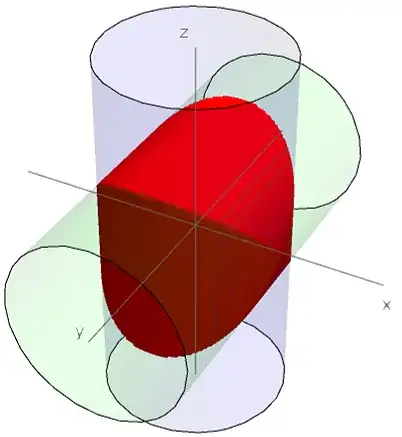
enter image description here

In particular, noting the three symmetries enjoyed by solid $\Omega$:

$$ (x,\,y,\,z) = \mathcal{S}(-x,\,y,\,z)\,, \quad \quad (x,\,y,\,z) = \mathcal{S}(x,\,-y,\,z)\,, \quad \quad (x,\,y,\,z) = \mathcal{S}(x,\,y,\,-z) $$

the measure of this solid is equal to:

$$ ||\Omega|| := \iiint\limits_{\Omega} 1\,\text{d}x\,\text{d}y\,\text{d}z = 2^3\iiint\limits_{\Omega^*} 1\,\text{d}x\,\text{d}y\,\text{d}z $$

where:

$$ \Omega^* := \left\{(x,\,y,\,z) \in \mathbb{R}^3 : x^2 + y^2 \le r^2, \, x^2 + z^2 \le r^2, \, x \ge 0, \, y \ge 0, \, z \ge 0\right\}. $$

This done, through a coordinate transformation of the type:

$$ \small (x,\,y,\,z) = (u\,r\,\cos v,\,u\,r\,\sin v,\,w) \quad \text{with} \; (u,\,v,\,w) \in \left[0,\,1\right] \times \left[0,\,\frac{\pi}{2}\right] \times \left[0,\,r\sqrt{1 - u^2\cos^2 v}\right] $$

we have:

$$ ||\Omega|| = 8\int_0^{\frac{\pi}{2}}\,\text{d}v \int_0^1 r^2\,u\,\text{d}u \int_0^{r\sqrt{1-u^2\cos^2 v}} \text{d}w = \frac{16}{3}\,r^3\,. $$


As for the boundary of solid $\Omega$, we have:

$$ \partial\Omega := \Sigma_1 \cup \Sigma_2 $$

where:

$$ \begin{aligned} & \Sigma_1 := \left\{(x,\,y,\,z) \in \mathbb{R}^3 : x^2 + y^2 = r^2, \, x^2 + z^2 \le r^2\right\}; \\ \\ & \Sigma_2 := \left\{(x,\,y,\,z) \in \mathbb{R}^3 : x^2 + z^2 = r^2, \, x^2 + y^2 \le r^2\right\}; \\ \end{aligned} $$

which for the above symmetries implies:

$$ ||\partial\Omega|| := \iint\limits_{\partial\Omega} 1\,\text{d}\Omega = 2\iint\limits_{\partial\Sigma_1} 1\,\text{d}\Sigma = 2 \cdot 2^3 \iint\limits_{\partial\Sigma_1^*} 1\,\text{d}\Sigma $$

where:

$$ \Sigma_1^* := \left\{(x,\,y,\,z) \in \mathbb{R}^3 : x^2 + y^2 = r^2, \, x^2 + z^2 \le r^2, \, x \ge 0, \, y \ge 0, \, z \ge 0\right\}. $$

This done, through a coordinate transformation of the type:

$$ (x,\,y,\,z) = (r\,\cos v,\,r\,\sin v,\,u) \quad \text{with} \; (u,\,v) \in \left[0,\,r\,\sin v\right] \times \left[0,\,\frac{\pi}{2}\right] $$

we have:

$$ ||\partial\Omega|| = 16 \int_0^{\frac{\pi}{2}} \text{d}v \int_0^{r\sin v} r\,\text{d}u = 16\,r^2\,. $$


All this verifies what has been reported about the Steinmetz solid, as noted in the comments.

1

The answer can be a lot more straightforward. How would you find the surface area of a cylinder $x^2+y^2=a^2$ of radius $a$ between bounds of $z$ that are constant values $z_1, z_2$? As you already know, it is $2 \pi a |z_2 - z_1|$ and it comes from integral $\displaystyle \int_0^{2\pi} \int_{z_1}^{z_2} a \ dz \ d\theta$. We evaluate the same integral here but $z$ is now a function of $\theta$. So coming back to the problem at hand, let's first consider the surface area of cylinder $x^2+y^2 = a^2$ bound by the cylinder $x^2+z^2 = a^2$.

We parametrize the surface of the cylinder $x^2+y^2 = a^2$ as $r(\theta, z) = (a \cos\theta, a \sin\theta, z)$. Bound of $z$ from $x^2+z^2 = a^2$ is given by $ - a |\sin\theta| \leq z \leq a |\sin\theta|$

So integral to find surface area is

$S_1 = \displaystyle \int_0^{2\pi} \int_{-a |\sin\theta|}^{a |\sin\theta|} a \ dz \ d\theta = 8a^2$

Due to symmetry surface area of cylinder $x^2 + z^2 = a^2$ bound by cylinder $x^2+y^2 = a^2$ is the same.

That results in a final answer of $S = S_1 + S_2 = 16a^2$.

Math Lover
  • 52,200
  • I had shared a link on surface integral earlier. That helps you understand how to find surface area in general, not sure if you are already familiar with it. But in case of a cylinder (the case here), it is lot more straightforward. In this problem, the only difference is that the height of the cylinder is not constant and changes based on $\theta$. Also you have surface area of two cylinders to evaluate and sum them for total surface area. – Math Lover Apr 21 '21 at 18:51
0

When you say Area is it safe to assume you mean surface area?

The shape in question is the intersection between two cylinders, one centred around the $z$ axis with radius $a$ and the other centred around the $y$ axis with radius $a$. Since the radii are equal I think this simplifies it somewhat. I just plotted it in GeoGebra to see what it looks like.

What you get is: $$|z|\le\sqrt{a^2-x^2}$$ $$|y|\le \sqrt{a^2-x^2}$$ $$|x|\le a$$

Henry Lee
  • 12,554
  • Yes, surface area is what I meant, sorry for my lousy English. This still does not answer my question though, I used GeoGebra as well but still I don't know how to calculate the surface area and which formula should be used for its calculation? – AnastasijaB Apr 21 '21 at 16:10
  • since it is symmetric try looking at one quadrant then multiplying – Henry Lee Apr 21 '21 at 16:36
0

Consider development of the elliptic area as under a sine curve

Area of sine curve $ y= \sin x (x,0, \pi/2) $ is unity

From symmetry, there are eight such areas.

Area under sine curve/ Bounding rectangle area fraction being $2/\pi,$

$$ 8 \cdot \pi r . r\cdot \frac {2}{\pi} = 16 r^2.$$

Narasimham
  • 42,260