0

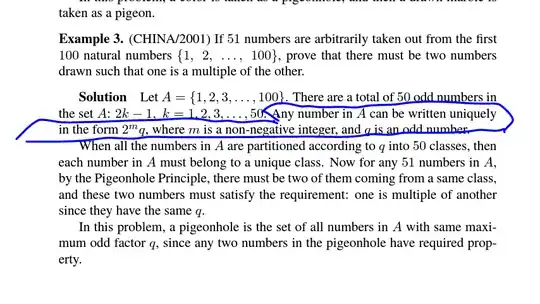
I saw this in a textbook I'm using to Self-study the Pigeon-hole principle and I'm quite sceptical about the claim in the bosses part of the text. The author claims the first 50 odd numbers can be uniquely expressed in the form $2^mq$, at first I taught it was a typo(as in, it should be of the form $2mq$ instead) but even it that were the case, it certainly wouldn't work for primes. So I need someone to help clear this up to me.

enter image description here

4 Answers4

3

Yes, it is true that every natural number $n$ can be written in one and only one way as $2^mq$ where $q$ is an odd number. Let $2^m$ be the greatest divisor of $n$ which is a power of $2$ (note that $1$ is a power of $2$, since $1=2^0$). Now let $q=\frac n{2^m}$. It is clear that $q$ is odd; otherwise, $2^m$ wouldn't be the greatest power of $2$ that divides $n$. Finally, it is clear that $m$ is unique, since it was the defined as the greatest exponent of $2$ for which $2^m\mid n$.

2

This is true, and it's a really helpful thing to remember about the integers.

One way to see it is to think of it first with $10$ instead of $2$. If you write the regular base-ten representation of an integer, it ends in no, one, two, three, or some other number of zeroes. For example, $342$ ends in no zeroes, but $102800$ ends in two zeros. Now $342 = 342\times10^0$, and $102800=1028\times10^2$. So every integer is (uniquely, because there is only one way to write the integer in base ten) the product of a power of $10$ (the number of zeroes it ends in) and a number not divisible by $10$ (the number made by the digits before the zeroes the number ends in).

Now write an integer $n$ in base two. Clearly there is only one way to do that, and the base two representation ends in some number of zeros... The number you get by removing all the trailing zeroes is odd.

Does that explain it for you?
Steve Kass
  • 15,314
1

m is non-negative, so in case of odd integers, m = 0 serves the purpose.

1

Just consider the prime factorization of $A$ and you are done.