Questions tagged [epsilon-delta]

For questions regarding $\varepsilon$-$\delta$ definitions of limits, continuity of functions and $\varepsilon-N$ definition of limit of sequences.

The $\varepsilon$-$\delta$ definition of limit of a function is usually first introduced as follows:

Suppose $f(x)$ is a function from $D$ to $\mathbb R$, where $D$ is a subset of $\mathbb R$. If $\forall \varepsilon>0 ~ \exists \delta>0$, such that $0<\vert x-c\vert <\delta\implies \vert f(x)-L\vert<\varepsilon$ for all $x\in D$, then the limit of $f(x)$ at $x=c$ is $L$. Notation: $\lim\limits_{x\to c}f(x)=L$.

Geometrically, this means that if we stay on the graph of $f$, the value of $f(x)$ will be within a distance of $\varepsilon$ from $L$, as long as the distance between $x$ and $c$ is smaller than $\delta$. (See picture.)
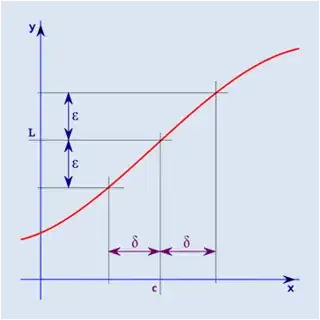
Picture

By changing the condition $0<\vert x-c\vert<\delta$ to $0< x-c<\delta$ we get the definition for the right hand limit, notation: $\lim\limits_{x\downarrow c}$, or $\lim\limits_{x\to c^+}$. Similarly, the definition for the left hand limit (notation: $\lim\limits_{x\uparrow c}$ or $\lim\limits_{x\to c^-}$) can be acquired by changing to $0< c-x<\delta$.

In the definition we explicitly stay away from the case $x=c$. This is because we don't require that $f(c)$ be defined.

This definition can very naturally be generalized to the case where $f:(X,d_X)\to (Y,d_Y)$ is a function between metric spaces. Here we have this:

Suppose that $f: D\to Y$, where $D$ is a subset of $X$ and that $c$ is a limit point of $D$. Now we say that $\lim\limits_{x\to c}f(x)=y$ when $\forall \varepsilon>0~\exists \delta>0$, such that $0<d_X(x,c)<\delta\implies d_Y\big(f(x),y\big)<\varepsilon$, for every $x\in D$.

The notion of the $\varepsilon$-$\delta$ definition of a limit or of continuity does not extend to general topological spaces.

The definition of limit of a sequence on a metric space is:

Suppose that $(x_n)_{n\in\Bbb N}$ is a sequence of elements of a metric space $(X,d)$ and that $l\in X$. Then $l$ is the limit of the sequence if $$(\forall\varepsilon>0)(\exists N\in\Bbb N)(\forall n\in\Bbb N):n\geqslant N\implies d(x_n,l)<\varepsilon.$$

3006 questions
59
votes
5 answers

$\epsilon$-$\delta$ proof that $\lim\limits_{x \to 1} \frac{1}{x} = 1$.

I'm starting Spivak's Calculus and finally decided to learn how to write epsilon-delta proofs. I have been working on chapter 5, number 3(ii). The problem, in essence, asks to prove that $$\lim\limits_{x \to 1} \frac{1}{x} = 1.$$ Here's how I…
50
votes
2 answers

How to prove a limit exists using the $\epsilon$-$\delta$ definition of a limit

I understand how to find a limit. I understand the concept of the $\epsilon$-$\delta$ definition of a limit. Can you walk me through what we're doing in this worked example? It is from my student solutions manual to my textbook. I need help…
FreeTrader
  • 1,036
45
votes
2 answers

What is the use of hyperreal numbers?

For sometime I have been trying to come to terms with the concept of hyperreal numbers. It appears that they were invented as an alternative to the $\epsilon-\delta$ definitions to put the processes of calculus on a sound footing. From what I have…
35
votes
5 answers

What's wrong with this "backwards" definition of limit?

Can anyone please give an example of why the following definition of $\displaystyle{\lim_{x \to a} f(x) =L}$ is NOT correct?: $\forall$ $\delta >0$ $\exists$ $\epsilon>0$ such that if $0<|x-a|<\delta$ then $|f(x)-L|<\epsilon$ I've been trying to…
Sebastian
  • 353
32
votes
7 answers

The epsilon-delta definition of continuity

As we know the epsilon-delta definition of continuity is: For given $$\varepsilon > 0\ \exists \delta > 0\ \text{s.t. } 0 < |x - x_0| < \delta \implies |f(x) - f(x_0)| < \varepsilon $$ My question: Why wouldn't this work if the implication would…
TestGuest
  • 1,061
31
votes
11 answers

Should a high school introductory calculus class teach $\varepsilon$-$\delta$ proofs?

It seems to me that most high school students are comfortable with the intuitive notion of a limit ("as $x$ gets arbitrarily close to $c$, $f(x)$ gets arbitrarily close to $L$") and gain little insight from learning the $\varepsilon$-$\delta$…
David Zhang
  • 9,125
  • 2
  • 43
  • 64
25
votes
1 answer

Is there a book only about epsilon delta proofs?

I want to know if there is such book, with beautiful epsilon delta proofs of all kind.
24
votes
4 answers

Is some thing wrong with the epsilon-delta definition of limit??

In the epsilon-delta definition of limit which is: For all $\epsilon>0$ there exists a $\delta>0$ such that, whenever $|x-a|<\delta$ then $|f(x)-L|<\epsilon$ . Now since $\epsilon$ is given and it should be proven that there is some $\delta$ for…
Jack
  • 285
20
votes
4 answers

How is the epsilon-delta definition of continuity equivalent to the following statement?

Claim: A function $f: \mathbb{X} \to \mathbb{Y}$ is continuous if given any open set $\mathbb{U} \subseteq \mathbb{Y}$ the inverse image $f^{-1} (\mathbb{U}) \subseteq \mathbb{X}$ is open. How is this definition intuitively compatible with the…
19
votes
4 answers

If $f,g$ are uniformly continuous prove $f+g$ is uniformly continuous but $fg$ and $\dfrac{f}{g}$ are not

Suppose $f:\mathbb{R} \supset E \rightarrow \mathbb{R}$ and $g: \mathbb{R} \supset E \rightarrow \mathbb{R}$ are uniformly continuous. Show that $f+g$ is uniformly continuous. What about $fg$ and $\dfrac{f}{g}$? My Attempt Firstly let's state the…
19
votes
14 answers

Does the epsilon-delta definition of limits truly capture our intuitive understanding of limits?

I've been delving into the concept of limits and the Epsilon-Delta definition. The most basic definition, as I understand it, states that for every real number $\epsilon \gt 0$, there exists a real number $\delta \gt 0$ such that if $0 \lt |x - a|…
16
votes
1 answer

Proving $ \lim\limits_{n\to\infty} \frac{8n^2-5}{4n^2+7} = 2$ using $\epsilon-\delta-$ definition.

I'm trying to prove the limit of this sequence using the formal definition. I've looked at other questions on the site but from the ones I've seen, the $n^2$ term always seems to cancel out, making it simpler. Show that $$ \lim_{n\to\infty}…
16
votes
8 answers

$\epsilon$ - $\delta$ definition of a limit - smaller $\epsilon$ implies smaller $\delta$?

The definition in my book is as follows: Let $f$ be a function defined on an open interval containing $c$ (except possibly at $c$) and let $L$ be a real number. The statement $$\lim_{x \to c} f(x) = L$$ means that for each $\epsilon>0$ there exists…
Ovi
  • 24,817
15
votes
4 answers

Choice of $\delta$ for "brute force" proof of continuity of exponential function $e^x$

I have read several answers (example 1, example 2) about continuity of $e^x$, but most rely on Power Series definition of $e^x$, or sequential definition of a limit, or squeeze theorem. I would like a brute-force proof that meets the following…
EthanAlvaree
  • 3,518
  • 3
  • 31
  • 65
14
votes
2 answers

Prove that $\lim\limits_{x\rightarrow 4} \sqrt{2x+7} = \sqrt{15}$.

Prove that $\displaystyle \lim_{x\rightarrow 4} \sqrt{2x+7} = \sqrt{15}$ using the epsilon-delta definition. This is what I have, but I know my delta value is incorrect. My professor said that it was the right path but my delta is incorrect. Proof:…
1
2 3
99 100