2

If I try to graph this function, it does not appear to reflect across the y-axis when it comes time to do the reflection. Rather, it is reflected around the point where the function begins on the graph.

Here is what I tried: $$\sqrt{2-x}=\sqrt{-(x-2)}$$ This makes it easier to graph the transformations:

Root function ($f(x)=\sqrt{x}$):
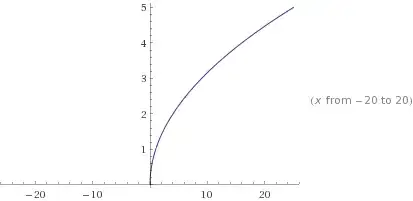
Graph of the real square root of x with x from -20 to 20.

With the right horizontal shift ($f(x)=\sqrt{x-2}$):
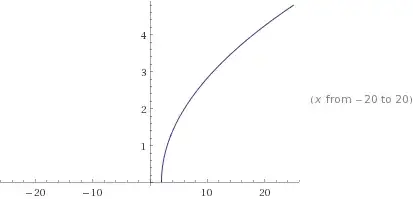
Previous graph, shifted over two units to the right.

With a horizontal reflection ($f(x)=\sqrt{-(x-2)}$):

This is the part I'm confused about. Why doesn't it reflect across the y-axis?
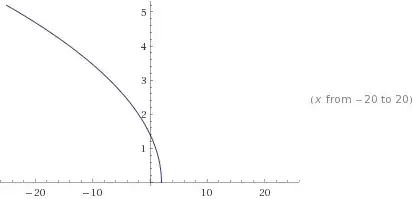
Previous graph, reflected horizontally accross the point of origin of the line.

I would expect the final graph to look like this:
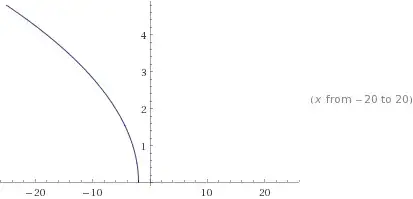
Same graph, but reflected across the y-axis.

Ian
  • 137

2 Answers2

4

When it comes to combining transformations, you should think of it as a replacement procedure. Shifting two units to the right means replacing $x$ with $x - 2$. A reflection over the $y$-axis means replacing $x$ with $-x$. So if we apply these transformations in the given order, then we would get $y = f(-x - 2) = \sqrt{-x - 2}$.

On the other hand, the function $y = f(-(x - 2))$ suggests that we applied the two transformations in reverse order. That is, we first reflected the function over the $y$-axis, then shifted the resulting graph two units to the right. Since expanding yields $y = f(-x + 2)$, notice that this is equivalent to first shifting the original graph two units to the left, then reflecting over the $y$-axis.

Adriano
  • 41,969
  • I apologize, I had mistyped in my original question. It should have been $-(x-2)$ not $-(x+2)$. It's fixed now. – Ian Sep 29 '14 at 20:49
4

As you observed that $f(2-x) = f\big(-(x-2)\big)$. Since $$ f(x) \quad \stackrel{(1)}{\longrightarrow} \quad f(-x) \quad \stackrel{(2)}{\longrightarrow} \quad f\big(-(x-2)\big), $$ we can obtain $f(2-x)$ from $f(x)$ by transformations that correspond to (1) and (2), where

(1) is reflection across the $y$-axis;

(2) is translation to the right by $2$ units.

E W H Lee
  • 2,366
  • Aren't you supposed to follow the order of operations with transformations? Thus the transformation inside the parentheses should be done first, right? – Ian Sep 29 '14 at 21:20
  • We follow order of operations only when we try to evaluate or simply something. In this case, we try to transform $f(x)$ into $f(2-x)$ (in some way); by doing so, since we know the graph of $f(x)$, we can obtain the graph of $f(2-x)$ by following the transformations we performed. In (1), we can transform $f(x)$ into $f(-x)$ by replacing every $x$ with $-x$; by doing so, we reflect the graph across the $y$-axis. As for (2), we replace every $x$ with $x-2$; by doing so, we translate to the right by 2 units. – E W H Lee Sep 29 '14 at 21:26
  • Alright, that makes more sense. – Ian Sep 29 '14 at 21:29