$\newcommand{\P}{\mathbf{P}}\newcommand{\R}{\mathbf{R}}$Caveat: The notion of "blow-up" described below is not the one you ask about, but it's doubtless similar in spirit. Perhaps this account will suggest how to define your notion precisely, or spur someone else to do so.
The "customary" algebro-geometric notion of blowing up amounts to the following: Let $i:M \hookrightarrow N$ be a smooth submanifold, and let $p:E \to M$ denote the normal bundle of $M$ in $N$. (You can think of the "normal bundle" merely as a complementary subbundle of $TM$ in $i^{*}TN$ if metrics are unavailable to take orthogonal complements.)
First, here's a description of blowing up one fibre of $E$ (i.e., "blowing up a point"). The set of lines through the zero vector in a fibre $E_{x}$ is a projective space $\P(E_{x})$. In the Cartesian product $\P(E_{x}) \times E_{x}$, consider the "tautological subset" $\widetilde{E_{x}}$ consisting of pairs $(\ell, v)$ such that $v \in \ell$. Projection on the second factor, i.e. $\Pi_{2}:\widetilde{E_{x}} \subset \P(E_{x}) \times E_{x} \to E_{x}$, induces a diffeomorphism except over the zero vector of $E_{x}$; the preimage of the zero vector is $\P(E_{x})$.
Geometrically, $\widetilde{E_{x}}$ comprises all one-dimensional linear subspaces of $E_{x}$, but now distinct subspaces have distinct zero vectors. In this sense, $\widetilde{E_{x}}$ is obtained from $E_{x}$ by removing the zero vector and gluing in the projective space $\P(E_{x})$; one point must be added for each line through the origin.
Here are pictures when $\dim(E_{x}) = 2$, created for Dana Mackenzie's What's Happening in the Mathematical Sciences, 2009; the labels indicate a complex vector space, but of course a real vector space is shown. Conceptually the real and complex pictures are identical.
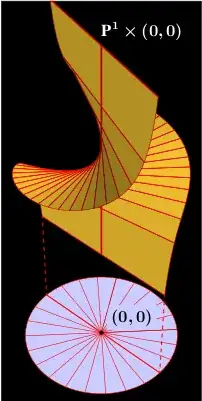
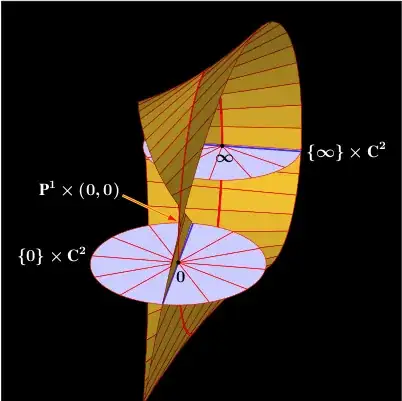
To blow up the submanifold $M \subset N$, one shows the preceding construction can be made locally in $M$, i.e., over a coordinate neighborhood $U \subset M$, essentially by taking the Cartesian product of the preceding picture with $U$. Geometrically, $M$ is removed from $N$, and the projective bundle $\P(E)$ is glued in, in such a way that distinct normal directions at a single point of $M$ "touch different points of $M$" in the blow-up.
For example, the blow-up of $\R^{n} \subset \R^{n+k+1}$ may be viewed as $\R^{n} \times \widetilde{E}^{k}$, with $\widetilde{E}^{k} \to \R\P^{k}$ the tautological bundle of lines over the projective space.

