Let $\mathcal N$ be an exact category and $C\mathcal N$ be the category of chain complexes with its usual exact structure. We have here the usual notion of "mapping cylinder" of a chain map. If $f:N\to M$ is a chain map, denote by $T(f)$ its mapping cylinder. Denote by $j_1:N\to T(f)$ and $j_2:M\to T(f)$ the inclusion on the first and third factors respectively. These are admissible monomorphisms.
Suppose we have a commutative diagram in $C\mathcal N$:

where $\alpha$ and $\beta$ are admissible monomorphisms.
Let $t:T(f)\to T(f')$ be the induced map; that is, $t=\left(\begin{smallmatrix} \alpha & 0 & 0 \\ 0 & \alpha[-1] & 0 \\ 0 & 0 & \beta \end{smallmatrix}\right)$.
I want to prove that the induced arrow $s$ in the pushout diagram below is an admissible monomorphism:
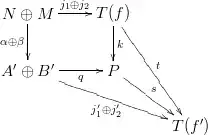
Notice that every arrow there but $s$ is an admissible monomorphism.
So I was able to show that $s$ has a cokernel (it's the cokernel $e$ of the map $T(f)\oplus (A'\oplus B') \to T(f')$ given by the matrix $(t \hspace{.6cm} j_1'\oplus j_2')$).
But I'm stuck at showing that $s$ is also the kernel of $e$. I've tried several different things for a couple of days now but I'm just absolutely stuck...
