Let's fix some terminology first. A category $\mathcal{C}$ is preabelian if:
1) $Hom_{\mathcal{C}}(A,B)$ is an abelian group for every $A,B$ such that composition is biadditive,
2) $\mathcal{C}$ has a zero object,
3) $\mathcal{C}$ has binary products,
4) $\mathcal{C}$ has kernels and cokernels.
A category $\mathcal{C}$ is abelian if it is preabelian and satisfies:
5) every monomorphism is a kernel and every epimorphism is a cokernel.
Define the coimage of a map to be the cokernel of its kernel, and the image to be the kernel of its cokernel. We have the following commutative diagram:
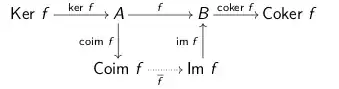
where $\overline{f}$ is the only existing map (because of universality of kernel and cokernel).
I'm having trouble proving the following:
A preabelian category $\mathcal{C}$ is abelian iff $\overline{f}$ is an isomorphism.
The converse is easily shown, I'm having trouble proving $\Rightarrow$...


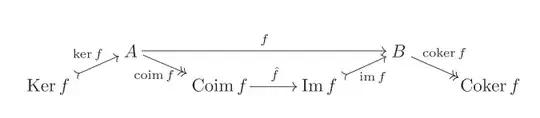 By step 4 we have that $A \to \operatorname{Im}{f}$ and $\operatorname{Coim}{f} \to B$ are epi and mono, respectively. Therefore $\bar{f}$ is both epi and mono and we're done by step 3.

I wonder whether it is true, in fact, that mono implies section and epi implies retraction?
– Bruno Stonek Jun 14 '11 at 00:57