First of all, if we prove that a rectangle is not homeomorphic to any cylinder obviously can't be isometric. In fact every isometry is an homeomorphism (we are working in $\mathbb{R}^n$ with the usual topology)
Always, when someone has to deal with this kind of exercises, the first thing is to recall the definitions:
homeomorphism
Isometry
and, locally isometric surfaces: $S_1,S_2$ differential surfaces are said locally isometric if for each point $p \in S_1$ exists a neighborhood $U_p \ni p$ in $S_1$, an open subset $V_p \subset S_2$ and an isometry $f_p : U_p \to V_p$
After the definitions, it's the time of What properties I have to check- what kind of preliminary reasonings can I made to cut unnecessary passages? A huge advice is to consider and (firstly) understand what kind of invariants a particular class of functions has. For example, a continuous map $g$ preserve compactness and connectness of a set, so if for example we are requested to find a continuous map from a connected set to a non connected set, then we have granted that such map doesn't exists without make any effort. (again, this is not a formal proof-discussion)
Luckily homeomorphisms have some invariants, and some of them are very easy to see. In general proving and finding an invariant is not so trivial.
Let's try to discuss one of this invariants: we want that homeomorphisms preserve the "shape" of a particular topological space (a set with a topology on it). So, what is a shape? First of all, a donut doesn't have the same shape of a "inside -full-sphere" (from here it will be denoted with $D^3$, the $3$-disk in $\mathbb{R}^3$). Donuts have (almost) always a hole in the middle (there are some observations to do here, but please focus on the example) and $D^3$ obviously not. So we don't want that a donut is homeomorphic to $D^3$.
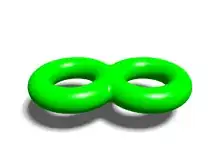
A double donut glued side by side with blueberry jam (see the figure) doesn't have the same shape of a normal donut - two holes again one hole-.
If we stop the request over an homeomorphism here we would only obtain the definition of homotopy equivalence, homeomorphism is more strictly. In fact if we speak only about shape (so we are allowed to squeeze something, stretch it, but not cut or pierce it) it is hard to distinguish $D^3$ from a point. Again, if a space $X$ has two holes and a space $Y$ has three holes (without giving the definition of holes, but recalling the natural intuition and imagination) there is no hope to find an homeomorphism between the two. Look here for a long list of Topological properties (the right name of these "invariants") and here for some more words about holes and so on.
So these are some of topological thoughts. And it should be clear that a rectangle doesn't have holes and a cylinder yes, so they aren't homeomorphic and so they can't be isometric. More interesting is the fact that the cylinder is locally isometric to the plane (pay 75 - not trivial, some knowledges about differential geometry are required). This fact is in fact expected. If you consider a small portion of the cylinder, it is very very similar to a curved paper, and important thing (not so obvious): the metric is preserved, so angles, distances and other metric properties inside this portion are preserved if I consider the same portion a piece of plane. This doesn't happen if I consider small portion of a sphere compared to a plane.
Ok, maybe you are more interested in what doesn't work in your reasoning. First: the sentence stick the sides should convince you that you are in fact changing shape, so likely no homeomoprhism between them. Then focusing on your function, (please stress what are domain and codomain of your functions - polar coordinates have some trouble in the origin-) I can see some problems in proving that such function is open (necessary condition in proving it's homeo between a rectangle ) just because you need to glue two sides of the rectangle! (the rectangle has to be of the form $[0,2\pi) \times I$ if you want to cover the cylinder globally, but then some little open set near the "closed side" of the rectangle should have non open image through your $f$. Please note that I didn't make the formal verifications, just because I concluded with the topological thoughts.
ADDENDUM a bijective map is NOT a homeo. You need to prove continuity of $f$ and $f^{-1}$. These are the most important properties of an homeomoprhism.


