Once you figure out how to map a single "ray from the origin" on the plane to its corresponding "line" on the cylinder, you can extend this to the entire plane by putting $e^{i\theta}$ in front of everything (in other words, repeating that map for each angle, and using it to send each ray to its line).
Here is a gif I made (originally from this post) that may help illustrate the map we should think of (I assume that in your problem, we are supposed to consider an infinite cylinder and the entire punctured plane, not a finite cylinder and an annulus, though in fact they are all homeomorphic).
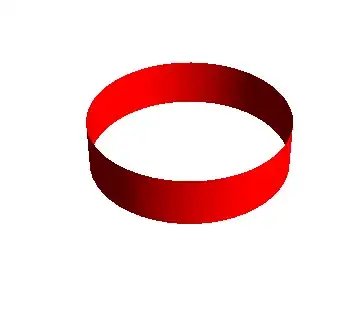
To be specific, let's say that the cylinder we're looking at is the infinite vertical cylinder of radius $1$:
$$C=\{(x,y,z)\in\mathbb{R}^3:x^2+y^2=1\}.$$
The punctured plane is
$$P=\{(x,y)\in\mathbb{R}^2:x\neq 0\,\text{ or }\,y\neq 0\}.$$
So, let's figure out how to do one ray and one line. Hopefully you agree that the ray
$$r_0=\{(x,0)\in\mathbb{R}^2:x>0\}$$
should be sent to the line
$$\ell_0=\{(1,0,z)\in\mathbb{R}^3:z\in\mathbb{R}\}$$
(roughly speaking, because they are both at an angle of $0^\circ$, when viewed from above).
We need to find a homeomorphism from $r_0$ (which is itself homeomorphic to $\mathbb{R}_{>0}$) to $\ell_0$ (which is itself homeomorphic to $\mathbb{R}$). So we just need to find a homeomorphism from $\mathbb{R}_{>0}$ to $\mathbb{R}$.
There are many examples, but one good one is the logarithm. Just like how $0$ is the "neutral element" for addition in the real numbers, $1$ is the "neutral element" in multiplication. And in fact, the logarithm is precisely the map $\log:\mathbb{R}_+\to\mathbb{R}$ that converts multiplication into addition:
$$\log(a\cdot b)=\log(a)+\log(b).$$
You can see that $\log(1)=0$, and that $\log(1),\log(2),\log(4),\log(8),\ldots$ are evenly spaced "additively" in $\mathbb{R}$, just like how $1,2,4,8,\ldots$ are evenly spaced "multiplicatively" in $\mathbb{R}_{>0}$.
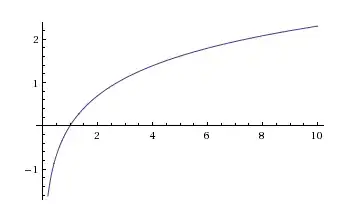
So, we can surmise that in the homeomorphism $f:P\to C$ that we're thinking of, we are going to have $f(r_0)=\ell_0$, and that the formula for how $f$ acts is
$$f(x,0)=(1,0,\log(x)),\;\text{ for all }x>0$$
Can you now modify this to see the formula for the entire map $f$?
(Again, I should say that of course there are infinitely many homeomorphisms from $P$ to $C$, this is just one that's easy to think of / write down.)


