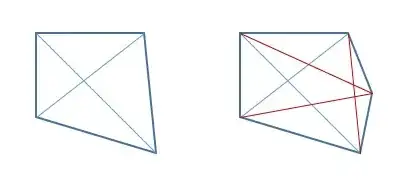
I assume that $D(n)$ is the number of diagonals in an $n$-sided convex polygon. Descriptively: each vertex of the polygon can be connected to $n-3$ other (connecting it with itself or its neighbors will not produce diagonals). That way, you make each diagonal twice, hence the formula.
If you want to use induction, then check for $n=3$, and then assume it works for all $k$-sided convex polygons where $k < n$. Look at the $n$-sided one.
We can pick any $n-1$ vertices, and the polygon they span has $(n-1)((n-1)-3)/2$ diagonals (by the assumption). But, one of its sides will also become a diagonal of the bigger polygon. Now, we're just missing $n-3$ diagonals from the $n$-th vertex, so in total we have:
\begin{align*}
\frac{(n-1)((n-1)-3)}{2} + 1 + (n-3) &= \frac{(n-1)(n-4) + 2 + 2(n-3)}{2} \\
&= \frac{n^2 - 5n + 4 + 2 + 2n - 6}{2} = \frac{n^2 - 3n}{2} \\
&= \frac{n(n-3)}{2}.
\end{align*}
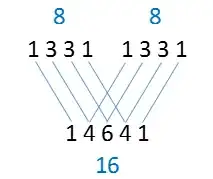
If you want the second one using induction, use the recursive formula for binomial coefficients:
$$\binom{n}{k} = \binom{n-1}{k-1} + \binom{n-1}{k}.$$
Edit: Since you asked how to do this (in comment to nsanger), I'm expanding that part of the answer. The idea is to note that the two terms on the right hand side are the same, only with a shift in $k$. In other words:
$$\sum_{k=1}^n \binom{n-1}{k-1} = \sum_{k=\color{red}{0}}^{\color{red}{n-1}} \binom{n-1}{\color{red}{k}}.$$
Now, we just need to play with the edge cases to get the sums to have the same limits:
\begin{align*}
\sum_{k=0}^n \binom{n}{k} &= \binom{n}{0} + \binom{n}{n} + \sum_{k=\color{red}{1}}^{\color{red}{n-1}} \binom{n}{k} = 1 + 1 + \sum_{k=1}^{n-1} \binom{n-1}{k} + \sum_{k=1}^{n-1} \binom{n-1}{k-1} \\
&= \binom{n-1}{0} + \sum_{k=1}^{n-1} \binom{n-1}{k} + \binom{n-1}{n-1} + \sum_{k=1}^{n-1} \binom{n-1}{k-1} \\
&= \sum_{k=\color{red}{0}}^{n-1} \binom{n-1}{k} + \sum_{k=1}^{\color{red}{n}} \binom{n-1}{k-1} \\
&= \Big\{ \text{Use the above formula for the second sum} \Big\} \\
&= \sum_{k=0}^{n-1} \binom{n-1}{k} + \sum_{k=0}^{n-1} \binom{n-1}{k} = 2\sum_{k=0}^{n-1} \binom{n-1}{k} \\
&= \Big\{ \text{Use the induction hypothesis} \Big\} \\
&= 2 \cdot 2^{n-1} = 2^n.
\end{align*}
The third one was answered by nsanger, so I won't be repeating that.