Proof of the property of the first figure.
Let $A_k$, $k=1,...4$ be the vertices of the quadrilateral (numbered in a direct orientation). Let $B_k$ $k=1,...8$ be the vertices of the octagon, beginning in such a way that triangle $A_1B_8B_1$ is one of the triangles of the figure.
Let us use complex number geometry techniques like in this answer, where we make no distinction between a point and the associated complex number.
For example, the geometrical fact that $\vec{A_1B_1}$ is obtained from $\vec{A_1A_2}$ by a $-\pi/2$ rotation, is translated, in the complex domain, into :
$$B_1-A_1=-i(A_2-A_1) \ \iff \ B_1=A_1-i(A_2-A_1)$$
Doing the same kind of computation for each vertex $B_k$ of the exterior octagon (red points), we obtain :
$$\begin{cases}
B_1&=&A_1-i(A_2-A_1)\\
B_2&=&A_2-i(A_2-A_1)\\
B_3&=&A_2-i(A_3-A_2)\\
B_4&=&A_3-i(A_3-A_2)\\
B_5&=&A_3-i(A_4-A_3)\\
B_6&=&A_4-i(A_4-A_3)\\
B_7&=&A_4-i(A_1-A_4)\\
B_8&=&A_1-i(A_1-A_4)\end{cases}
$$
Therefore, midpoints (green color) are :
$$\begin{cases}
M_1&=&A_1+i(A_4-A_2)/2\\
M_2&=&A_2+i(A_1-A_3)/2\\
M_3&=&A_3+i(A_2-A_4)/2\\
M_4&=&A_4+i(A_3-A_1)/2
\end{cases}
$$
giving, for the line segments connecting opposite midpoints :
$$\begin{cases}M_3-M_1&=&(A_3-A_1)+i(A_2-A_4)\\M_4-M_2&=&(A_4-A_2)+i(A_3-A_1)\end{cases}$$
Due to the fact that $M_3-M_1=-i(M_4-M_2)$, the orthogonality of line segments $[M_1,M_3]$ and $[M_2,M_4]$ is established.
Two remarks : the figure of your first question represents a case where the initial quadrilateral and the external octagon are convex. As we haven't used at any moment a convexity hypothesis, here are two cases where the given property still holds.
(fig. 1) Here, though the initial quadrilateral is convex, the exterior octagon isn't convex.
(fig. 2) In this case, not only the quadrilateral isn't convex, but even more, it is self-intersecting.
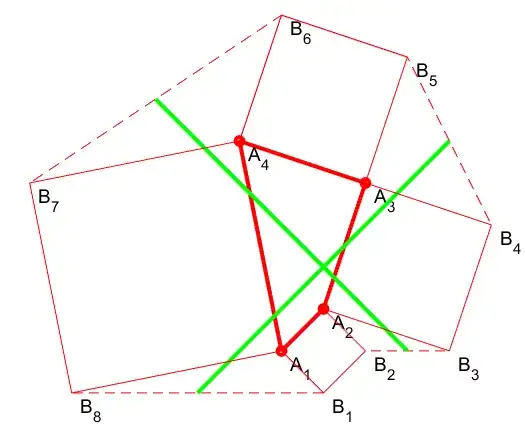
Fig. 1 : A case where the exterior octagon isn't convex.
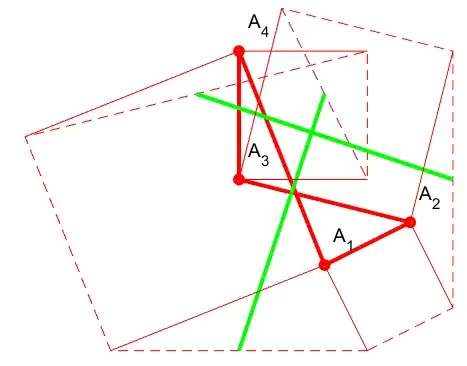
Fig. 2 : A case where the quadrilateral is self-intersecting.
These examples have been obtained with the following Matlab program implementing formulas above :
 clear all;close all
 A=[1+1*i,2+2*i,3+5*i,6*i];A=[A,A(1)];
 V=diff(A);
 plot(A,'-or',LineWidth=3),axis equal off;hold on
 set(gcf,'defaulttextfontsize',14)
 L=A(1:4);d=ones(1,4);
 text(real(L)+0.2*d,imag(L)-0.4*d,{'A_1','A_2','A_3','A_4'})
 for k=1:4
    B(2*k-1)=A(k)-i*V(k);
    B(2*k)=A(k+1)-i*V(k);
 end;
 d=ones(1,8);
 text(real(B)+0.2*d,imag(B)-0.4*d,{'B_1','B_2','B_3','B_4','B_5','B_6','B_7','B_8'});hold on
 plot([B,B(1)],'--r');hold on;
 M(1)=A(1)+i*(A(4)-A(2))/2;
 M(2)=A(2)+i*(A(1)-A(3))/2;
 M(3)=A(3)+i*(A(2)-A(4))/2;
 M(4)=A(4)+i*(A(3)-A(1))/2;
plot([M(1),M(3)],'g',LineWidth=3);hold on
plot([M(2),M(4)],'g',LineWidth=3);hold on
plot([B(7),B(8),A(1),B(1),B(2),A(2),B(3),B(4),A(3),B(5),B(6),A(4),B(7)],'-r');hold on;


