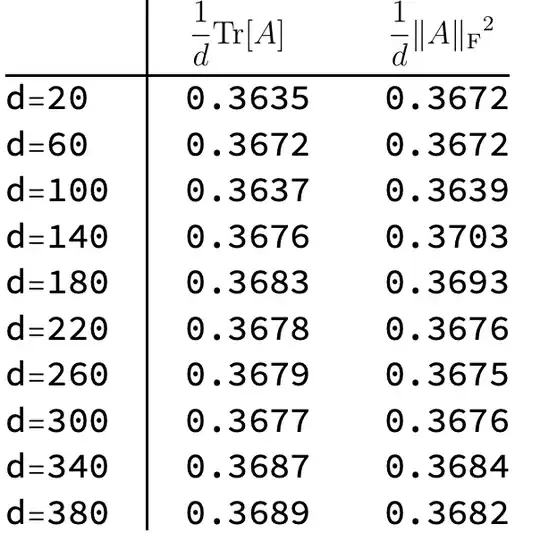
We can abstract each update as $$B = (I - vv^T) A,\tag{*}$$ where $v$ is chosen from the unit hypersphere independent of the choices of $A$. Our derivation will use the following facts:
$$
\begin{align}
\mathbb{E}[vv^T] = \frac{1}{d} \cdot I, \qquad \mathbb{E}[(v^TMv)^2] =
\frac{1}{d(d+2)} \left[\operatorname{tr}^2(M) + \operatorname{tr}(M^TM)+ \operatorname{tr}(M^2)\right]
\end{align}.
$$
From (*) we get
$$
\begin{align}
\operatorname{tr}(B) &= \operatorname{tr}(A) - v^TAv
\end{align}
$$ and $$\operatorname{tr}^2(B) = \operatorname{tr}^2(A) - 2 \operatorname{tr}(A) \cdot v^TAv + (v^TAv)^2.$$
Taking the conditional expectation, we have
$$
\mathbb{E}[\operatorname{tr}^2(B)|A] = \left(1-\frac{2}{d}\right)\operatorname{tr}^2(A) + \frac{1}{d(d+2)}\left[\operatorname{tr}^2(A) + \operatorname{tr}(A^TA)+ \operatorname{tr}(A^2)\right].\tag{1}
$$
Similarly, as $B^2 = (I - vv^T) A(I - vv^T) A = A^2 - vv^T A^2 - Avv^TA + vv^TAvv^TA$, we have
$$\operatorname{tr}(B^2) = \operatorname{tr}(A^2) - 2v^TA^2v + (v^TAv)^2$$
and
$$\mathbb{E}[\operatorname{tr}(B^2)|A] = \left(1-\frac{2}{d}\right)\operatorname{tr}(A^2) + \frac{1}{d(d+2)} \left[\operatorname{tr}^2(A) + \operatorname{tr}(A^TA)+ \operatorname{tr}(A^2)\right].\tag{2}$$
Also, since $B^TB = A^T(I-vv^T)A = A^TA - A^Tvv^TA$, we have
$$\mathbb{E}[\operatorname{tr}(B^TB)|A] = \left(1-\frac{1}{d}\right) \operatorname{tr}(A^TA) .\tag{3}$$
Taking another expectation of (1)-(3), we get
$$
\begin{bmatrix}
\mathbb{E}[\operatorname{tr}^2(B)]\\
\mathbb{E}[\operatorname{tr}(B^2)]\\
\mathbb{E}[\operatorname{tr}(B^TB)]
\end{bmatrix}
= C
\begin{bmatrix}
\mathbb{E}[\operatorname{tr}^2(A)]\\
\mathbb{E}[\operatorname{tr}(A^2)]\\
\mathbb{E}[\operatorname{tr}(A^TA)]
\end{bmatrix},\qquad
C =
\begin{bmatrix}
1-\frac{2}{d} + \frac{1}{d(d+2)} & \frac{1}{d(d+2)} & \frac{1}{d(d+2)}\\
\frac{1}{d(d+2)} & 1-\frac{2}{d} + \frac{1}{d(d+2)} & \frac{1}{d(d+2)}\\
0 & 0 & 1-\frac{1}{d}
\end{bmatrix}.
$$
The matrix $C$ has eigenvalues $\lambda_1 = 1-\frac{2}{d}+ \frac{2}{d(d+2)}, \lambda_2 = 1-\frac{2}{d}, \lambda_3 = 1-\frac{1}{d}$, with corresponding eigenvectors $(1, 1, 0)^T, (1, -1, 0)^T, (1, 1, d)^T$.
The initial condition is $A = I$, and $\begin{bmatrix}
\mathbb{E}[\operatorname{tr}^2(A)]\\
\mathbb{E}[\operatorname{tr}(A^2)]\\
\mathbb{E}[\operatorname{tr}(A^TA)]
\end{bmatrix} = \begin{bmatrix}d^2\\ d\\ d\end{bmatrix} = \frac{d^2 + d - 2}{2}
\begin{bmatrix} 1 \\ 1 \\ 0\end{bmatrix} + \frac{d^2 - d}{2}
\begin{bmatrix} 1 \\ -1 \\ 0\end{bmatrix} +
\begin{bmatrix} 1 \\ 1 \\ d\end{bmatrix} $.
Therefore, after iterating $d$-steps, we obtain the result
$$\begin{align}
\mathbb{E}[\operatorname{tr}^2(A)] &= \frac{d^2 + d - 2}{2} \cdot \lambda_1^d + \frac{d^2 - d}{2} \cdot \lambda_2^d + \lambda_3^d\\
&= \frac{d^2 + d - 2}{2} \cdot \left(1-\frac{2}{d}+ \frac{2}{d(d+2)}\right)^d + \frac{d^2 - d}{2} \cdot \left(1-\frac{2}{d}\right)^d + \left(1-\frac{1}{d}\right)^d.\end{align}
$$
As $\mathbb{E}[\operatorname{tr}(A)] = \left(1-\frac{1}{d}\right)^d d$, we have
$$
\begin{align}
\operatorname{var}(\operatorname{tr}(A)) &=
\mathbb{E}[\operatorname{tr}^2(A)]
-
(\mathbb{E}[\operatorname{tr}(A)])^2 \\
&=
\frac{d^2 + d - 2}{2} \cdot \left(1-\frac{2}{d}+ \frac{2}{d(d+2)}\right)^d + \frac{d^2 - d}{2} \cdot \left(1-\frac{2}{d}\right)^d + \left(1-\frac{1}{d}\right)^d - \left(1-\frac{1}{d}\right)^{2d} d^2.
\end{align}
$$
which has a constant limit $\frac{-3 + 2 e}{2 e^2}$from Wolfram Alpha.
Remarks:
- This approach can be extended to analyze the variance of $\operatorname{var}(\|A\|_F^2) = \operatorname{var}(\operatorname{tr}(A^TA))$, which converges to $1/e^2$ (see below);
- As a byproduct, we also get
$$
\begin{align}\mathbb{E}[\operatorname{tr}(A^2)] &= \frac{d^2 + d - 2}{2} \left(1-\frac{2}{d}+ \frac{2}{d(d+2)}\right)^d - \frac{d^2 - d}{2}\left(1-\frac{2}{d}\right)^d + \left(1-\frac{1}{d}\right)^d\\
&= \frac{2d}{e^2} + \frac{e - 3}{e^2} + O\left(\frac1d\right)
\end{align}
\tag{P1} $$
(asymptotic from Wolfram Alpha)
On $\operatorname{var}(\operatorname{tr}(A^TA))$:
Since $$B^TB = A^T(I-vv^T)A = A^TA - A^Tvv^TA,\tag{#}$$ we have $
\operatorname{tr}(B^TB) = \operatorname{tr}(A^TA) - v^TAA^Tv$, and
$\operatorname{tr}^2(B^TB) = \operatorname{tr}^2(A^TA) - 2 \operatorname{tr}(A^TA) \cdot v^TAA^Tv + (v^TAA^Tv)^2.
$
Therefore,
$$
\mathbb{E}[\operatorname{tr}^2(B^TB)|A]
= \left(1 - \frac{2}{d}\right)\operatorname{tr}^2(A^TA) + \frac{1}{d(d+2)} \left[\operatorname{tr}^2(A^TA) + 2\operatorname{tr}((A^TA)^2)\right].
$$
Similarly, from (#), we obtain
$$\begin{align}(B^TB)^2 &= (A^TA - A^Tvv^TA)(A^TA - A^Tvv^TA) \\
&= (A^TA)^2 - A^TAA^Tvv^TA - A^Tvv^TAA^TA + (A^Tvv^TA)^2
\end{align}$$ and thus
$$\mathbb{E}[\operatorname{tr}((B^TB)^2)|A]
=
\left(1 - \frac{2}{d}\right)\operatorname{tr}((A^TA)^2) + \frac{1}{d(d+2)} \left[\operatorname{tr}^2(A^TA) + 2\operatorname{tr}((A^TA)^2)\right].
$$
Taking another expectation, we obtain
$$
\begin{bmatrix}
\mathbb{E}[\operatorname{tr}^2(B^TB)]\\
\mathbb{E}[\operatorname{tr}((B^TB)^2)]
\end{bmatrix}
= C'
\begin{bmatrix}
\mathbb{E}[\operatorname{tr}^2(A^TA)]\\
\mathbb{E}[\operatorname{tr}((A^TA)^2)]
\end{bmatrix},\qquad
C' =
\begin{bmatrix}
1-\frac{2}{d} + \frac{1}{d(d+2)} & \frac{2}{d(d+2)} \\
\frac{1}{d(d+2)} & 1-\frac{2}{d} + \frac{2}{d(d+2)}
\end{bmatrix}.
$$
The matrix $C'$ has eigenvalues $\lambda_1 = 1-\frac{2}{d} + \frac{3}{d(d+2)}, \lambda_2 = 1-\frac{2}{d}$, and corresponding eigenvectors
$(1, 1)^T$ and $(2, -1)^T$.
The initial condition is $ A = I$ and
$\begin{bmatrix}
\mathbb{E}[\operatorname{tr}^2(A^TA)]\\
\mathbb{E}[\operatorname{tr}((A^TA)^2)]
\end{bmatrix} =
\begin{bmatrix}
d^2\\d
\end{bmatrix}
= \frac{d^2+2d}{3}
\begin{bmatrix} 1\\1\end{bmatrix}
+ \frac{d^2-d}{3}
\begin{bmatrix} 2\\-1\end{bmatrix}
$.
Therefore, after iterating $d$-steps, we obtain the result
$$\begin{align}
\mathbb{E}[\operatorname{tr}^2(A^TA)] &=
\frac{d^2+2d}{3}
\left(1-\frac{2}{d} + \frac{3}{d(d+2)}\right)^d
+ 2 \cdot \frac{d^2-d}{3} \left(1-\frac{2}{d}\right)^d
.\end{align}
$$
As $\mathbb{E}[\operatorname{tr}(A^TA)] = \left(1-\frac{1}{d}\right)^d d$, we have
$$
\begin{align}
\operatorname{var}(\operatorname{tr}(A^TA)) &=
\mathbb{E}[\operatorname{tr}^2(A^TA)]
-
(\mathbb{E}[\operatorname{tr}(A^TA)])^2 \\
&=
\frac{d^2+2d}{3}
\left(1-\frac{2}{d} + \frac{3}{d(d+2)}\right)^d
+ 2 \cdot \frac{d^2-d}{3} \left(1-\frac{2}{d}\right)^d - \left(1-\frac{1}{d}\right)^{2d} d^2.
\end{align}
$$
which has a constant limit $1/e^2$ from Wolfram Alpha.
We also get
$$
\begin{align}
\mathbb{E}[\operatorname{tr}((A^TA)^2)] &=
\frac{d^2+2d}{3}
\left(1-\frac{2}{d} + \frac{3}{d(d+2)}\right)^d
- \frac{d^2-d}{3} \left(1-\frac{2}{d}\right)^d\\
&= \frac{2d}{e^2} -\frac{1}{2e^2} + O\left(\frac1d\right)
,\end{align}\tag{P2}
$$
(asymptotic from Wolfram Alpha)
We can compare (P2) with (P1) and show their expectations have the same linear term. This is related to the case $p = 2$ discussed in this post "Why is $\operatorname{Tr}(A^p)\approx \sum_i \sigma_i^{2p}$ for this random matrix?".