19

The smallest root of a polynomial is defined as the root which has the smallest absolute value. Consider the polynomial $a_0 + a_1 x + a_2 x^2 + \cdots + a_n x^n$. I observed that if $a_n$, is the sequence of natural numbers then the smallest root of the polynomial

$$1 + 2x + 3x^2 + 4x^3 + \cdots + (n+1)x^{n} \tag 1$$

is real if $n$ is odd and it is complex $n$ is even. But but if $a_n$ is the sequence of prime numbers and $n \ge 14$ then the smallest root of

$$2 +3x + 5x^2 + 7x^3 + \cdots + p_{n+1}x^n \tag 2$$

is always complex for all values up to $14 \le n \le 1200$. Beyond this I have verified the claim for $n$ at random values up to $12,000$ (Computation gets slower as $n$ increases). Clearly there is something about prime numbers which prevent the polynomials from having a real smallest root if the degree of the polynomial is $14$ or higher.

Question 1: Is it true that if the coefficients of a polynomial of degree $14$ or higher is the sequence of prime numbers and than its smallest root is always complex?

Question 2: Why do the smallest root alternate between real of complex depending parity if the coefficients are natural numbers but not for primes?

Bill Dubuque
  • 282,220
  • 3
    You say the smallest root is always complex for $n \geq 14$. But isn't this what you're asking? You're looking for a proof of this assertion, right? Perhaps it's better to indicate for which values of $n$ this has been experimentally verified – Max Lonysa Muller May 09 '24 at 14:18
  • 1
    @MaxMuller Done. It has been verified for $n \le 1200$ – Nilotpal Sinha May 09 '24 at 14:25
  • 5
    I'd probably start by examining the roots with a visualization to see if there is any obvious pattern. For instance it might turn out to be the case that after a while the smallest root stabilizes with the new terms not causing it to move much. Anyway that's the kind of pattern I'd look for. – Jake Mirra May 09 '24 at 14:38
  • 2
    Since $p_n \sim n \log n$, the infinite power series $\sum_{n=0}^\infty p_n z^n$ actually converges for $|z| < 1$. So if it has a root within the unit disc, I would expect that the roots you are computing will converge to that root. – Jair Taylor May 09 '24 at 16:57
  • @NilotpalSinha When you write "complex", I think you mean "non-real". (Complex numbers include real numbers.) – Dan May 10 '24 at 13:49
  • In (1), are you suggesting that the sequence of natural numbers begins with a pair of $1$s? :) – Blue May 10 '24 at 13:57
  • 1
    @Blue Corrected the typpo :) – Nilotpal Sinha May 10 '24 at 15:10
  • @Dan Yes, by complex, I mean non-real numbers. – Nilotpal Sinha May 10 '24 at 15:26
  • @JairTaylor I agree with your suspicion, if a sequence of holomorphic functions $(f_n)$ converge uniformly to a (necessarily) holomorphic function $f$, then the zeroes of the $f_n$ converge to the zeroes of $f$ and the convergence of a power series is uniform within it's radius of convergence. To test this, you should try different power series whose smallest root is non-real – Carlyle Jul 01 '24 at 20:24
  • As far as I know, complex numbers cannot be ordered, so you can not say that one complex number is smaller than the other. So how can the smallest root of any equation be a complex number? – Dominique Jul 08 '24 at 11:22
  • @Dominique smallest in absolute value – Exodd Jul 08 '24 at 11:32
  • @Exodd: so $(1,1)$ is smaller than $3$, while $(1,5)$ is larger than $3$, although in both cases the real part is equal? And what about "symmetrical" complex numbers, like $(4,3)$ and $(3,4)$ or even $(-3, -4)$? You might even say they have the same "size" as $(5,0)$ or even as $(0,-5)$ :-) – Dominique Jul 08 '24 at 11:36
  • @Dominique are you hiding a hint in your comments about comparing the size of the roots? It doesn't seem unreasonable to me to phrase the question like this (but then again I'm quite often dealing with dynamical systems where the magnitude of the eigenvalues is a first-order thing to look at) – Chris Lewis Jul 08 '24 at 14:28
  • @ChrisLewis: I'm not talking about ordering the size of some numbers, I'm talking about ordering numbers. This can be done with real number, but not with complex numbers. The idea of ordering complex numbers, based on their size, is simply wrong. – Dominique Jul 08 '24 at 14:33

2 Answers2

14

Partial answer to Question 2.

I will show that $f(x)=1+2x+3x^2+4x^3+\cdots+(2k+1)x^{2k}$ (which has even degree) has no real root, therefore the smallest root is non-real.

If $x\ge 0$ then obviously $f(x)>0$.

$\begin{align} f(x)&=\frac{\text{d}}{\text{d}x}(x+x^2+x^3+\cdots+x^{2k+1})\\ &=\frac{\text{d}}{\text{d}x}\left(\frac{x-x^{2k+2}}{1-x}\right)\\ &=\dfrac{(2k+1)x^{2k+2}-(2k+2)x^{2k+1}+1}{(1-x)^2}\\ \end{align}$

If $x<0$, then $x^{2k+2}>0$ and $-x^{2k+1}>0$, so $f(x)>0$.

Therefore $f(x)$ has no real root, and therefore the smallest root is non-real.

Dan
  • 35,053
1
1. Restatement of the Question to Make it Easier to Reference in the Answer

The smallest root of a polynomial is defined as the root which has the smallest absolute value. Consider the polynomial $a_0 + a_1 x + a_2 x^2 + \cdots + a_n x^n$. I observed that if $a_n$, is the sequence of natural numbers then the smallest root of the polynomial $$1 + 2x + 3x^2 + 4x^3 + \cdots + (n+1)x^{n} \tag 1$$ is real if $n$ is odd and it is complex $n$ is even. But but if $a_n$ is the sequence of prime numbers and $n \ge 14$ then the smallest root of $$2 +3x + 5x^2 + 7x^3 + \cdots + p_{n+1}x^n \tag 2$$ is always complex for all values up to $14 \le n \le 1200$. Beyond this I have verified the claim for $n$ at random values up to $12,000$ (Computation gets slower as $n$ increases). Clearly there is something about prime numbers which prevent the polynomials from having a real smallest root if the degree of the polynomial is $14$ or higher.

Question 1: Is it true that if the coefficients of a polynomial of degree $14$ or higher is the sequence of prime numbers and than its smallest root is always complex?

Question 2: Why do the smallest root alternate between real of complex depending parity if the coefficients are natural numbers but not for primes?

2. Solution Steps
Consider first in Equation 1 the simple case $1+2x=1+2\,r\,e^{i\,\theta}=0$ where $i=\sqrt{-1}$ using [Euler's formula][1] Clearly, it only has one root with $r=\frac1{2}$ and $e^{i,\pi}=-1$ so that this root is $x_1=-\frac1{2}$ where the subscript $x_i$ is used to denote the highest power in the polynomial $\sum_{n=0}^{n=i} x^n=0$. When $i=0$, $1\ne 0$. When $i\in\{\text{Odd Counting Numbers}\}$ then the highest power of $x$ is odd. Now all polynomials or order $i$ (of the type in the question) have $i$ solutions. But the key question is if there is a *real-solution*, because if so, then here the real solution is the smallest root. Consider from Equation 1: $$ 1+2\,x+3\,x^2=0 $$ The highest term $x^2$ is *even* and therefore for real $x$ is always positive. This is a parabola so the derivative can be taken to determine its minimum. $$ 6x+2=0 \underset{implies}\implies x=-\frac1{3} $$ Then $$ 1+2\,x+3\,x^2=1+2\,\left(-\frac1{3}\right)+ 3 \left(-\frac1{3}\right)^2 =1-\frac{2}{3}+\frac{3}{9}=\frac{2}{3} $$ So the minimum in this case occurs for a positive value of $1+2\,x+3\,x^2$. That means that the polynomial has a real minimum for a sum of positive quantities, and **there is no real root that evaluates to zero**. I believe this concept can be extended to address the rest of the question, but I need more time to complete this route towards a solution.

For now, I am marking the response as a Community wiki.

3. Solution Steps Towards **Question 1**: Is it true that if the coefficients of a polynomial of degree $14$ or higher is the sequence of prime numbers and than its smallest root is always complex?

To start by solving Question 1:

Question 1: Is it true that if the coefficients of a polynomial of degree $14$ or higher is the sequence of prime numbers and than its smallest root is always complex?

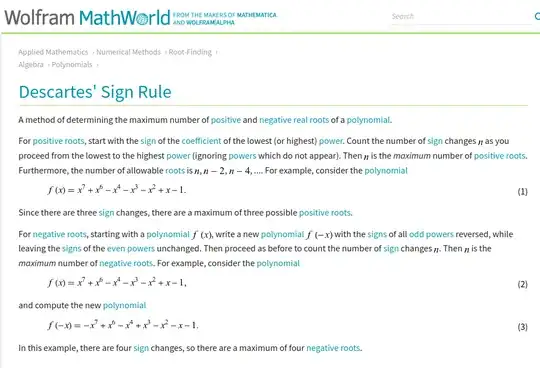
Applying Descartes's Sign Rule (see Appendix), the coefficients of degree of $14$ or higher is the sequence of prime numbers then we have:

$$f\left(x\right)=2+3\,x+5\,x^2+7\,x^3+11\,x^4+13\,x^5+\\ +17\,x^6+19\,x^7+23\,x^8++29\,x^9+31\,x^{10}+37\,x^{11}+\\ +41\,x^{12}+43\,x^{13}+47\,x^{14}+\dots$$ Since the sign of all coefficients is positive, and the smallest coefficient is $2$ there are no positive real roots where $\left.f\left(x\right)\right|_{x\ge 0}=0$. It is fairly obvious to see this result since each term is greater or equal to zero (going further and further away from a root) and $2>0$. However, the remaining question is what is the result in terms of roots for $x<0$.

I am still working on that question. I am still working on fully solving Question 2.

4. Appendix: Descartes's Sign Rule

The application of Descartes' Sign Rule might greatly assist this effort as quoted in the screen-shot below. If there is a situation that there are no positive roots and no negative roots, then all roots are complex and therefore the minimal root is complex.
Quoted Descartes' Sign Rule