I am not surprised that you were not able to show the other inclusion. Under the given conditons "$Y$ connected and $X$ path-connected" it is in general not true. See Vincent Boelens's answer for a proof under stronger assumptions.
Here is a counterexample. Let $T \subset \mathbb R^2$ denote the closed topologist's sine curve $T = L \cup S$ with $L = \{0\} \times [-1,1]$ and $S= \{\left(x, \sin(\frac \pi x)\right) \mid x \in (0,1] \}$. Let $\tau_n : \mathbb R^2 \to \mathbb R^2$ denote the translation by the vector $(0,n)$ with $n \in \mathbb Z$. Define $T_n = \tau_n(T)$. We have $T_n \cap T_{n+1} = \{(n+1,0)\}$ and $T_n \cap T_m =\emptyset$ if $m \ge n+2$. Now define
$$Y = \bigcup_{n \in \mathbb Z} T_n .$$
$Y$ is an infinite chain of copies of $T$. It is well known that $T$ is connected and has two path-components ($L$ and $S$) which are contractible. Hence $Y$ is connected and has infinitely many path components $P_n = \tau_n(S) \cup \{n+1\} \times [-1,1]$ which are contractible.
The additive group $\mathbb Z$ operates on $Y$ via the translations $\tau_n$ (which restrict to homeomorphisms on $Y$).
The quotient $X = Y /\mathbb Z$ of this operation is nothing else than the quotient space $T/E$ obtained by identifying $E= \{ (0,0), (0,1)\}$ to a single point. The quotient map $p : Y \to X$ is a covering map. This is completely analogous to the standard covering map $p : \mathbb R \to [0,1]/\{0,1\} = S^1$.
The space $X = T/E$ is a variant of the Warsaw circle:
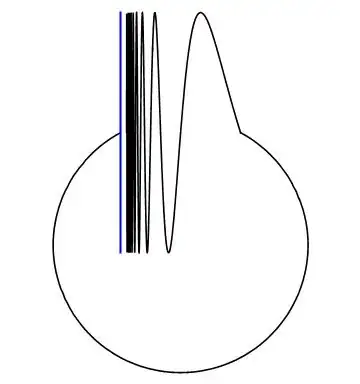
It is well-known that this space is path-connected and simply connected (it has no non-contractible loops).
Pick any $x \in X$. Then $S =p^{-1}(x)$ is countably infinite. Since $X$ is simply connected, lifts of closed paths are again closed paths. Thus $z * \sigma = z$ for all $z \in S$ so that the condition $\varphi(z*\sigma)=\varphi(z)*\sigma$ is satisfied for all $\varphi \in \operatorname{Aut}(S)$.
However, the only deck transformtions of $Y$ are the translations $\tau_n$. This shows that $\operatorname{Aut}(Y/X) \subsetneqq \operatorname{Aut}(S)$.


