1

We have a quadratic bezier curve, with control point A (red start), control point B (red end), and yellow point X what belongs to the curve and what you actually "drag" - so it should be the closest point to the missing control point C (blue) what forms the curve. What is a formula getC(A,B,X) to calculate it?

drawing http://www.freeimagehosting.net/newuploads/d89e6.gif

A popular solution is when we think that X corresponds to t=1/2 for calculating C is not giving a nice result.

The concept is explained on this thread. But still I can't figure out the final formula for calculating C from it - having difficulty to understand the "orthogonality relation"

Thanks for any help!

bub
  • 13
  • I'm surprised that using $t = 1/2$ doesn't give a good result. If you use $t = 1/2$, then $X$ will be the mid-point of the line from $C$ to $\tfrac12(A+B)$, and the tangent at $X$ will be parallel to the chord $AB$. So, you generally get "natural" behaviour that users like. What problems did you find? – bubba Sep 01 '13 at 02:03
  • well I was implementing a "dragging" of the curve what has static start and the end. so if I drag the yellow point close to the end (right red X on the picture) - it corresponds to the t = 1/10 or so, and if we calculate the missing control point based on t = 1/2 we are getting a "not optimal" curve, smth like that image - black curve is what we get, yellow is a desired curve. it looks nice only if you drag in the middle - that's why I was looking for a better solution – bub Sep 09 '13 at 23:53
  • OK. Thanks. Makes sense. My experience is that users tend to drag near the middle of the curve, so using t=1/2 has never been a problem for me. But, the new solution is certainly better. It was a good question, and I learned a lot by working on it. – bubba Sep 10 '13 at 03:09

4 Answers4

2

For simplicity of derivation, choose a coordinate system such that $\vec{X}$ is the origin. The quadratic curve between $\vec{A}$ and $\vec{B}$ has the parametrization:

$$[0,1] \ni s \quad\mapsto\quad \vec{\gamma}(s) = (1-s)^2 \vec{A} + s^2 \vec{B} + 2s(1-s)\vec{C}$$

Since $\vec{X}$ lies on the quadratic curve, for some $t \in [0,1]$, $\vec{\gamma}(t) = \vec{X} = \vec{0}$. This implies $$\vec{C} = -\frac12 \left( \lambda^{-1} \vec{A} + \lambda \vec{B} \right) \quad\text{ where }\quad \lambda = \frac{t}{1-t}.$$ So the problem of locating $\vec{C}$ reduces to the problem of figuring out the parametrization parameter $t$ for $\vec{X}$.

The tangent vector for the quadratic curve at $X$ is given by:

$$\gamma'(t) = \left.\frac{d\vec{\gamma}(s)}{ds}\right|_{s=t} = -2(1-t)\vec{A} + 2t\vec{B} + 2(1-2t)\vec{C} $$

Notice $$\lambda = \frac{t}{1-t} \implies t = \frac{\lambda}{1+\lambda},\;\;1 - t = \frac{1}{1+\lambda} \;\;\text{ and }\;\; 1 - 2t = \frac{1-\lambda}{1+\lambda}$$ We find

$$ \gamma'(t) = -\frac{2}{1+\lambda}\vec{A} + \frac{2\lambda}{1+\lambda} \vec{B} - \frac{1 - \lambda}{1+\lambda} \left( \lambda^{-1} \vec{A} + \lambda \vec{B} \right) = \lambda \vec{B} - \lambda^{-1}\vec{A} $$ The condition that $\vec{X}$ is the point on $\vec{\gamma}(s)$ closest to $\vec{C}$ can be expressed as:

$$\gamma'(t) \cdot \vec{C} = 0 \quad\iff\quad \left( \lambda^2 \vec{B} - \vec{A} \right) \cdot \left( \lambda^2 \vec{B} + \vec{A} \right) = \lambda^4 R_B^2 - R_A^2 = 0 $$ where $R_A = |\vec{A}| $ and $R_B = |\vec{B}|$. This give us

$$\lambda = \sqrt{R_A/R_B} \quad\implies\quad\vec{C} = -\frac{\sqrt{R_AR_B}}{2}\left( \frac{\vec{A}}{R_A} + \frac{\vec{B}}{R_B} \right)$$

Update

In the general case when $\vec{X}$ is not the origin, let

$$\vec{A} = (A_x,A_y),\;\;\vec{B} = (B_x,B_y),\;\;\vec{C} = (C_x,C_y),\quad\text{ and }\quad \vec{X} = (X_x,X_y).$$

The distances of $\vec{A}$, $\vec{B}$ from $\vec{X}$ become $$\begin{cases} R_A = & \sqrt{(A_x - X_x)^2 + (A_y - X_y)^2}\\ R_B = & \sqrt{(B_x-X_x)^2 + (B_y-X_y)^2}, \end{cases}$$

and the coordinates of $\vec{C}$ turns into:

$$\begin{cases} C_x = & X_x - \frac{\sqrt{R_A R_B}}{2}\left(\frac{A_x - X_x}{R_A} + \frac{B_x - X_x}{R_B}\right)\\ \\ C_y = & X_y - \frac{\sqrt{R_A R_B}}{2}\left(\frac{A_y - X_y}{R_A} + \frac{B_y - X_y}{R_B}\right) \end{cases}$$

achille hui
  • 125,323
2

An addendum to Achille Hui's fine solution (which is too long for a comment):

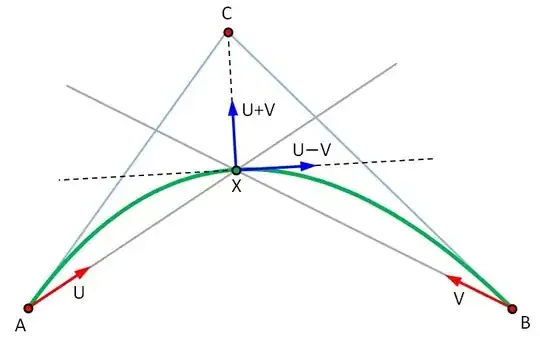
Let $\vec{U}$ and $\vec{V}$ be unit vectors in the directions of $\vec{X} - \vec{A}$ and $\vec{X} - \vec{B}$ respectively. Also, let $h = \Vert{\vec{X} - \vec{A}}\Vert$ and $k = \Vert{\vec{X} - \vec{B}}\Vert$. My $h$ and $k$ are Achille's $R_A$ and $R_B$ respectively. Then we have $\vec{X} - \vec{A} = h\vec{U}$ and $\vec{X} - \vec{B} = k\vec{V}$.

Achille showed that $$ \vec{C} = \vec{X} + \frac12\sqrt{hk}(\vec{U} + \vec{V}) $$

But the vector $\vec{U} + \vec{V}$ is along the bisector of the lines $AX$ and $BX$, so, we get a nice geometric result: the middle control point $\vec{C}$ of the "optimal" curve lies on the bisector of the lines $AX$ and $BX$.

Also, the first derivative vector of the optimal curve at the point $\vec{X}$ is given by $$ \gamma'(t) = \sqrt{hk}(\vec{U} - \vec{V}) $$ The vector $\vec{U} - \vec{V}$ is along the other bisector of the lines $AX$ and $BX$, so, we get another nice geometric result: the tangent vector of the "optimal" curve is parallel to the bisector of the lines $AX$ and $BX$.

In aircraft lofting departments, there are people who construct parabolas (and other conic section curves) all day long. I wonder if they use this construction to get a "nice" parabola through three given points. I'll ask, next time I get a chance.

Here's a picture illustrating the geometry: curve

bubba
  • 44,617
0

Actually the bisector thing is a beautiful found I did at 2012 also at my paper that cover that theme “Quadratic bezier through three points” and something related of what I call “equivalent quadratic bezier”. Hope you found it interesting

https://microbians.com/math/Gabriel_Suchowolski_Quadratic_bezier_through_three_points_and_the_-equivalent_quadratic_bezier_(theorem)-.pdf

also had some more info on quadratic offseting and examples here https://microbians.com/mathcode

enter image description here

Gabriel
  • 141
0

My approach would be along the lines of:

  1. Find the slope of the tangent line at any point along the quadratic curve
  2. Find the slope of the line from any point on the curve to the blue control point
  3. Then pick a point from step 2 that gives you a slope that is orthogonal (i.e. perpendicular) to the slope of the tangent line at that same point

Remember that two slopes are orthogonal if their product is -1.

Mufasa
  • 5,522
  • the problem is that the curve is unknown, we have only red points (start and end) and the yellow point X what belongs to it - we have to build a curve by figuring out the unknown blue point C (control point) - we know only that CX is orthogonal to the tangent line in the point X) – bub Aug 30 '13 at 22:37