1

In the $ABC$ triangle $ m(\widehat{BAC})=18^o$, $m(\widehat{ACB})=30^o$ and $m(\widehat{CBA})=132^o$. Inside the $ABC$ triangle we take a point $O$ so that $m(\widehat{OAB})=12^o$ and $m(\widehat{OBA})=114^o$. Calculate $m(\widehat{OCA})$ and $m(\widehat{OCB})$ without using the Trigonometric Form of Ceva's Theorem.

I tried making different geogebra diagrams but came to no clear idea, how should I start?

enter image description here

Birgitt
  • 387
  • That looks like something you can just read from the drawing, or am I missing something? – Dominique Oct 23 '23 at 14:55
  • i will attach a drawing in a second – Birgitt Oct 23 '23 at 15:04
  • If you were allowed to use the trigonometric form of Ceva's theorem, what would your answer be? – Calvin Lin Oct 23 '23 at 16:22
  • @CalvinLin Using the trigonometric form of Ceva's I got that $m(\widehat{OCA})=18^o$ and $m(\widehat{OCB})=12^o$. – Birgitt Oct 23 '23 at 16:31
  • 1
    One approach is to use the 30-gon, and show that those chords are concurrent, which is why the angles are $ 18^\circ, 12^\circ$. It's not ideal as it requires knowing the answer before hand. Several of these trio problems where the angle is multiples of $6^\circ$ or $10^\circ$ could be dealt with in a similar manner. – Calvin Lin Oct 23 '23 at 23:42

1 Answers1

2

I provide another answer since the one given by sirious, despite being accepted, appears to be, so far, incomplete.

The idea orginates from the observation that the angles involved are related to those of regular pentagon and triangle.

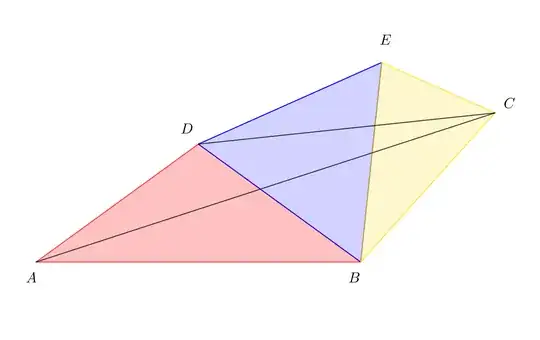
We will therefore "carve out" triangle $ABC$ from the figure below, where $ABD$ is an isosceles triangle with $\measuredangle ADB = 108^\circ$, $BED$ is an equilateral triangle, and $BCE$ is an isoceles triangle with $\measuredangle EBC = 36^\circ$. See figure below.
enter image description here

We first show that in fact $ABC$ is the triangle in OP. To this aim, note that $\measuredangle ABC = \measuredangle DEC = 132^\circ$, by angle chasing. Furthermore we have $BC:AB= EC:ED$ (side and diagonals respectively of regular pentagons. This is the key point in my proof, I believe.). Therefore $ABC \sim CED$ (SAS criterion). And since, by angle chasing, $\measuredangle EDC = 18^\circ$ and $\measuredangle ECD = 30^\circ$, we reach our conclusion.

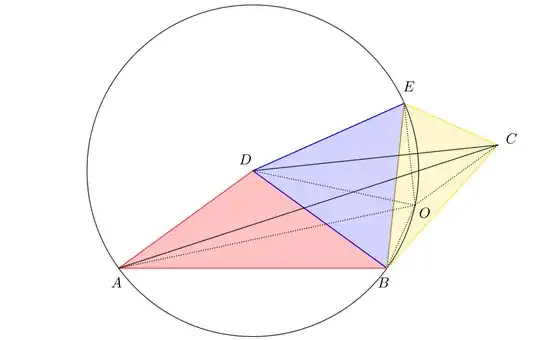
Consider now the circle $(ABE)$, which is centered in $D$, and take on it point $O$ in such a way that $\measuredangle ODB = 24^\circ$.
enter image description here

Let us verify that $O$ is the unique point that satisfies the hypotheses. We obviously have $\measuredangle OAB = \frac12 \measuredangle ODB= 12^\circ$, and $\measuredangle AOB = \frac12 \measuredangle ADB = 54^\circ$, therefore $\measuredangle ABO = 114^\circ$. We thus have $\measuredangle CBO = 18^\circ$, as in the hypotheses. Note that $BO$ bisects $\angle EBC$.

Our thesis is now reached, once we observe that $EBO \cong CBO$ (SAS criterion), and that $\measuredangle BEO = \measuredangle BAO = 12^\circ$. We conclude therefore that $$\boxed{\measuredangle BCO = 12^\circ}.$$

dfnu
  • 8,050
  • It's not clear for me how you got $BC:AB=EC:ED$, what are the regular pentagons that you obtained that from? – Birgitt Nov 03 '23 at 16:02
  • @Birgitt In order to see that, construct the regular pentagon with side $EC$ and note that $EB \cong ED$ is its diagonal. Simlarly, construct the regular pentagon with side $BD \cong BC$ and note that $AB$ is its diagonal. Let me now if you need more details. – dfnu Nov 03 '23 at 19:43
  • I understand, but just to be sure that ratio comes from the golden ratio of a hexagon? I haven't used this propriety before and I just want to be sure i understood everything correctly. So using the golden ratio we can write that $EC:EB=ϕ$ but because $\Delta BDE$ is equilateral $\Rightarrow EB=DB=DE$ so we can write $EC:ED=ϕ$ and in the other hexagon $AB$ is diagonal so $BD:AB=ϕ$, but $BD=BE$ and also $\Delta BEC$ is isoscel so $BC=EB$ we get that $BC:AB=ϕ$ and in conclusion we get $BC:AB=EC:ED$. This is how you got this ratio right? – Birgitt Nov 04 '23 at 09:21
  • And also how did you get $\sphericalangle EDC=18^o$ by angle chasing, I'm just not seeing it for some reason. – Birgitt Nov 04 '23 at 10:06
  • @Birgitt yes, in this case you even know the similarity ratio (the golden ratio). You can avoid any explicit reference to the pentagon, though, e.g. by letting $F \in AB$ a point that gives $FDB \cong EBC$ and work on the similarity $ADF \sim ADB$. As for you second comment, you observe that $DBC$ is isosceles and use its internal angles. – dfnu Nov 04 '23 at 14:00