4

By definition, the small inductive dimension $\operatorname{ind}(\emptyset) = -1$ and, recursively, the small inductive dimension $\operatorname{ind}(X)$ of a nonempty topological space $X$ is the least integer $n \geq 0$ such that each point $x$ has a local base (i.e., a neighborhood base) of open sets $V$ such that $\operatorname{ind}(\operatorname{\partial} V) \leq n - 1$, where $\operatorname{\partial} V$ denotes the boundary of $V$.

(Some versions of the definition require that each neighborhood $U$ of $x$ contain such a $V$ with $\operatorname{cls} V \subset U$. However, that requirement here is redundant since the spaces involved are regular.)

That $\operatorname{ind}(\mathbb{R}) = 1$ is easy to see: $\mathbb{R} \neq \emptyset$; and each point in $\mathbb{R}$ has arbitrarily small neighborhoods of the form $V = (a, b)$, and $\partial\,V$ is the two-point discrete space $\{a, b\}$, which is 0-dimensional.

But what about $\mathbb{R}^2$: is there an elementary proof that $\operatorname{ind} (\mathbb{R}^2) = 2$?

Evidently $\operatorname{ind}(\mathbb{R}^2) \leq 2$, since each point has arbitrarily small neighborhoods that are open disks, and the boundary of such a disk has small inductive dimension $1$. Moreover, $\operatorname{ind}(\mathbb{R}^2) \neq 0$, since the plane is connected; and of course $\operatorname{ind}(\mathbb{R}^2) \neq -1$.

So the thing that remains to prove is that $\operatorname{ind} (\mathbb{R}^2) \neq 1$.

I know there are not-so-elementary proofs that $\operatorname{ind} (\mathbb{R}^n) = n$, but I'm looking for an elementary proof just in the case $n = 2$.

murray
  • 773
  • Ah, okay. Thank you for the edit. This is a slightly different phrasing than I am familiar with. Let me think for a bit, but I think I might have a convincing "elementary" argument. – Xander Henderson Jun 27 '22 at 19:42

3 Answers3

1

In my book

Edgar, Gerald A., Measure, topology, and fractal geometry, Undergraduate Texts in Mathematics. New York etc.: Springer-Verlag. ix, 230 p. DM 58.00/hbk (1990). ZBL0727.28003.

I included what I considered to be the most elementary proof of this fact, Theorem 3.3.4. [It's about 4 pages.] This is done first talking about degree (mod 2) of a map from the circle to itself; then Brouwer's fixed point theorem for the disk; then the topological dimension of the plane.

In the first edition of the book, where I do inductive dimension first, this is done with inductive dimension. In the second edition of the book I switched to the more common arrangement, doing covering dimension first, so this is done with covering dimension.

GEdgar
  • 117,296
  • I am interested in the case of small inductive dimension, and to get at the proof directly, without using the theorem about equality of covering dimension and small inductive dimension for separable metrizable spaces. Alas, I own, and have access, only to the 2nd edition. – murray Jul 04 '22 at 15:00
0

It suffices to show that for every bounded open set $V$ on the plane, its boundary $\partial V$ has a connected subset that has more than one point. Let $V_1$ be a connected component of $V$. Then $K=\overline{V_1}$ is compact and connected. Its complement $K^c$ contains exactly one unbounded connected component $D$. For this domain $D$, its complement $D^c$ consists of $K$ together with the bounded domains in $K^c$, so it is elementary to verify that $D^c$ is connected. Thus the union $D\cup \{\infty\}$ is simply connected on the Riemann sphere, see [2]. Therefore the boundary $\partial D$ is connected, see e.g. [1]. Certainly $\partial D$ contains more than 1 point. But $\partial D \subset \partial K =\partial V_1 \subset \partial V$.

[1] Is it true that a boundary of a simply connected and bounded set is connected in $\mathbb{C}$?

[2] Complement is connected iff Connected components are Simply Connected

Yuval Peres
  • 22,782
  • You state that both $D$ and $D\cup{\infty}$ are simply connected but I guess you mean only the latter, right? Still this is not entirely clear to me. How would you prove it? – Ruy Jul 04 '22 at 03:41
  • Right, only $D \cup{\infty}$ is simply connected. I will add some more detail to the answer. – Yuval Peres Jul 04 '22 at 04:58
  • Robert Israel's answer in [2] assumes that a simple (Jordan) curve in the plane is homotopic to a constant within the bounded region it determines. Although this sounds reasonable, I don't know how to prove it in detail! Do you? – Ruy Jul 04 '22 at 06:17
  • Another fact used by Robert in [2] making me a bit unsure is that a non-simply connected space admits a simple curve not homotopically trivial. – Ruy Jul 04 '22 at 06:28
0

This answer is supposed to be a complement to the answer offered by Yuval Perez, with the following observations:

  1. I am not convinced of the proof given in the link Is it true that a boundary of a simply connected and bounded set is connected in $\mathbb{C}$?, so my answer essentially attempts to fix the part of Yuval's answer that uses that link.

  2. As I mentioned in a comment below Yuval's answer, I am not entirely comfortable with the claim that the set denoted $D$ in Yuval's answer is indeed simply connected (after $\infty $ is added to it). Unfortunately I have no easy fix for this, hence my own answer is dependent on this point.

This said, as noted by Yuval, it suffices to prove the following:

Lemma. If $U$ is a nonempty, open, bounded, simply connected subset of ${\mathbb R}^2$, then the boundary $\partial U$ is connected.

Proof. Identifying ${\mathbb R}^2$ with the complex plane, and using the Riemann mapping theorem, there is a bi-holomorphic map $f$ from the open unit disk $\mathbb D$ onto $U$.

For each real number $r$ in the interval $(0,1)$, consider the subset of $U$ defined by $$ C_r= \{f(z): |z|=r\}. $$

Diagram

Roughly speaking, we will prove that the $C_r$ converge to $\partial U$, and since each $C_r$ is connected, so will be $\partial U$. The details are as follows:

Fixing $\varepsilon >0$, denote by $V_\varepsilon $ the open set $$ V_\varepsilon :=\{x\in U: \text{dist}(x, \partial U)<\varepsilon \}. \tag {1} $$ We then claim that there is some $r_0\in (0,1)$ such that, for every $r$ in $(0,1)$, with $r>r_0$, one has that $$ C_r\subseteq V_\varepsilon . $$

To prove the claim, observe that $$ K_\varepsilon := U\setminus V_\varepsilon = \{x\in U: \text{dist}(x, \partial U)\geq \varepsilon \} $$ is a compact set (Reason: every sequence in $K_\varepsilon $ has a sub-sequence wich converges in $\bar U$, say with limit $x$, because $\bar U$ is compact. By continuity $\text{dist}(x, \partial U)\geq \varepsilon $, so $x$ is not in $\partial U$, meaning that $x\in U$).

The collection of sets $$ D_r:= \{f(z) : |z|<r\}, $$ for $r$ ranging in $(0,1)$, clearly forms a cover for $U$, and in particular also for $K_\varepsilon $. Since the $D_r$ are increasing, by compactness there is some $r_0$ such that $K_\varepsilon \subseteq D_{r_0}$, and hence also $K_\varepsilon \subseteq D_r$, for every $r\geq r_0$. It follows that $$ C_r \subseteq U\setminus D_r \subseteq U \setminus K_\varepsilon = V_\varepsilon , $$ as desired.

Assuming by contradiction that $\partial U$ is disconnected, write $\partial U=B_1\sqcup B_2$, where $B_1$ and $B_2$ are nonempty, closed sets, "$\sqcup$" standing for disjoint union.
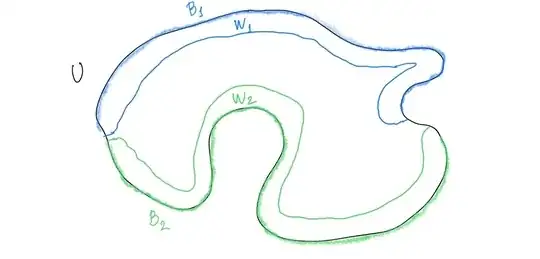
Diagram2

Since both $B_1$ and $B_2$ are closed and bounded, they are compact and hence their distance is strictly positive. In symbols $$ d:= \inf\{|x-y|: x\in B_1, \ y\in B_2\} >0. $$ We then consider, for every $i=1,2$, the open set $$ W_i=\{x\in U: \text{dist}(x, B_i) < d/2\}. $$ Evidently $W_1\cap W_2=\emptyset$, while $W_1\cup W_2=V_{d/2}$ (as defined in (1)).

Taking $r_0$, as above, for the choice of $\varepsilon =d/2$, we conclude that for every $r$ in the interval $(r_0, 1)$, one has that $$ C_r\subseteq W_1\cup W_2. $$ Observing that $C_r$ is connected, we deduce that either $C_r\subseteq W_1$, or $C_r\subseteq W_2$.

However, it is a simple matter to show that, for every $i$, the set $$ J_i:= \{r\in (r_0, 1): C_r\subseteq W_i\} $$ is open. Since $(r_0, 1)= J_1\sqcup J_2$, we have by connectedness that either $J_1$ or $J_2$ coincides with $(r_0,1)$. We then suppose, without loss of generality that $J_1=(r_0, 1)$, which is to say that $$ C_r\subseteq W_1,\quad \forall r\in (r_0,1).\tag {2} $$

Pick some point $x$ in $B_2$, and let $\{x_n\}_n$ be a sequence in $U$, converging to $x$. Assuming, as we may, that $|x_n-x|<d/2$, we necessarily have that $x_n\in W_2$.

Write $x_n=f(z_n)$, where $z_n$ lies in the open unit disk $\mathbb D$. By passing to a subsequence, we may assume that $\{z_n\}_n$ converges to some point $z\in \bar {\mathbb D}$. Clearly $z$ cannot lie in ${\mathbb D}$, because otherwise $$ x = \lim_n x_n = \lim_n f(z_n) = f(z) \in U, $$ but we know that $x\in B_2\subseteq \partial U$.

It follows that $|z|=1$, so $\lim_n|z_n|=1$, and hence there is some $n_0$ such that $n\geq n_0$ entails $|z_n|>r_0$. This implies that, for $n\geq n_0$, $$ x_n=f(z_n) \in C_{|z_n|} \subseteq W_1, $$ by (2), contradicting the fact that $x_n$ lies in $W_2$. QED

Ruy
  • 20,073
  • I would hardly call the preceding an "elementary" proof, using as it does the Riemann mapping theorem! – murray Jul 04 '22 at 15:04
  • How about the Jordan curve Theorem which is also implicitly used here and in the other answers? Unfortunately some facts that look elementary often require a bit of work! – Ruy Jul 04 '22 at 15:46
  • It seems not wholly unreasonable to allow the Jordan curve theorem in an "elementary" proof, although something more basic such as the Brouwer fixed-point theorem in dimension 2 would be preferable. – murray Jul 05 '22 at 20:33