35

I understand the definition of the Maurer-Cartan form on a general Lie group $G$, defined as

$\theta_g = (L_{g^{-1}})_*:T_gG \rightarrow T_eG=\mathfrak{g}$.

What I don't understand is the expression

$\theta_g=g^{-1}dg$

when $G$ is a matrix group. In particular, I'm not sure how I'm supposed to interpret $dg$. It seemed to me that, in this concrete case, I should take a matrix $A\in T_gG$ and a curve $\sigma$ such that $\dot{\sigma}(0)=A$, and compute $\theta_g(A)=(\frac{d}{dt}g^{-1}\sigma(t))\big|_{t=0}=g^{-1}A$ since $g$ is constant. So it looks like $\theta_g$ is just plain old left matrix multiplication by $g^{-1}$. Is this correct? If so, how does it connect to the expression above?

Brian Klatt
  • 2,282

2 Answers2

25

This notation is akin to writing $d\vec x$ on $\mathbb R^n$. Think of $\vec x\colon\mathbb R^n\to\mathbb R^n$ as the identity map and so $d\vec x = \sum\limits_{j=1}^n \theta^j e_j$ is an expression for the identity map as a tensor of type $(1,1)$ [here $\theta^j$ are the dual basis to the basis $e_j$]. In the Lie group setting, one is thinking of $g\colon G\to G$ as the identity map, and $dg_a\colon T_aG\to T_aG$ is of course the identity. Since $(L_g)_* = L_g$ on matrices (as you observed), for $A\in T_aG$, $(g^{-1}dg)_a(A) = a^{-1}A = L_{a^{-1}*}dg_a(A)\in\frak g$.

Ted Shifrin
  • 125,228
  • I am confused by the equality $\theta_a(A)=a^{-1}(A)$. I thought that this equality defines the RHS, but as far as I understand you are saying that RHS makes sense in its own right if $G$ is a Lie subgroup of $\operatorname{GL}(n)$, since you wrote that $(L_g)_*=L_g$ on matrices. – Filippo Feb 13 '25 at 23:38
  • Does it have to do with the fact that $\mathfrak g$ can be identified with a Lie sub algebra of $\operatorname{Mat}(n\times n)$? – Filippo Feb 13 '25 at 23:48
  • Sure, but even if $G$ is not a matrix group, this makes sense according to the very last equality in my answer. – Ted Shifrin Feb 14 '25 at 01:15
5

The map $g:G\to M_{n\times n}$ is a parameterization (embedding if you want) of the group as a submanifold of $M_{n\times n}$ but the name $g$ is a bit misleading. For example, consider for $S\subset \mathbb{R}^2$ the embedding $$ \iota: S \to \mathbb{R}^3 $$ given by $\iota(a,b)=(a^2+b,-b,a+b)$. The differential $d\iota$ is a map $$ d\iota: TS \to T \mathbb{R}^3 $$ and we know that for a vector $(v_1,v_2)\in T_p S$ the image is computed as $$ d\iota_p(v)=\begin{pmatrix} 2a& 1 \\ 0&-1\\ 1&1\\ \end{pmatrix}\cdot \begin{pmatrix} v_1\\ v_2 \end{pmatrix}= \begin{pmatrix} 2av_1+v_2\\ -v_2\\ v_1+v_2 \end{pmatrix}. $$ If we use the natural identification $T_{\iota(p)} \mathbb{R}^3\approx \mathbb{R}^3$ we can think of $d\iota$ as the $\mathbb{R}^3$-valued differential 1-form $$ d\iota=(2ada+db,-db,da+db) $$ In the case of $g:G\to M_{n\times n}$, think of $G$ as the parameter space and $M_{n\times n}$ a fancy way of writing $\mathbb{R}^{n^2}$. So $dg$ is a $M_{n\times n}$-valued differential form in $G$.

By the way, I think you shouldn't write $\theta_g=g^{-1}dg$, but $\theta=g^{-1}dg$ and reserve the subindex for evaluation on an specific $p\in G$. That is, $$ \theta_p=g(p)^{-1} d g_p $$

Even more, with this approach $\theta$ is not really a $\mathfrak{g}$-valued form, but a $M_{n\times n}$-valued one. To have an authenic Maurer-Cartan form the expression should be, for $p\in G$ and $V\in T_pG$ $$ \theta_p (V)=dg_e^{-1}(g(p)^{-1} dg_p(V)). $$
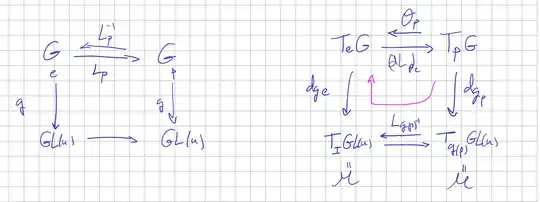
.

I have to admit that I have not seen this expression before, but only the classical $$ g^{-1}dg. $$

Sha Vuklia
  • 4,356
  • I understand the definition of the map $dg_e:T_eG\to M_{n\times n}$, but it is clearly not invertible / surjective in general, so I don't understand your equation $\theta_p (V)=dg_e^{-1}(g(p)^{-1} dg_p(V)).$ – Filippo Feb 14 '25 at 10:36
  • We do not need $dg_e$ to be surjective, we only need the commutativity of the diagram to ensure that $g(p)^{-1} dg_p(V)$ lands inside $\operatorname{im} dg_e$, allowing $dg_e^{-1}$ to be meaningfully applied. – A. J. Pan-Collantes Feb 15 '25 at 12:34
  • 1
    Thank you for the comment. I took me a while to properly understand/appreciate the answer, but now I really like it (+1). – Filippo Feb 15 '25 at 17:34