5

I'm making a pump and I need to make a circular (from the front perspective) hole in a side of a pipe. I can't use a drill and I have to print out a shape that I will stick onto it and cut and file away. Will this circle projected off center onto a cylinder be an ellipse, or is it not an exact ellipse and I have to use a different shape?

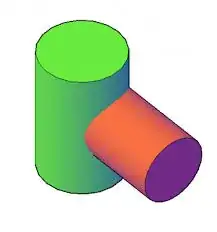
To further clarify, it will look something like this picture if you imagine the orange pipe is a boring bit and is not reaching beyond the centerline of the green pipe. enter image description here

Jean Marie
  • 88,997
  • 2
    It's not an ellipse, since it's not a plane curve (because it's a curve on the cylinder). But maybe you are interested in the actual curve being "unrolled", like if you would unroll the cylinder on which it is "printed"? As it might be easier for you to draw the curve on a sheet of paper and plate it on the cylinder before cutting it? – Jean-Claude Arbaut Jan 16 '22 at 09:57
  • If the pipes have the same diameter, see this. But I assume it's not the case here. – Jean-Claude Arbaut Jan 16 '22 at 10:07
  • Yes, I want to know what shape should i print out on a piece of paper which will be glued on the pipe – Francis L. Jan 16 '22 at 10:51
  • Is the hole centered? I mean, are the axes of the two cylinders coplanar? Also, are thoses axes orthogonal? – Jean-Claude Arbaut Jan 16 '22 at 12:25
  • Their axes are perpendicular to each other but not coplanar – Francis L. Jan 16 '22 at 12:27
  • If you are really cutting a pipe, I wouldn't use math for this. Make a tube out of construction paper and fit it to the contour of the pipe. When you've dialed it in, pencil out the outline to get shape that must be cut. – John Douma Jan 16 '22 at 18:31

2 Answers2

8

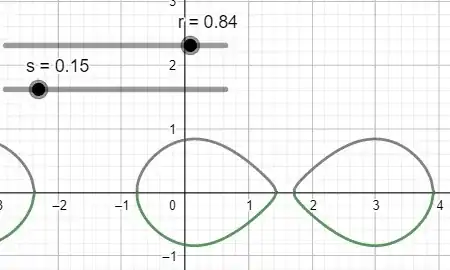
A) Let us consider first the case of intersecting axes (even, as Jean-Claude Arbaut has pointed to, they aren't intersecting in the question). In fact, the equation of the unwrapped intersection curve is a general oval curve (see equation (*)) and even more complicated curves with equation (**) which are not ellipses.
enter image description here

It is possible to play on the $r$ slider (and also the $s$ slider, see below) on the Geogebra figure:

https://www.geogebra.org/calculator/eugrnnec

(Look in particular how close to a circle is the curve when $r$ is small).

Its equation is (assuming the radius of the initial cylinder is $1$ and the boring cylinder has radius $r$ with the $x$ axis taken as its horizontal axis):

$$z=f_r(t)=r \sin(\cos^{-1}(\frac1r \sin(t)))\tag{*}$$

in a $(t,z)$ coordinate system .

Explanation:

$$\begin{cases}x&=&\cos(t)& \ Eq. 1a\\y&=&\sin(t)& \ Eq. 1b\end{cases}\tag{1}$$ and $$\begin{cases}y&=&r \cos(u)& \ Eq. 2a\\z&=&r\sin(u)& \ Eq. 2b\end{cases}\tag{2}$$

Indeed, knowing that unrolling the big cylinder is like taking angle $t$ as the new abscissa, it suffices to be able to express height $z$ as a function of $t$ as given by (*). This will be done in two steps, starting from the equality of Eq. 1b and Eq. 2b :

$$r\cos u= \sin t \implies u= \cos^{-1}(\frac1r \sin t),$$

and then plugging this expression into Eq. 2b.

B) Now, the non interesting case is a little more complicated because (2) has to be replaced by

$$\begin{cases}y&=&r \cos(u)+s& \ Eq. 2a\\z&=&r\sin(u)& \ Eq. 2b\end{cases}\tag{2}$$

where $s$ is the shift amount, finally giving:

$$z=f_{r,s}(t)=r \sin(\cos^{-1}(\frac1r (\sin(t)-s)))\tag{**}$$

Remark: Playing with the $s$ slider, you will see the interesting case of lemniscates (looking like an $\infty$ sign).
Jean Marie
  • 88,997
6

enter image description here

enter image description here

Hints: Here is three figures that may help you:

Flattened I:The of inserting pipe r is equal to radius of large pipe R and the axis es of two pipes are co-planer.

Flattened II: r<R and axis es of two pipes are co-planer.

Flatten III: r<R and surface of insert pipe and large pipe are co-planer(the axis es of pipes are not co-planer).

The radius of cut of inserting pipe is equal to R in all cases.

sirous
  • 12,694
  • 1
    Have you a proof of the last statement? If the radii are equal, then the flattened curve can't be an ellipse, see the link in my comment above. – Jean-Claude Arbaut Jan 16 '22 at 11:01
  • @Jean-ClaudeArbaut, Let's put it this way. Consider two planes having angle$\alpha$, one on the table(horizontal). We have an ellipse on other plane. The projection of this ellipse is a circle on horizontal plane and vise versa. The large pipe when flattened acts like the plane with angle $\alpha$. – sirous Jan 16 '22 at 11:21
  • 3
    When unrolled, you do not get an ellipse: think for example to the limit case where the extrusion is done with a cylinder the same size as the original cylinder: you have in this case a figure with 2 spikes. – Jean Marie Jan 16 '22 at 11:34
  • 3
    @sirous But it's not the same situation here. You are not projecting the circle on a plane, but on a cylinder. So far you haven't proved your statement, and it's wrong when the radii are equal. Actually, there is a reason to believe the curve is more "pointy" than an ellipse: consider the cylinder as the limit of a prism when the number of sides tends to $\infty$. Then the projection on each (plane) face is an arc of ellipse, which is more and more eccentric as the angle between the face of the prism and the plane of the circle grows. – Jean-Claude Arbaut Jan 16 '22 at 12:22
  • @Jean-ClaudeArbaut, you are right. I corrected my figures. These verify the Jean Marie answer. – sirous Jan 17 '22 at 15:25