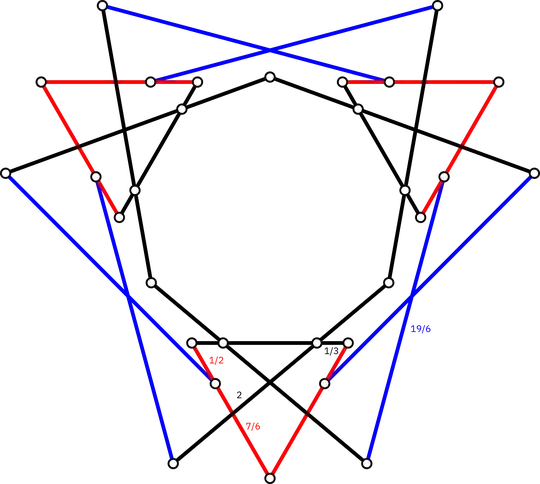
Here is a rational bracing of the regular nonagon of side $1$ with $12$ extra rods (extensions of the nonagon sides don't count), fulfilling a long-held dream of mine:
I found it in a similar manner to the rationally braced pentagon by considering the following framework where $a,b,c$ and the blue edge length are all rational – rods are interpreted as vectors pointing from bottom to top:
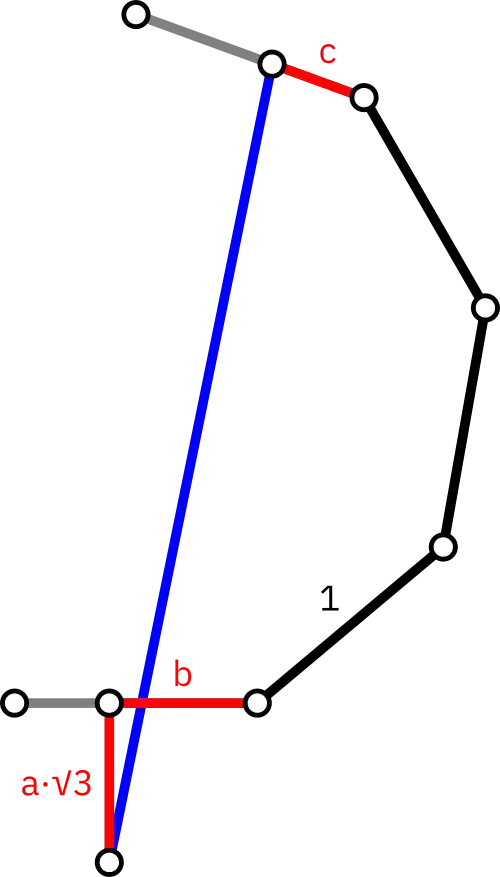
$a,b,c>0$ as depicted, while the bottom-most point can be fixed relative to the horizontal rod by building an equilateral triangle on it, so there's no problem in making the first vector length $a\sqrt3$. Then the blue rod as a complex number is $$a(z^3-z^6)+b+z+z^2+z^3+cz^4$$ where $z=e^{2i\pi/9}$, and its squared length is in $\mathbb Q(z)$: $$3a^2+b^2+c^2+3a-b-c+3+(1+2ac)z-(1+2ac)z^2+(-1-3a-b-c+ac+bc)z^4+(-2-3a-b-c-ac+bc)z^5$$ Since $\{1,z,z^2,z^3,z^4,z^5\}$ is a $\mathbb Q$-basis for $\mathbb Q(z)$ yet the expression has to be a rational square, the coefficients of $z$ to $z^5$ must be zero, leading to $b$ and $c$ expressed in terms of $a$: $$b=\frac{1-3a-6a^2}{1+2a}\qquad c=-\frac1{2a}$$ Substituting gives the blue rod length as $$\frac{\sqrt{1+6a+24a^2+48a^3+144a^4+288a^5+192a^6}}{2a(1+2a)}$$ so all rational bracings under this framework correspond to rational points on the hyperelliptic curve $y^2=1+6a+24a^2+48a^3+144a^4+288a^5+192a^6$.
Using PARI/GP I have found four pairs of rational points on the curve with $a=-\frac12,0,\frac14,\frac32$. The first two values cause a divide-by-zero upon substituting, the third gives the bracing shown at top and the last gives a vertex-edge-degenerate and very large but still rigid bracing. The question here, since this is a hyperelliptic curve, is natural:
Does $a\in\left\{-\frac12,0,\frac14,\frac32\right\}$ describe the complete set of rational points on $y^2=1+6a+24a^2+48a^3+144a^4+288a^5+192a^6$?
I suspect the problem can be resolved with current methods – although the rank of the Mordell–Weil group of the Jacobian is $2$, the sextic in $a$ is also a defining polynomial for $\mathbb Q(z)$, which means it has Galois group $C_6$ and (I think) "elliptic curve Chabauty" as mentioned in this MathOverflow answer (and explicated for $y^2=x^6+x^2+1$ here, though I can't follow the whole thing) can be applied.
It may help that the substitution $a=\frac1{2(t-1)}$ produces a "minimal" birationally equivalent curve $$y^2=t^6-3t^5+6t^4-8t^3+12t^2-6t+1$$

P<x> := PolynomialRing(RationalField()); C := HyperellipticCurve(x^6-3*x^5+6*x^4-8*x^3+12*x^2-6*x+1); Points(C : Bound:=1000);provides a few more points. They appear already withBound:=5, and no further points are found when raisingBoundto 1000. Note that I used your alternative model. – Douglas Molin Nov 17 '21 at 19:01