1

If $P(1,2)$, $Q(−3,2)$ and $R(3,−2)$ are the vertices of the triangle $PQR$, then find the value of $\tan Q$.

$\tan Q = 2/3$

I am unable to solve for $\tan Q$. I constructed the triangle $PQR$ and measured $\alpha$. I found $\tan Q$ to be $2/3$. geometry

I am expected to solve it with slopes, but I am not limited to slopes. I found the slopes of $PQ, QR, \mathrm{and} PR$ i.e. $m_1$, $m_2$, $m_3$ respectively using:
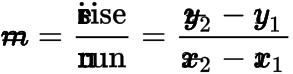
slope

\begin{aligned}m_{1}=\dfrac{2-2}{\left( -3\right) -1}=0\\ m_{2}=\dfrac{\left( -2\right) -2}{3-\left( -3\right) }=\dfrac{-2}{3}\\ m_{3}=\dfrac{\left( -2\right) -2}{3-1}=-2\end{aligned}

geometry-2

  • The second drawing shows that $,\tan(\pi-\theta)=-2/3,$. You should be able to find $,\tan \theta,$ from there. – dxiv Sep 23 '21 at 05:55

3 Answers3

1

Since slope of PQ is zero, we need only to find slope of straight line QR

$$\tan \angle PQR = \frac{-2-(-2)}{3-(-3)}=\frac{-2}{3}.$$

Narasimham
  • 42,260
0

Use this formula:

$\tan (\theta)=\frac {m_2-m_1}{1+m_1\cdot m_2}$

You found $m_1=0$ and $m_2=-\frac 23$,so we have:

$ tan (\theta)=\frac {0-(-\frac 23)}{1-0\times -\frac 23}=\frac 23$

this is for acute angle. You may also find $tan (\theta)=-\frac 23$ which is for obtuse angle $\pi-\theta$.

sirous
  • 12,694
  • $\tan (\theta) =\left| \frac { m _ { 2 } - m _ { 1 } } { 1 + m _ { 1 } \cdot m _ { 2 } } \right|$ –  Sep 23 '21 at 06:23
  • What should I substitute for $m_1$ and $m_2$? –  Sep 23 '21 at 06:47
0

The slope of the line which passes through the points $Q(-3,2)$ and $R(3,-2)$ is

$$m=\frac{y_2-y_1}{x_2-x_1}=\frac{-2-2}{3+3}=-\frac{2}{3}$$

Then the inclination angle, with the horizontal line $QP$ and the line $QR$ is given by

$$-\tan(\theta)=-\frac{2}{3}\implies\tan(\theta)=\frac{2}{3}$$

See also 1 2.

Alessio K
  • 10,679