1

If we have to compute the angle between two lines when their slopes are given, then for using the formula $\tan θ=\dfrac{m_2-m_1}{1+m_2\cdot m_1}$, how would we know which slope to assign $m_1$ and to which $m_2$?

In my textbook question was given like: find the angle from the line with slope $-\frac{7}{3}$ to the line $\frac{5}{2}$ so I can't figure out which one of them should be $m_1$ and which should be $m_2 $ ?

nmasanta
  • 9,640
zb khan
  • 11
  • 1
    I don't think it should really matter, it would come down to a difference of a positive or negative sign. The sign would represent the direction you rotate in, clockwise or counterclockwise, but since all we want is the measure of the angle you should be able to just drop the sign. – Stephen Donovan Jun 18 '21 at 03:21
  • 1
    Why not do it both ways, zb, and see what difference it makes? – Gerry Myerson Jun 18 '21 at 04:11
  • @StephenDonovan yes but when we are solving the mcqs then we want the exact answer with signs so that is why I was asking – zb khan Jun 18 '21 at 04:27
  • In that case you may want to ask for a clarification on whether the sign/direction is important. At that point it's an issue of convention rather than some underlying truth. That said, I would expect given the phrasing that they want the measure of the smallest angle between the two lines, so I would say to give the positive result. – Stephen Donovan Jun 18 '21 at 04:50
  • @ zb the the first is m1 and the second m2. The result will be an angle from the first line to the second. You could verify this by drawing the lines intersecting, since any two will have the same angle, draw the two line through the origin. – Moti Jun 18 '21 at 06:13
  • 5
    Does this answer your question? Slopes and lines –  Sep 23 '21 at 08:31

1 Answers1

0

The angle between two lines of slope $m_1$ and $m_2$ is $$\tan \theta = \left|\dfrac{ m_1 - m_2}{1+m_1m_2} \right|$$ Now if $~\frac{ m_1 - m_2}{1+m_1m_2}~$ is positive then the angle between the lines is acute and if $~\frac{ m_1 - m_2}{1+m_1m_2}~$ is negative then the angle between the lines is obtuse.

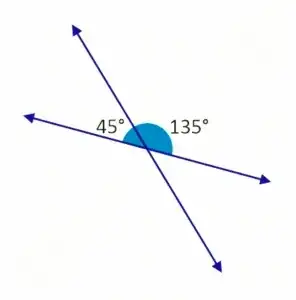
Geometrically, the two different angles represent the same situation with respect to the lines.
For example if $~m_1 = 1/2~$ and $~m_2 = -1/3~,$ then $~\tan θ~$ comes out to be $~1~,$ which means $~θ = 45^\circ~.$ But if we take $~m_1= -1/3~$ and $~m_2= 1/2~,$ then $~\tan θ~$ would come out to be $~-1~,$ which means $~θ = 135^\circ~.$ For more understandable about the fact take a look at the next figure,
enter image description here

So, we needn’t worry about this issue much. But to keep things clean, we use a modulus sign on the formula of $~\tan\theta~$ i.e., the formula for the angle between two lines.

nmasanta
  • 9,640