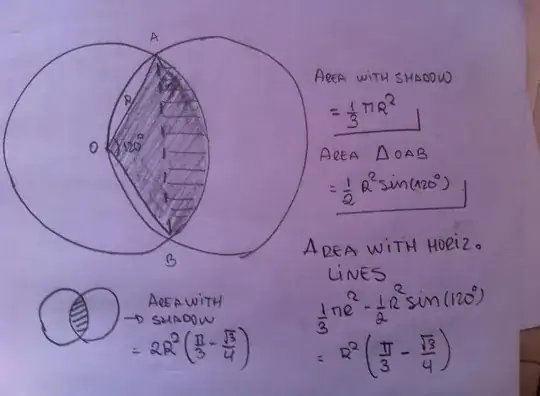
Suppose you have 2 circles that intersect each other in such a way that each circle passes through the other's center. What is the area between the circle(or common area) i.e. area between the centres of the circles?

Suppose you have 2 circles that intersect each other in such a way that each circle passes through the other's center. What is the area between the circle(or common area) i.e. area between the centres of the circles?

Label the center of the first circle $C$ and the center of the second circle $C'$. Label one of the points of intersection of the two circles $A$ and the other $B$. Let the radius of the circles be $r>0$. It should be clear that the following lengths are all equal to $r$. $AC$, $AC'$, $BC$, $BC'$, $CC'$. With a simple application of Pythagoras' Theorem, we get that the length of the line segment $AB$ is $\sqrt{3}r$.
With some basic trigonometry, we find the angles $\angle ACB=\angle AC'B=\dfrac{2\pi}{3}$. So, the area of one half of the intersection is the area of a circular segment with angle $\theta=\dfrac{2\pi}{3}$ and radius $r$, which gives an area of $\dfrac{r^2}{2}(\theta-\sin\theta)=\dfrac{r^2}{2}\left(\dfrac{2\pi}{3}-\dfrac{\sqrt{3}}{2}\right)$ and so the area of the entire intersection is twice this. This gives an area of $$r^2\left(\dfrac{2\pi}{3}-\dfrac{\sqrt{3}}{2}\right).$$

We can build an Equilateral triangle between the points, whose side length is $r$:
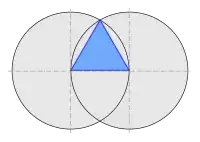
So we know that the points of intersection are $\sqrt{3}r$ apart, and the angle at them is $60^\circ$, by building a rhombus between the dots and centers we know that the angle that "opens" the area is $120^\circ$:
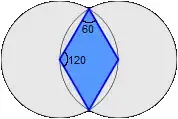
We can now calculate half the area in question as a circular segment:
$$S=2\left[\frac{r^2}{2}\left(\frac{2\pi}{3}-\sin\left(\frac{2\pi}{3}\right)\right)\right]=r^2\left(\frac{2\pi}{3}-\frac{\sqrt{3}}{2}\right)$$
$S$ is the total area in question
One approach is to set up a Boolean function $f$ as
$$f(x,y) = \left\{ \begin{array}{ll} 1 & \text{if } x^2+y^2<r^2 \text{ and } (x-r)^2+y^2<r^2 \\ 0 & \text{else}. \end{array}\right. $$
The area can then be expressed as
$$\int_0^r \int_{-r}^r f(x,y) \, dx \, dy.$$
Here's how to do this computation in Mathematica.
Integrate[
  Boole[x^2 + y^2 < r^2 && (x - r)^2 + y^2 < r^2],
 {x, 0, r}, {y, -r, r},
 Assumptions -> r > 0
]

(* Out: -((3*Sqrt[3] - 4*Pi)*r^2)/6 *)

We can find the answer by using this formula
$4\left(\dfrac{πr^2}{6} - \dfrac{\sqrt{3}}{4r^2}\right) + 2 \dfrac{\sqrt{3}}{4r^2}$
derivation of this formula is this-
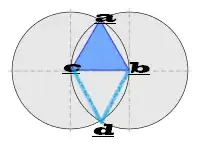
Just like triangle ABC we construct triangle CDB.
We know that triangle ABC is an equilateral triangle because they are radii of same circle.
Therefore angle ABC = 60 degree.
Hence we can find area of between chord AB and BC by multiplying the area of a circle with 1/6 i.e.πr^2/6 (because 60 degree/360 degree=1/6)
We can subtract the area of triangle ( √3/4 * side^2) from it to find the area of the curved part.
In all there are four such congruent parts.
Then we can again add the area of the triangle (twice)
Hence we will get an answer.

The angle between points of intersection is $2 \pi / 3$, so it is: $$ 2 r^2 \cdot \left( \frac{\pi}{3} - \frac{\sqrt{3}}{2} \right) $$