This answer just establishes a lower bound of $11$ tiles. Perhaps the idea can be pushed further to get to $12$.
The number of $2\times2$-squares in the $6\times12$-rectangle is precisely $5\times11=55$, and every such $2\times2$-squares allows for $4$ ways to place the figure in it. So there are $4\times55=220$ ways to place the figure in the rectangle.
With every figure we place, we exclude a number of other placements of the figure:
- Placing a figure in a corner, we exclude either $10$, $14$ or $15$ placements, depending on the orientation of the figure. This includes the placement of this figure itself.
- Placing a figure along an edge, but not in the corner, we exclude either $17$ or $21$ placements, depending on the orientation of the figure. This again includes the placement of the figure itself.
- Placing a figure in the interior we exclude $27$ placements. This again includes the placement of the figure itself.
So to exclude all $220$ placements we certainly need at least $\lceil\tfrac{220}{27}\rceil=9$ figures. This is of course a weak lower bound; there is no such ideal placement of $9$ figures that excludes all other placements. For starters, note that to exclude the four corner placements, in wich a figure covers one corner square and the two adjacent edge squares, we must place a figure along an edge or in a corner. This shows that we need at least $4$ edge or corner placements. Together these exclude at most $4\times21=84$ placements, and so to exclude the remaining $220-84=136$ placements we need at least $\lceil\tfrac{136}{27}\rceil=6$ tiles. So we need at least $4+6=10$ figures.
We can improve this bound further: For every interior placement of a figure, the $12$ squares that are directly adjacent (including diagonally) allow for $6$ ways to place a figure entirely inside the adjacent squares:
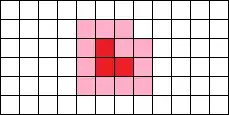
To exclude these $6$ placements we must place figures in such a way that they exclude some placements already excluded by the original placement, shown in red. It is not hard to verify that in this way, at least $10$ placements excluded by the red placement will also be excluded by another placement. That is to say, for every interior placement there will be $10$ out of $27$ placements that will be excluded twice. So effectively an interior placement excludes at most $27-\tfrac{10}{2}=22$ placements. So we need at least $4+\lceil\tfrac{136}{22}\rceil=11$ figures.


