This is a partial answer:
I propose a definition and present conjectures based on extensive computations.
I would like to propose the following definition:
$n\in\mathbb N$ is a Base-Exponent Invariant Sum = Strongly Power Invariant Number (SPIN), if it is an exponentiation invariant sum of unique non-invariant perfect powers:
$$
n=\sum_{i=1}^{k} a_{i}^{b_{i}}=\sum_{i=1}^{k} b_{i}^{a_{i}}, \quad a_{i}>1, b_{i}>1, \quad a_{i}^{b_{i}} \neq b_{i}^{a_{i}}, \quad\left(i \neq j \Longrightarrow\left\{a_{i}, b_{i}\right\} \neq\left\{a_{j}, b_{j}\right\}\right)
$$
For example, the smallest SPIN has $k=6$ terms in the sum and equals:
$$\begin{align}
432 &= 3^{2}+5^{2}+2^{6}+3^{4}+5^{3}+2^{7} \\&= 2^{3}+2^{5}+6^{2}+4^{3}+3^{5}+7^{2}.
\end{align}$$
Some numbers $n$ correspond to more than just one sum. For example:
$$
\begin{align}
1554&=3^{2}+7^{2}+6^{3}+2^{8}+4^{5} \\
&=2^{3}+2^{7}+3^{6}+8^{2}+5^{4}, \\
1554&=3^{2}+5^{2}+2^{6}+10^{2}+2^{7}+3^{5}+2^{8}+3^{6}\\
&=2^{3}+2^{5}+6^{2}+2^{10}+7^{2}+5^{3}+8^{2}+6^{3}.
\end{align}
$$
$1554$ equals to one $5$-term sum and to one $8$-term sum.
Up to $n\le 10^4$, there are $887$ SPINs (counting duplicates), see them on pastebin.com.
But, we are interested in examples where $k$ - the number of terms (summands), is small.
$(k\le 5)$ term SPINs
Up to $n\le 10^{20}$, there are only $14$ SPINs with $5$ or less terms, and they all have $5$ terms:
$$\begin{array}{}
1422 &= 5^{2} + 7^{2} + 9^{2} + 3^{5} + 4^{5} &= 2^{5} + 2^{7} + 2^{9} + 5^{3} + 5^{4} \\
1464 &= 5^{2} + 6^{2} + 7^{2} + 5^{4} + 3^{6} &= 2^{5} + 2^{6} + 2^{7} + 4^{5} + 6^{3} \\
1554 &= 2^{3} + 8^{2} + 2^{7} + 5^{4} + 3^{6} &= 3^{2} + 2^{8} + 7^{2} + 4^{5} + 6^{3} \\
2612 &= 5^{2} + 6^{2} + 11^{2} + 3^{5} + 3^{7} &= 2^{5} + 2^{6} + 2^{11} + 5^{3} + 7^{3} \\
3127 &= 2^{3} + 6^{3} + 7^{3} + 2^{9} + 2^{11} &= 3^{2} + 3^{6} + 3^{7} + 9^{2} + 11^{2} \\
4481 &= 6^{2} + 10^{2} + 11^{2} + 2^{7} + 4^{6} &= 2^{6} + 2^{10} + 2^{11} + 7^{2} + 6^{4} \\
5644 &= 9^{2} + 10^{2} + 7^{3} + 4^{5} + 4^{6} &= 2^{9} + 2^{10} + 3^{7} + 5^{4} + 6^{4} \\
16122 &= 2^{3} + 4^{3} + 13^{2} + 2^{8} + 5^{6} &= 3^{2} + 3^{4} + 2^{13} + 8^{2} + 6^{5} \\
68521 &= 8^{2} + 5^{4} + 10^{3} + 6^{4} + 4^{8} &= 2^{8} + 4^{5} + 3^{10} + 4^{6} + 8^{4} \\
77129 &= 12^{2} + 16^{2} + 6^{4} + 4^{7} + 3^{10} &= 2^{12} + 2^{16} + 4^{6} + 7^{4} + 10^{3} \\
82583 &= 5^{2} + 3^{4} + 16^{2} + 2^{12} + 5^{7} &= 2^{5} + 4^{3} + 2^{16} + 12^{2} + 7^{5} \\
1065585 &= 9^{2} + 12^{2} + 20^{2} + 4^{7} + 4^{10} &= 2^{9} + 2^{12} + 2^{20} + 7^{4} + 10^{4} \\
4227140 &= 13^{2} + 7^{4} + 11^{4} + 5^{6} + 2^{22} &= 2^{13} + 4^{7} + 4^{11} + 6^{5} + 22^{2} \\
6164560 &= 18^{2} + 7^{5} + 5^{9} + 2^{21} + 8^{7} &= 2^{18} + 5^{7} + 9^{5} + 21^{2} + 7^{8}
\end{array}$$
where the largest one is smaller than $10^7 \ll 10^{20}$.
Conjecture: There are no SPINs with fewer than $5$ terms.
Conjecture: There are exactly $14$ SPINs with exactly $5$ terms.
This is probably hard to prove.
E.g. a similar problem to $k=2$ was linked by TheSimpliFire in the comments; which is still open: Conjecture: No positive integer can be written as $a^b+b^a$ in more than one way. That is, $k=2$ is equivalent to the linked problem but for $a^b-b^a$ instead:
$$
a^b+c^d=b^a+d^c \iff a^b-b^a = d^c - c^d.
$$
$(k\ge 6)$ term SPINs
Conjecture: For any fixed $k\ge 6$, there are infinitely many $k$-term SPINs.
That is, the known $20$-term family:
$$
n(t) = 2^{2t} + 2^{2t+8}+ 2^{2t+16} + 2^{2t+32} + 2^{2t+34} + 4^{t+1} + 4^{t+2} + 4^{t+10} + 4^{t+14} + 4^{t+18} + t^{4} + (t+4)^{4} + (t+8)^{4} + (t+16)^{4} + (t+17)^{4} + (2t+2)^{2} + (2t+4)^{2} + (2t+20)^{2} + (2t+28)^{2} + (2t+36)^{2}
$$
gives a $20$-term SPIN for every $t\gt 4$, but I claim that a $6$-term family $n(t_1,t_2,\dots)$ exists.
But, this is also probably hard to show.
In my attempts to find such a family, I found a "special kind" of $k=6$ examples.
$(k = 6)$ term SPINs, of special kind
Up to $n\le 10^{10}$, there are $101$ SPINs with $6$ terms; see them on github.io.
It is actually possible to find very large examples for $k=6$. For example,
$$
n^* = 2^5 + 11^2 + 2^{28} + 52^2 + 8192^4 + 2^{16384} = 5^2 + 2^{11} + 28^2 + 2^{52} + 4^{8192} + 16384^2
$$
has $4933$ decimal digits (is larger than $n^*\gt 10^{4932}$).
This was possible to find by searching for a "special kind" of $6$-term SPINs:
$$
n^{*}=\sum_{i=1}^4a_i^{b_i} + x^4 + 2^{2x} =\sum_{i=1}^4b_i^{a_i} + 4^x + (2x)^2
$$
which are numerous because $|(4^x-x^4) - ((2x)^2-2^{2x})|$ is "quite small". That is,
when I was searching for a $k=2$ example, I was trying to minimize the "error":
$$|(a_1^{b_1}-b_1^{a_1})-(a_2^{b_2}-b_2^{a_2})|$$
for a fixed first term $i=1$ and finding nearest smaller second term $i=2$.
In the logarithmic plot of "error"s for first $1000$ terms $(a_i^{b_i}-b_i^{a_i})$ we find:
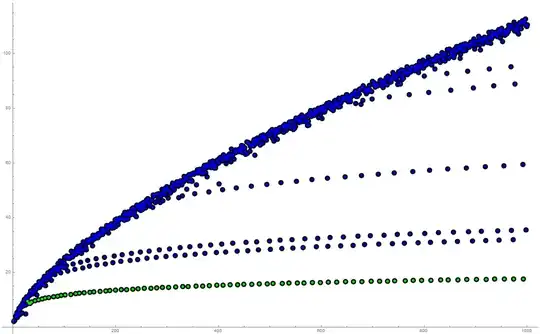
that $\{a_1,b_1\}=\{4,x\}$ and $\{a_2,b_2\}=\{2x,2\}$ have the smallest "error"s. That is, observe the arc of points ("errors") closest to the x-axis, which I colored in green.
These errors can sometimes be reduced to $0$ by adding $4$ additional terms, which gives a $6$-term example of this "special kind" $n^{*}$.
Up to $n^{*}\le 10^{20}$, there are $41$ of these "special kind" $6$-term SPINs:
$$\begin{align}
3^{2} + 5^{2} + 2^{7} + 5^{3} + 3^{4} + 2^{6} &=& 2^{3} + 2^{5} + 7^{2} + 3^{5} + 4^{3} + 6^{2} \\
2^{5} + 3^{4} + 5^{3} + 9^{2} + 5^{4} + 2^{10} &=& 5^{2} + 4^{3} + 3^{5} + 2^{9} + 4^{5} + 10^{2} \\
2^{3} + 3^{4} + 6^{2} + 6^{3} + 5^{4} + 2^{10} &=& 3^{2} + 4^{3} + 2^{6} + 3^{6} + 4^{5} + 10^{2} \\
2^{3} + 7^{3} + 8^{3} + 5^{6} + 3^{4} + 2^{6} &=& 3^{2} + 3^{7} + 3^{8} + 6^{5} + 4^{3} + 6^{2} \\
5^{2} + 7^{2} + 8^{2} + 11^{2} + 7^{4} + 2^{14} &=& 2^{5} + 2^{7} + 2^{8} + 2^{11} + 4^{7} + 14^{2} \\
7^{2} + 4^{6} + 2^{14} + 9^{3} + 3^{4} + 2^{6} &=& 2^{7} + 6^{4} + 14^{2} + 3^{9} + 4^{3} + 6^{2} \\
6^{2} + 2^{8} + 2^{9} + 6^{4} + 7^{4} + 2^{14} &=& 2^{6} + 8^{2} + 9^{2} + 4^{6} + 4^{7} + 14^{2} \\
3^{7} + 6^{5} + 13^{2} + 4^{7} + 3^{4} + 2^{6} &=& 7^{3} + 5^{6} + 2^{13} + 7^{4} + 4^{3} + 6^{2} \\
2^{3} + 7^{2} + 2^{8} + 12^{2} + 8^{4} + 2^{16} &=& 3^{2} + 2^{7} + 8^{2} + 2^{12} + 4^{8} + 16^{2} \\
3^{2} + 5^{2} + 3^{5} + 12^{2} + 8^{4} + 2^{16} &=& 2^{3} + 2^{5} + 5^{3} + 2^{12} + 4^{8} + 16^{2} \\
8^{2} + 5^{4} + 4^{6} + 8^{3} + 8^{4} + 2^{16} &=& 2^{8} + 4^{5} + 6^{4} + 3^{8} + 4^{8} + 16^{2} \\
2^{6} + 9^{2} + 5^{7} + 8^{4} + 5^{4} + 2^{10} &=& 6^{2} + 2^{9} + 7^{5} + 4^{8} + 4^{5} + 10^{2} \\
5^{3} + 8^{3} + 7^{5} + 2^{16} + 7^{4} + 2^{14} &=& 3^{5} + 3^{8} + 5^{7} + 16^{2} + 4^{7} + 14^{2} \\
3^{2} + 2^{11} + 2^{13} + 14^{2} + 9^{4} + 2^{18} &=& 2^{3} + 11^{2} + 13^{2} + 2^{14} + 4^{9} + 18^{2} \\
9^{2} + 7^{3} + 5^{7} + 16^{2} + 9^{4} + 2^{18} &=& 2^{9} + 3^{7} + 7^{5} + 2^{16} + 4^{9} + 18^{2} \\
6^{3} + 3^{7} + 2^{13} + 9^{3} + 10^{4} + 2^{20} &=& 3^{6} + 7^{3} + 13^{2} + 3^{9} + 4^{10} + 20^{2} \\
2^{9} + 6^{4} + 3^{10} + 16^{2} + 10^{4} + 2^{20} &=& 9^{2} + 4^{6} + 10^{3} + 2^{16} + 4^{10} + 20^{2} \\
3^{2} + 3^{4} + 8^{2} + 7^{4} + 11^{4} + 2^{22} &=& 2^{3} + 4^{3} + 2^{8} + 4^{7} + 4^{11} + 22^{2} \\
7^{2} + 2^{10} + 2^{12} + 9^{3} + 11^{4} + 2^{22} &=& 2^{7} + 10^{2} + 12^{2} + 3^{9} + 4^{11} + 22^{2} \\
11^{2} + 12^{2} + 13^{2} + 7^{4} + 13^{4} + 2^{26} &=& 2^{11} + 2^{12} + 2^{13} + 4^{7} + 4^{13} + 26^{2} \\
5^{2} + 4^{7} + 2^{14} + 10^{3} + 13^{4} + 2^{26} &=& 2^{5} + 7^{4} + 14^{2} + 3^{10} + 4^{13} + 26^{2} \\
5^{3} + 4^{7} + 9^{3} + 15^{2} + 14^{4} + 2^{28} &=& 3^{5} + 7^{4} + 3^{9} + 2^{15} + 4^{14} + 28^{2} \\
7^{2} + 8^{3} + 2^{17} + 7^{6} + 14^{4} + 2^{28} &=& 2^{7} + 3^{8} + 17^{2} + 6^{7} + 4^{14} + 28^{2} \\
2^{9} + 3^{7} + 3^{8} + 10^{3} + 15^{4} + 2^{30} &=& 9^{2} + 7^{3} + 8^{3} + 3^{10} + 4^{15} + 30^{2} \\
5^{4} + 6^{4} + 7^{4} + 15^{2} + 15^{4} + 2^{30} &=& 4^{5} + 4^{6} + 4^{7} + 2^{15} + 4^{15} + 30^{2} \\
3^{4} + 9^{2} + 8^{3} + 10^{3} + 16^{4} + 2^{32} &=& 4^{3} + 2^{9} + 3^{8} + 3^{10} + 4^{16} + 32^{2} \\
13^{2} + 3^{9} + 6^{7} + 9^{4} + 17^{4} + 2^{34} &=& 2^{13} + 9^{3} + 7^{6} + 4^{9} + 4^{17} + 34^{2} \\
2^{8} + 8^{3} + 15^{2} + 16^{2} + 18^{4} + 2^{36} &=& 8^{2} + 3^{8} + 2^{15} + 2^{16} + 4^{18} + 36^{2} \\
2^{5} + 6^{2} + 2^{11} + 17^{2} + 19^{4} + 2^{38} &=& 5^{2} + 2^{6} + 11^{2} + 2^{17} + 4^{19} + 38^{2} \\
4^{3} + 2^{7} + 3^{7} + 17^{2} + 19^{4} + 2^{38} &=& 3^{4} + 7^{2} + 7^{3} + 2^{17} + 4^{19} + 38^{2} \\
5^{6} + 5^{7} + 16^{2} + 7^{6} + 20^{4} + 2^{40} &=& 6^{5} + 7^{5} + 2^{16} + 6^{7} + 4^{20} + 40^{2} \\
5^{3} + 6^{4} + 7^{4} + 11^{3} + 21^{4} + 2^{42} &=& 3^{5} + 4^{6} + 4^{7} + 3^{11} + 4^{21} + 42^{2} \\
2^{9} + 3^{7} + 15^{2} + 8^{5} + 25^{4} + 2^{50} &=& 9^{2} + 7^{3} + 2^{15} + 5^{8} + 4^{25} + 50^{2} \\
2^{8} + 2^{13} + 4^{8} + 19^{2} + 26^{4} + 2^{52} &=& 8^{2} + 13^{2} + 8^{4} + 2^{19} + 4^{26} + 52^{2} \\
2^{17} + 9^{4} + 4^{24} + 48^{2} + 26^{4} + 2^{52} &=& 17^{2} + 4^{9} + 24^{4} + 2^{48} + 4^{26} + 52^{2} \\
17^{2} + 4^{9} + 4^{26} + 52^{2} + 24^{4} + 2^{48} &=& 2^{17} + 9^{4} + 26^{4} + 2^{52} + 4^{24} + 48^{2} \\
5^{2} + 2^{11} + 9^{4} + 8^{5} + 28^{4} + 2^{56} &=& 2^{5} + 11^{2} + 4^{9} + 5^{8} + 4^{28} + 56^{2} \\
2^{7} + 10^{3} + 4^{10} + 13^{3} + 28^{4} + 2^{56} &=& 7^{2} + 3^{10} + 10^{4} + 3^{13} + 4^{28} + 56^{2} \\
2^{8} + 2^{11} + 13^{2} + 10^{4} + 32^{4} + 2^{64} &=& 8^{2} + 11^{2} + 2^{13} + 4^{10} + 4^{32} + 64^{2} \\
6^{2} + 2^{10} + 4^{6} + 20^{2} + 32^{4} + 2^{64} &=& 2^{6} + 10^{2} + 6^{4} + 2^{20} + 4^{32} + 64^{2} \\
5^{3} + 2^{19} + 12^{3} + 10^{4} + 32^{4} + 2^{64} &=& 3^{5} + 19^{2} + 3^{12} + 4^{10} + 4^{32} + 64^{2} \\
\end{align}$$
It seems that there are infinitely many of these "special kind" examples.
It also seems that there are infinitely many more $6$-term SPINs (that are not "special kind").
But again, this is probably hard to prove.
We could also probably generate a lot of examples by considering the "second best arc" above the green arc, and so on. Furthermore, we can try to observe smallest errors for larger $k\gt 2$, and try to extend those to even more examples and to examples of $k\gt 6$.
But for $k\le 5$, the errors seem to be too big for large examples to exist.


