1

Question
Using $$\int\int_sG(x,y,z) \;dS=\int\int_RG[x,y,f(x,y)] \sqrt{1+\bigg(\frac{\partial f}{\partial x}\bigg)^2+\bigg(\frac{\partial f}{\partial y}\bigg)^2} \;dx\;dy$$ evaluate the Surface Integral, $\int\int_SG(x,y,z)dS$ where $$G(x,y,z)= \frac{1}{1+4(x^2+y^2)}dS$$ and $S$ is the portion of the paraboloid $z=x^2+y^2$ between $z=0$ and $z=1$.

[Problem II-$4 (b)$, Taken from Div, Grad, Curl, and All that : An Informal Text on Vector Calculus, Chapter-II]

Claimed Answer $$\frac{\pi}2(\sqrt{5} - 1)$$

My Answer $$\frac{\pi}4(\sqrt{5} - 1)$$
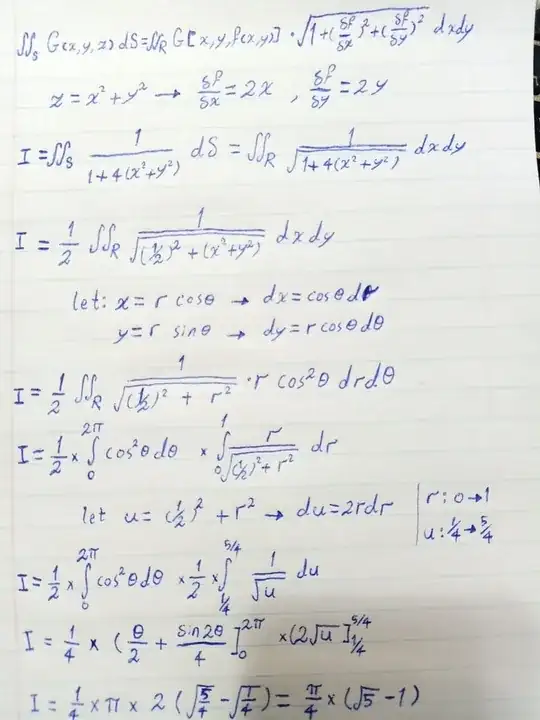
enter image description here

Is my answer incorrect? And if yes, where did I made the mistake?

Rohit Singh
  • 1,141
  • 2
  • 6
  • 16

2 Answers2

1

The problem I suspect is from your change of variables you used. Please be careful when working with expressions such as $dx$.

In general, when you have a a change of variable function $f(x,y) = (u(x,y),v(x,y))$ then you can apply the transformation to an integral of some function $g$ over an area $A$ as such $$\iint _Ag dx dy = \iint_{f(A)} g |\det(J_f)| dudv$$

Where $J_f $ is called the Jacobian matrix, the matrix $\begin{pmatrix} \frac{\partial u}{\partial x} & \frac{\partial u}{\partial y} \\ \frac{\partial v}{\partial x} & \frac{\partial v}{\partial y} \end{pmatrix}$. For an explanation to this please see this post where I got wonderful explanations for this question a few years back.

Anyways if you go ahead and calculate this Jacobian you actually get just $r$, which actually gets you your answer!

Ziad Fakhoury
  • 2,621
  • 1
  • 14
  • 31
0

In your work when you made the transformations $x = r\cos\theta$ and $y = r\sin\theta$, you didn't transform your differentials correctly. Remember that the differential area element transforms as $dxdydz = rdrd\theta dz$. This stems from the determinant of the Jacobian matrix:

$$ \det\left [ \begin{array}{ccc} \partial_rx & \partial_\theta x & \partial_z x \\ \partial_ry & \partial_\theta y & \partial_z y \\ \partial_rz & \partial_\theta z & \partial_z z \\ \end{array} \right ] \;\; =\;\; \det\left [ \begin{array}{ccc} \cos\theta & -r\sin\theta & 0 \\ \sin\theta & r\cos\theta & 0 \\ 0 & 0 & 1 \\ \end{array} \right ] \;\; =\;\; r. $$

Mnifldz
  • 13,228