10

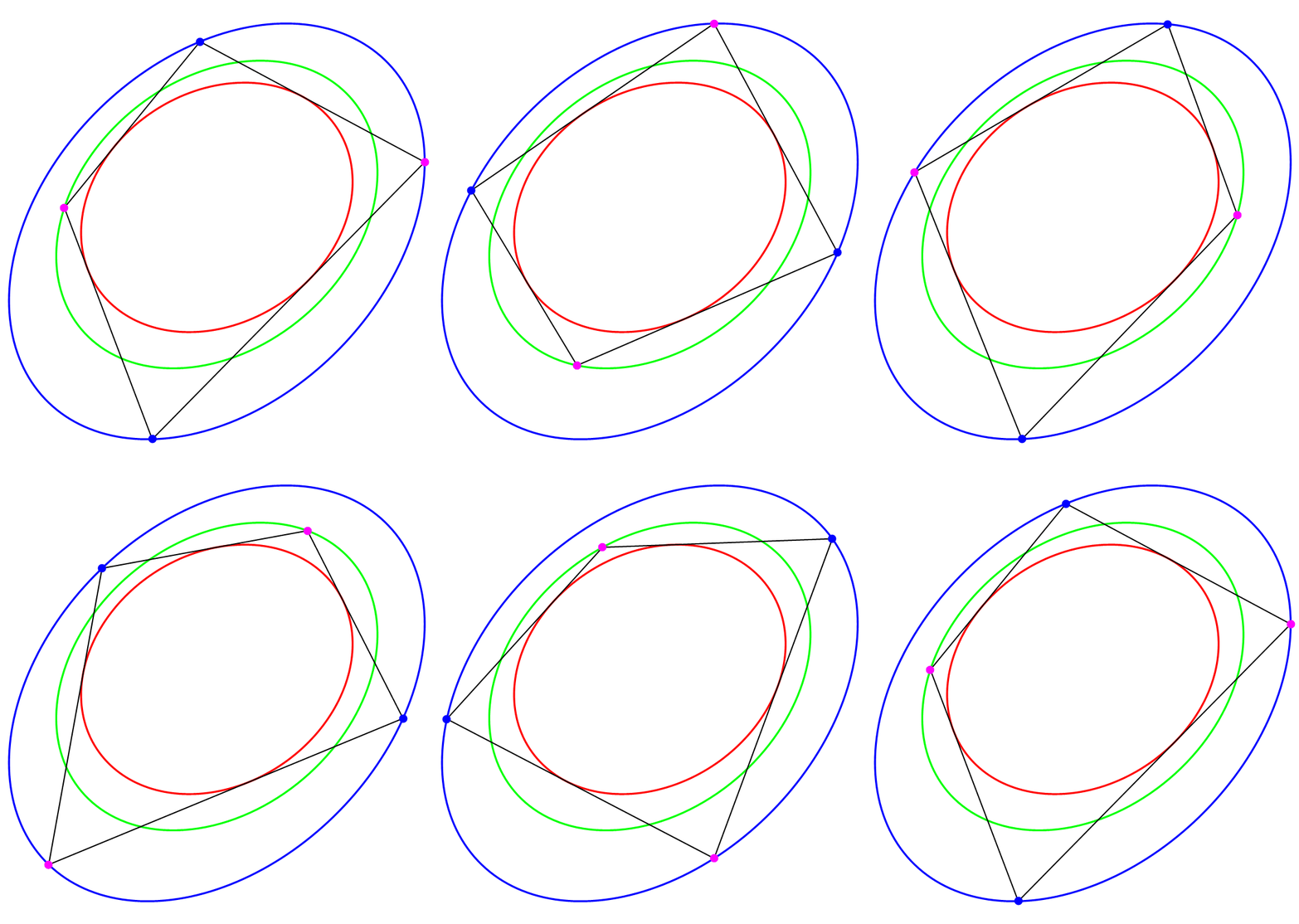
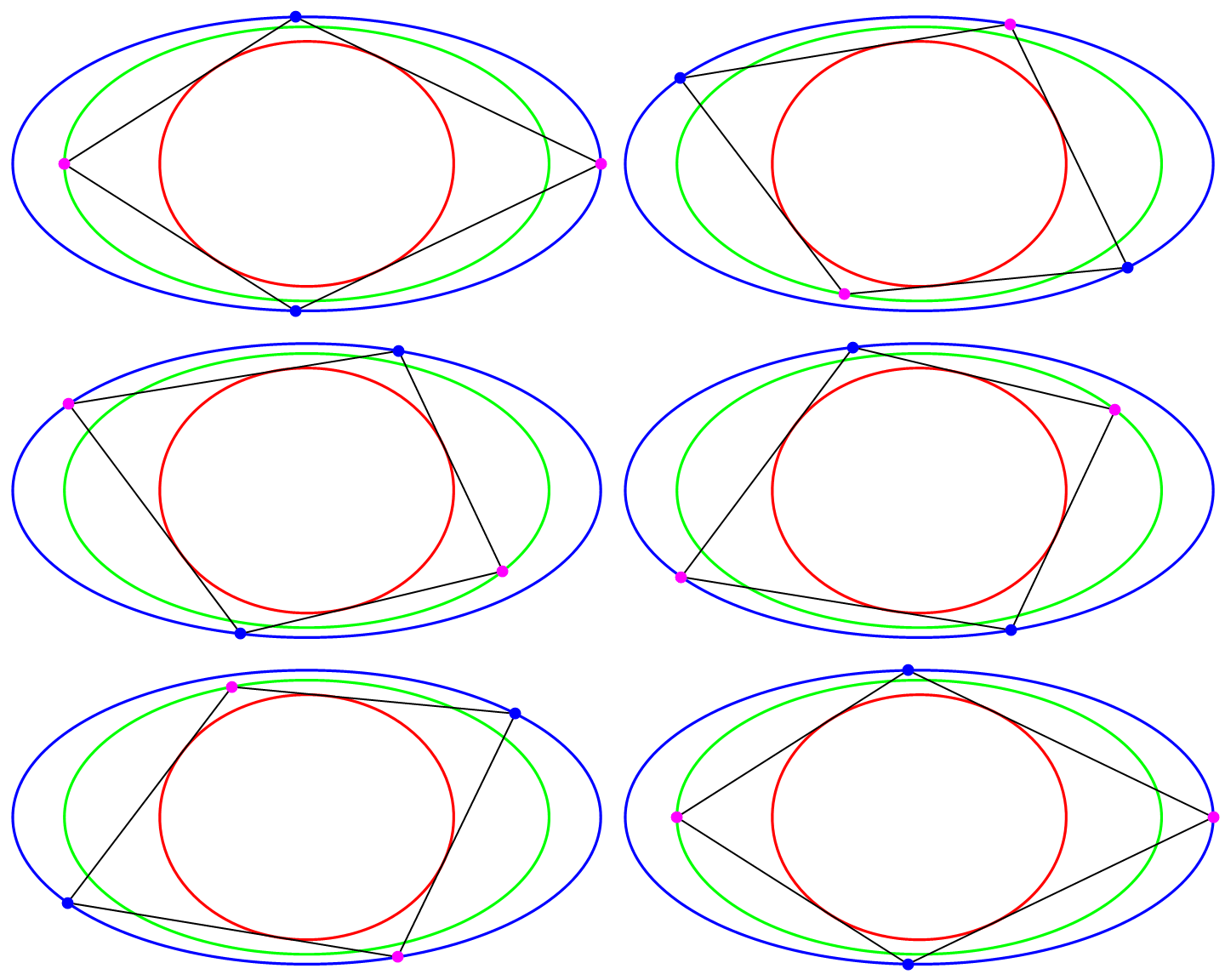
Consider an ellipse and a circle inside it. They have the same center. Let $P$ be a moving point on the ellipse. Through $P$, draw the two tangents to the circle, which meet the ellipse at $A,B$. Again, through $A,B$ respectively, draw the tangents to the circle, which meets each other at $Q$. What's the locus of $Q$?

By software graphing, it seems to be an ellipse too. But how to prove this without much computation? It's better to explain by projective geometry.

enter image description here

WuKong
  • 14,376
  • 1
  • 18
  • 45
  • Assuming the locus found, we can imagine that exactly the problem is requested in the opposite direction. Naturally we will find the ellipse of the beginning and apparently the requested locus must then also be an ellipse. However, effective calculations are very heavy or tedious. It may be through projective geometry as you say .......... – Ataulfo Feb 08 '20 at 02:14
  • Some similarities with a recent question I have solved through "heavy" calculation (https://math.stackexchange.com/q/3509582). I am still looking for a more geometric solutipn... Take maybe a look at the reference I give at the end of my answer... – Jean Marie Feb 08 '20 at 12:42
  • Based on playing with this in Geogebra, the circle and the ellipse don't have to share a center. And the circle can be an ellipse. From visual evidence I wouldn't be surprised that if the red and green curves are arbitrary conics, the blue locus will be a conic as well. – brainjam Feb 09 '20 at 21:48
  • @Piquito If I correctly understand what you intended to say, I think that is a mistake. If we start with the blue "ellipse" in the image, we would not project $Q$ to $A$ and $B$, but rather to some points also on the blue "ellipse". – 2'5 9'2 Feb 14 '20 at 21:57
  • @alex jordan.- Maybe you are right but I don't understand what you say. In the "inverse" problem the point $P$ would be $Q$, the "first" tangents $QA$ and $QB$, the points $A$ and $B$ would be the same and the point of the new locus would be clearly $P$. I don't rule out being wrong, of course. Regards. – Ataulfo Feb 15 '20 at 01:26
  • @Piquito. In the "inverse" problem, the outer ellipse is not known. When you "start" at $Q$ you have no way to get to $A$ and $B$. Instead you would get to some points $A'$ and $B'$ on the blue ellipse (the ellipse where $Q$ is born). – 2'5 9'2 Feb 15 '20 at 01:28
  • I understand now. Thanks you. – Ataulfo Feb 15 '20 at 23:04
  • 1
    @JeanMarie, the similar question that you refer to (https://math.stackexchange.com/q/3509582) amounts to the projective dual of this one. See the last part of my answer https://math.stackexchange.com/a/3560237/1257 – brainjam Feb 26 '20 at 17:52

3 Answers3

4

This is an algebraic proof using complex numbers. It is not simple but not that horrible. One corollary of this proof is coordinates of $P$ and $Q$ are related by different scaling in $x$- and $y$- direction $(*2')$. I think this could be a key for any geometric proof of this interesting problem.


Choose a coordinate system so that the circle/ellipse are centered at origin, the circle has unit radius and the semi-major axis of the ellipse is the $x$- axis. Let $\alpha, \beta$ be the semi-major and semi-minor axes of the ellipse. We will assume $\alpha > \beta > 1$ so that the ellipse lies completely outside the circle.

Identify points with complex numbers. We will use upper case letter to denote a point and same lower case letter to denote corresponding complex number.

Let $Z = (x,y)$ be any point outside the unit circle. $z = x + iy$ and $Z$ lies on the ellipse when and only when $$\begin{align}\frac{x^2}{\alpha^2} + \frac{y^2}{\beta^2} = 1 &\iff \frac{(z + \bar{z})^2}{\alpha^2} - \frac{(z - \bar{z})^2}{\beta^2} = 4\\ &\iff \lambda(z^2 + \bar{z}^2) + 2(1-\mu)z\bar{z} = 4\end{align}\tag{*1}$$ where $\displaystyle\;\lambda = \frac{1}{\alpha^2} - \frac{1}{\beta^2}$ and $\displaystyle\;\mu = 1 -\frac{1}{\alpha^2} - \frac{1}{\beta^2}$.

It is not hard to show under inversion with respect to the unit circle, point $Z$ get mapped to midpoint of $U$ and $V$. In terms of corresponding complex numbers, we have

$$\frac{1}{\bar{z}} = \frac{u+v}{2} \implies \bar{z} = \frac{2}{u+v} \implies z = \frac{2uv}{u+v}$$

Substitute this into ($*1$) and simplify, the condition for $Z$ to lie on the ellipse becomes $\Omega(u,v) = 0$ where $$\begin{align} \Omega(u,v) &= \lambda( \lambda(1 + u^2 v^2 ) + 2(1-\mu)uv - (u+v)^2)\\ &= \lambda( (\lambda u^2 - 1)v^2 - 2\mu uv + (\lambda - u^2))\\ &= (\lambda u^2 - 1)(\lambda v^2 -1 ) - (1 - \lambda^2 + 2\lambda\mu uv) \end{align}$$

Let $E, F, G, H$ be the points on unit circle touching the line segments $QA, AP, PB$ and $BQ$ respectively. Since $A, P, B$ lies on the ellipse, we get

$$\Omega(e,f) = \Omega(f,g) = \Omega(g,h) = 0$$ Notice $\Omega(u,v)$ is symmetric in $u,v$ and is a quadratic polynomial in of its arguments. $e$ and $g$ and roots of the quadratic polynomial $\Omega(f,\cdot)$, By Vieta's formula, we get

$$e + g = \frac{2\mu f}{\lambda f^2 - 1} = \frac{2\mu f(\lambda g^2 - 1)}{1 - \lambda^2 + 2\lambda \mu f g}$$ By a similar argument to $f, h$ and $\Omega(g,\cdot)$, we have

$$f + h = \frac{2\mu g}{\lambda g^2 - 1} = \frac{2\mu g(\lambda f^2-1)}{1 - \lambda^2 + 2\lambda \mu f g}$$ Summing these and rearrange, we find

$$e + h = \left[\frac{2\mu( \lambda fg - 1)}{1 - \lambda^2 + 2\lambda \mu f g} - 1\right](f+g) = - \frac{1- \lambda^2 + 2\mu}{1 - \lambda^2 + 2\lambda \mu f g} (f + g)$$

Taking complex conjugate, invert them and using $fg = \frac{p}{\bar{p}}$, we get $$q = - \frac{1 - \lambda^2 + 2\lambda\mu \bar{f}\bar{g}}{1 - \lambda^2 + 2\mu} p = - \frac{(1-\lambda^2) p + 2\lambda \mu \bar{p}}{1 - \lambda^2 + 2\mu}\tag{*2}$$ If $P = (x_p,y_p)$ and $Q = (x_q,y_q)$, this is equivalent to

$$(x_q, y_q) = \left( -\frac{1 - \lambda^2 + 2\lambda \mu}{1 - \lambda^2 + 2\mu} x_p, -\frac{1 - \lambda^2 - 2\lambda\mu}{1 - \lambda^2 + 2\mu} y_p\right)\tag{*2'}$$

As long as $1 - \lambda^2 + 2\mu \ne 0$, $Q$ lies on the ellipse $\displaystyle\;\frac{x_q^2}{\tilde{\alpha}^2} + \frac{y_q^2}{\tilde{\beta}^2} = 1$ where

$$( \tilde{\alpha}, \tilde{\beta} ) = \left( \alpha \left|\frac{1 - \lambda^2 + 2\lambda \mu}{1 - \lambda^2 + 2\mu}\right|,\; \beta \left|\frac{1 - \lambda^2 - 2\lambda \mu}{1 - \lambda^2 + 2\mu}\right|\right)$$

achille hui
  • 125,323
  • Is there any real need to assume $\alpha\not=\beta$? – Barry Cipra Feb 14 '20 at 18:09
  • @BarryCipra if $\alpha = \beta$, then $\lambda = 0$ and $\Omega(u,v)$ vanish identically. The end result is the same but the derivation/argument will be more complicated (it is already too complicated to my taste) – achille hui Feb 14 '20 at 18:18
  • 1
    @OscarLanzi the counterexample in your answer corresponds to the special case $1 - \lambda^2 + 2 \mu = 0$. – achille hui Feb 14 '20 at 22:22
3

This isn't an answer, it isn't a rigorous proof at all, but a simple numerical experiment.

In particular, copy-pasting the following code in Wolfram Mathematica 12.0:

{xF1ext, yF1ext, xF2ext, yF2ext, V1V2ext} = {1, 0, 6, 5, 10};
{xF1int, yF1int, xF2int, yF2int, V1V2int} = {2, 2, 5, 4, 6};

Δext = V1V2ext^2 - (xF1ext - xF2ext)^2 - (yF1ext - yF2ext)^2;
Δint = V1V2int^2 - (xF1int - xF2int)^2 - (yF1int - yF2int)^2;

If[V1V2ext > 0 && V1V2int > 0 && Δext > 0 && Δint > 0,

   a = (xF1ext + xF2ext) / 2;
   b = Sqrt[Δext + (xF1ext - xF2ext)^2] / 2;
   c = 0;
   d = (yF1ext + yF2ext) / 2;
   e = (xF1ext - xF2ext) (yF1ext - yF2ext) / (4 b);
   f = V1V2ext Sqrt[Δext] / (4 b);
   xP = a + b Cos[θ] + c Sin[θ];
   yP = d + e Cos[θ] + f Sin[θ];

   Δextint = Sqrt[(xP - xF1int)^2 + (yP - yF1int)^2] + 
             Sqrt[(xP - xF2int)^2 + (yP - yF2int)^2] - 
             V1V2int /. {θ -> 0};

   If[Δextint > 0,

      g = 4 (V1V2int^2 - (xF1int - xF2int)^2);
      h = 4 (V1V2int^2 - (yF1int - yF2int)^2);
      i = -8 (xF1int - xF2int) (yF1int - yF2int);
      j = 4 ((xF1int - xF2int) (xF1int^2 + yF1int^2 - 
          xF2int^2 - yF2int^2) - V1V2int^2 (xF1int + xF2int));
      k = 4 ((yF1int - yF2int) (xF1int^2 + yF1int^2 - 
          xF2int^2 - yF2int^2) - V1V2int^2 (yF1int + yF2int));
      l = 2 V1V2int^2 (xF1int^2 + yF1int^2 + xF2int^2 + 
          yF2int^2) - (xF1int^2 + yF1int^2 - xF2int^2 - yF2int^2)^2 - V1V2int^4;

      m = (a - b) ((a - b) g + (d - e) i + j) + (d - e)^2 h + (d - e) k + l;

      If[m != 0,

         n = 2 (a (2 c g + f i) - b (2 c g + f i) + 
             c ((d - e) i + j) + 2 f h (d - e) + f k) / m;       
         o = 2 (a (d i + j) - b e i + 2 c (c g + f i) + 
             d k + g (a^2 - b^2 ) + h (d^2 - e^2 + 2 f^2) + l) / m;    
         p = 2 (a (2 c g + f i) + b (2 c g + f i) + 
             c ((d + e) i + j) + 2  f h (d + e) + f k) / m;     
         q = ((a + b) ((a + b) g + (d + e) i + j) + 
             (d + e)^2 h + (d + e) k + l) / m;

         r = (-3 n^2 + 8 o) / 8;
         s = (n^3 - 4 n o + 8 p) / 8;
         t = -3 n^4 + 16 n^2 o - 16 o^2 - 16 n p + 64 q;
         u = (16 o^2 - 48 n p + 192 q + t) / 256;

         Δ = 16 r^4 u - 4 r^3 s^2 - 128 r^2 u^2 + 144 r s^2 u - 27 s^4 + 256 u^3;

         If[(Δ > 0 && (r > 0 || t > 0)) || (Δ == 0 && r > 0 && s == 0 && t == 0),

            {xP, yP} = Transpose[Table[{xP, yP}, {θ, 0, 2π, π/100.}]];

            a = v^2 (x1 + x2);
            b = v^2 (y1 + y2);
            c = v^2 (x1 + x2 - 2 x3);
            d = v^2 (y1 + y2 - 2 y3);

            e = (x1 - x2) (x1 + x2 - 2 x3);
            f = (y1 - y2) (y1 + y2 - 2 y3);
            g = (x1 - x2) (x1 + x2 + 2 x3);
            h = (y1 - y2) (y1 + y2 + 2 y3);

            i = x1^2 - x2^2 + f;
            j = y1^2 - y2^2 + e;

            k = v^2 - (x1 - x2)^2;
            l = v^2 - (y1 - y2)^2;
            m = k - (y1 + y2 - 2 y3)^2;
            n = l - (x1 + x2 - 2 x3)^2;

            o = 2 (x3 (y1 + y2 - 2 y3) - x1 (y2 - y3) - x2 (y1 - y3));           
            p = 2 v^2 (x1^2 + y1^2 + x2^2 + y2^2 + 2 x3^2 + 2 y3^2) - 
                4 (a x3 + b y3) - (e + f)^2 - v^4;
            q = (k - (y1 - y2)^2) (m x4^2 + n y4^2 - 2 o x4 y4);
            r = o + z Sqrt[p];

            num1X = 2 l r^2 x3 + n^2 (a - i (x1 - x2)) + r n (d - (g + f) (y1 - y2));
            num1Y = 2 k n^2 y3 + r^2 (b - j (y1 - y2)) + r n (c - (e + h) (x1 - x2));      
            den1 = 2 (r^2 l + k n^2 - 2 r n (x1 - x2) (y1 - y2));

            num2X = 2 l x3 y4^2 + x4^2 (a - i (x1 - x2)) + 
                    x4 y4 (d - (g + f) (y1 - y2)) - v x4 Sqrt[q];    
            num2Y = 2 k y3 x4^2 + y4^2 (b - j (y1 - y2)) + 
                    x4 y4 (c - (e + h) (x1 - x2)) - v y4 Sqrt[q];     
            den2 = 2 (v^2 (x4^2 + y4^2) - ((x1 - x2) x4 + (y1 - y2) y4)^2);

            {xT1, yT1} = {num1X, num1Y} / den1 /. {v -> V1V2int, x1 -> xF1int, y1 -> yF1int, 
                         x2 -> xF2int, y2 -> yF2int, x3 -> xP, y3 -> yP, z -> -1};
            {xT2, yT2} = {num1X, num1Y} / den1 /. {v -> V1V2int, x1 -> xF1int, y1 -> yF1int, 
                         x2 -> xF2int, y2 -> yF2int, x3 -> xP, y3 -> yP, z -> +1};

            {xA, yA} = {num2X, num2Y} / den2 /. {v -> V1V2ext, x1 -> xF1ext, 
                       y1 -> yF1ext, x2 -> xF2ext, y2 -> yF2ext, x3 -> xT1, 
                       y3 -> yT1, x4 -> xP - xT1, y4 -> yP - yT1};
            {xB, yB} = {num2X, num2Y} / den2 /. {v -> V1V2ext, x1 -> xF1ext, 
                       y1 -> yF1ext, x2 -> xF2ext, y2 -> yF2ext, x3 -> xT2, 
                       y3 -> yT2, x4 -> xP - xT2, y4 -> yP - yT2};

            {xT3, yT3} = {num1X, num1Y} / den1 /. {v -> V1V2int, x1 -> xF1int, y1 -> yF1int, 
                         x2 -> xF2int, y2 -> yF2int, x3 -> xA, y3 -> yA, z -> -1};
            {xT4, yT4} = {num1X, num1Y} / den1 /. {v -> V1V2int, x1 -> xF1int, y1 -> yF1int, 
                         x2 -> xF2int, y2 -> yF2int, x3 -> xB, y3 -> yB, z -> +1};

            num3X = xA xT4 (yB - yT3) - xB xT3 (yA - yT4) + 
                    xA xB (yT3 - yT4) + xT3 xT4 (yA - yB);               
            num3Y = xA yT3 (yB - yT4) - xB yT4 (yA - yT3) + 
                    xT4 yB (yA - yT3) - xT3 yA (yB - yT4);                  
            den3 = (xA - xT3) (yB - yT4) - (xB - xT4) (yA - yT3);

            {xQ, yQ} = {num3X / den3, num3Y / den3};

            ellipses = ListLinePlot[{Transpose[{xP, yP}], Transpose[{xT1, yT1}], 
                       Transpose[{xQ, yQ}]}, PlotStyle -> {Blue, Red, Green}];

            frames = Table[lines = Graphics[{Black, Line[{Transpose[{xP, yP}][[i]], 
                                   Transpose[{xT1, yT1}][[i]], Transpose[{xA, yA}][[i]], 
                                   Transpose[{xT3, yT3}][[i]], Transpose[{xQ, yQ}][[i]], 
                                   Transpose[{xT4, yT4}][[i]], Transpose[{xB, yB}][[i]], 
                                   Transpose[{xT2, yT2}][[i]], Transpose[{xP, yP}][[i]]}]}];

                           points = Graphics[{Magenta, PointSize[Large], 
                                    Point[{Transpose[{xP, yP}][[i]], Transpose[{xQ, yQ}][[i]]}], 
                                    Blue, PointSize[Large], Point[{Transpose[{xA, yA}][[i]], 
                                    Transpose[{xB, yB}][[i]]}]}];

                           Magnify[Show[{ellipses, lines, points}, Axes -> False, 
                                         AspectRatio -> Automatic], 2],

                          {i, 201}]

           ]

        ]

     ]

  ];

Export["image.gif", frames, "AnimationRepetitions" -> ∞];

we get:
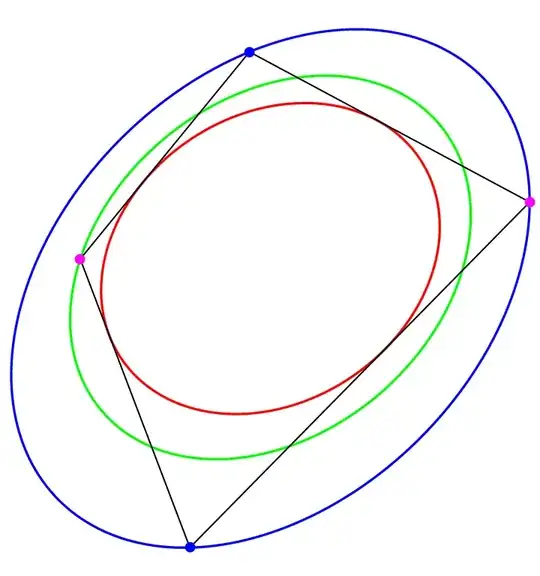
enter image description here

from which we can observe a generic case with any two ellipses. With a simple code change:

{a, b, c, d} = {12, 6, 6, 5};
{xF1ext, yF1ext, xF2ext, yF2ext, V1V2ext} = {-Sqrt[a^2 - b^2], 0, Sqrt[a^2 - b^2], 0, 2 a};
{xF1int, yF1int, xF2int, yF2int, V1V2int} = {-Sqrt[c^2 - d^2], 0, Sqrt[c^2 - d^2], 0, 2 c};

we can refer to the particular case of two ellipses centered and parallel to the Cartesian axis system:
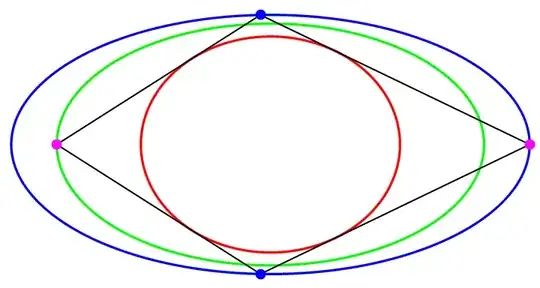
enter image description here

Taking advantage of this code, in symbolic rather than numerical mode, in the latter case the green ellipse, i.e. the locus of the points $(x_Q,\,y_Q)$, is also centered in the origin and has half-axes:

$$ a' = \frac{3\,a\,b^4\,c^4 - 2\,a^3\,b^2\,c^2\,(b^2 + d^2) - a^5\,(b^2 - d^2)^2}{b^4\,c^4 + 2\,a^2\,b^2\,c^2\,(b^2 - d^2) - a^4\,(b^2 - d^2)\,(3\,b^2 + d^2)} \;; \\ b' = \frac{3\,a^4\,b\,d^4 - 2\,a^2\,b^3\,d^2\,(a^2 + c^2) - b^5\,(a^2 - c^2)^2}{b^4\,c^4 + 2\,a^2\,b^2\,c^2\,(b^2 - d^2) - a^4\,(b^2 - d^2)\,(3\,b^2 + d^2)} \;. \\ $$

That's all.

3

The problem can be generalized so that both curves (the circle and outer ellipse in the diagram) are conics. Then the resulting locus is also a conic. Although the subject matter and concepts are very much that of projective geometry, the methods of proof tend to be more analytic than synthetic.

As described in Andrea Del Centina's Poncelet’s porism: a long story of renewed discoveries (also on JSTOR) the problem was studied in the 19th century, and is related to Poncelet's Theorem.

Look for Fig. 21 in Del Centina's paper (pg 68) which illustrates the approach in George Salmon's On the problem of the In-and-circumscribed Triangle.

Figure 21

Salmon derives an equation for the locus as a weighted sum of the original conics ($U$ and $V$) and a third conic $F$. ($F$ has the remarkable property that the tangents from any point on $F$ to $U$ and $V$ form a harmonic pencil.)

Further on, look for Fig. 31, which illustrates a theorem by Darboux.

Figure 31

A tangential pencil is the set of all conics tangent to a four given lines (some of which may be complex), and is dual to an ordinary conic pencil: the set of all conics containing four given points (some of which may be complex).

If $K_3=K_2=K_1$, the quadrilateral circumscribes $K$ (the inner circle/conic in the question) and three of its vertices lie on $K_1 $ (the outer ellipse/conic), as in the original question (see figure below). Then Darboux's theorem says that the locus of the fourth vertex $Q$ is a conic in the tangential pencil $\mathbf T$ containing $K$ and $K_1$.

modified Darboux

To compute the members of $\mathbf T$, let $K'$ and $K'_1$ be the dual conics of $K$ and $K_1$. Then $\mathbf T$ is the set of duals of members of the pencil containing $K'$ and $K'_1$.

Finally, the paper points out that Darboux observed that his theorem was the dual of Poncelet's General Theorem. In the comments, @JeanMarie has pointed out that this question has some similarity with another question math.stackexchange.com/q/3509582. And indeed that one is the dual of this one and is a case of Poncelet's General Theorem.

brainjam
  • 9,172
  • Hi, can you help me here: https://math.stackexchange.com/questions/3968108/what-kind-of-a-locus-y-describe-when-moving-omega I'm interested how to recognise such curve without any calculation. – nonuser Dec 31 '20 at 16:32
  • @Aqua, I have very little experience with these curves, but I have added some observations as a comment to your question. – brainjam Dec 31 '20 at 19:00
  • Yes, I'm reading, thank you! – nonuser Dec 31 '20 at 19:01