We can use the Newton polytope. A positive polynomial should have a convex hull defined by even degree monomials. Our polynomial has a polytope representation as can be observed in the following plot.
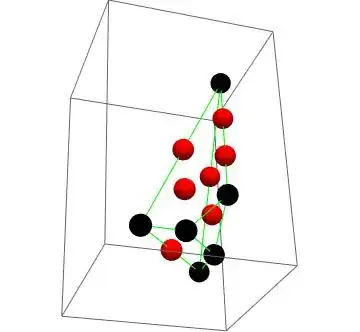
In black the convex hull monomials which are
$$
\left[
\begin{array}{ccc}
x & y & z\\
4 & 0 & 0 \\
0 & 2 & 0 \\
0 & 1 & 0 \\
0 & 0 & 2 \\
0 & 0 & 1 \\
1 & 0 & 0 \\
\end{array}
\right]
$$
and in red the inner monomials which are.
$$
\left[
\begin{array}{ccc}
x & y & z\\
0 & 1 & 1 \\
1 & 0 & 1 \\
1 & 1 & 0 \\
2 & 0 & 0 \\
2 & 0 & 1 \\
2 & 1 & 0 \\
3 & 0 & 0 \\
\end{array}
\right]
$$
Accordingly we should have $a_{11}=a_{12}=a_{13}=0$. After that, the polytope is represented as
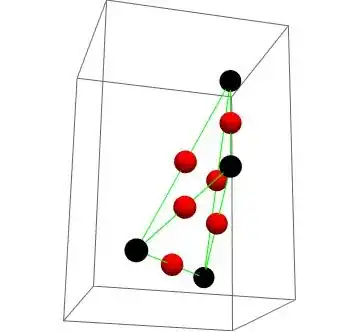
Now the convex hull is formed by
$$
\left[
\begin{array}{ccc}
x & y & z\\
4 & 0 & 0 \\
0 & 2 & 0 \\
0 & 0 & 2 \\
2 & 0 & 0 \\
\end{array}
\right]
$$
and this arrangement has chance of positivity. To proceed we can obtain this convex hull
$$
\{x^4,\ x^2,\ y^2,\ z^2\}
$$
using a convenient monomial basis as
$$
\{x^2,\ x,\ y, \ z\}
$$
so our polynomial form can be represented as
$$
f(x,y,z) = Z^{\dagger}B Z
$$
with $Z = \{x^2,\ x,\ y, \ z\}^{\dagger}$ and $B$ a $4\times 4$ matrix of coefficients. At this point we can follow with the analysis performed on the comment references.
NOTE
After the $B$ determination (definite positiveness) we have the relationships
$$
\left\{
\begin{array}{rcl}
b_{4,4}&=&a_1 \\
b_{3,4}+b_{4,3}&=&a_2 \\
b_{2,4}+b_{4,2}&=&a_4 \\
b_{1,4}+b_{4,1}&=&a_5 \\
b_{3,3}&=&a_3 \\
b_{2,3}+b_{3,2}&=&a_8 \\
b_{1,3}+b_{3,1}&=&a_9 \\
b_{2,2}&=&a_6 \\
b_{1,2}+b_{2,1}&=&a_{10} \\
b_{1,1}&=&a_7 \\
\end{array}
\right.
$$


