41

On Wikipedia, in the article on Ramanujan summation as well as some related articles, examples of Ramanujan summation of the form $ \sum\frac{1}{n^s}$ are done for various values of $s$ which seem to imply that Ramanujan summation yields $\zeta(s)$.

However other sources such as this longer pedagogical paper on Ramanujan summation, Ramanujan summation of divergent series (PDF) by B Candelpergher, it says for example on page xii in the intro, or equation 1.22 on page 19, and again on page 59, that

$$ \sum^{\mathfrak{R}} \frac{1}{n^{z}}=\zeta(z) - \frac{1}{z-1}. $$

This shorter summary on Ramanujan summation also contains the same formula at the end.

So which is it?

Does

$$ \sum^{\mathfrak{R}} \frac{1}{n^{s}}=\zeta(s) - \frac{1}{s-1}. $$

or is it just

$$ \sum^{\mathfrak{R}} \frac{1}{n^{s}}=\zeta(s) $$

instead?

Are there two different conventions for Ramanujan summation? If so, can someone elucidate their definitions and differences?

ziggurism
  • 17,476
  • 1
    https://terrytao.wordpress.com/2010/04/10/the-euler-maclaurin-formula-bernoulli-numbers-the-zeta-function-and-real-variable-analytic-continuation/ – Luke Collins Nov 23 '19 at 16:07
  • There are very many similar questions (see the links here, for example). – Dietrich Burde Nov 23 '19 at 16:19
  • 3
    @LukeCollins As far as I can tell, that post by Terry Tao does not mention Ramanujan summation. Is it just for background or did you have something specific in it that you thought would be relevant? – ziggurism Nov 23 '19 at 16:30
  • $\sum^{\mathfrak{R}} \frac{1}{n^{s}}=\zeta(s) - \frac{1}{s-1}.$ is not a summation of sequence but of the function $f(x)=x^{-s}$, it will give a different value if you replace it by $g(x)=x^{-s}+\sin(\pi x)e^{-x}$ even if $g(n)=f(n)$, in particular the underlying summation doesn't give the expected value for absolutely convergent series, thus it is not a summation method – reuns Dec 02 '19 at 02:20

2 Answers2

11

this had been a comment, but is now meant as an answer introducing the citation from E. Delabaere, Université d' Angers

I've just skimmed the intro of the Candelspergher-book, and have not much time to go deeper into it. But I see that he says, that the notation $\qquad \displaystyle \sum_{n \ge 0}^\mathcal R \cdots \qquad$ means to have captured the pole of the zeta.
As far as I've understood this, this means that the singularity of the $\zeta(1)$ is removed - and this result is called "Ramanujan sum".

So what he calls the "Ramanujan sum" is actually $\zeta(s)-1/(s-1)$. It seems that it is perhaps a unlucky misnomer. Possibly it were better (like with the "incomplete gamma-function") to write
"The Ramanujan sum of the zeta is the incomplete zeta" or the like,
and thus this should then be called "Ramanujan incomplete sum" to indicate that a completing-term is systematically missing from the sum of the series under discussion. The including of the completion-term would then be called with the common name "Ramanujan-summation"

Then there would be nothing irritating when writing

The "Ramanujan incomplete sum" of the series $1+2+3+4+...$ is $$\sum_{n \ge 1}^{\mathcal R} n = \zeta(-1)-\frac1{-1-1} = -\frac1{12} + \frac12 = \frac5{12}$$ and must be completed by $ - \frac12 $ to arrive at the known value $ - \frac1{12} $ for the zeta-interpretation of this series.

Just my 2 cents...


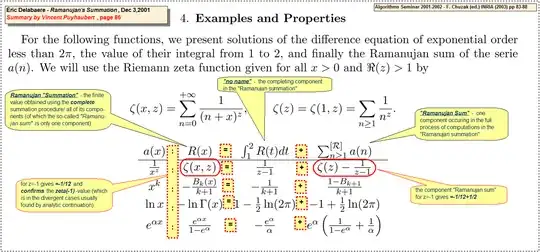
update for completeness of my arguments I just include a snippet from E.Delabaeres article on "Ramanujan summation" by the summary of Vincent Puyhaubert, page 86.
  • Legend: Here $a(x)$ are the terms of the series, rewritten as when the full series $a_1+a_2+a_3+...$ is expressed in the transformed form $a(1)+a(2)+ a(3)+\cdots $ and the powerseries-representation of $a(x)$ is combined with the Bernoully-numbers (according to the Euler-Maclaurin-formula for this problem)
  • The background-colored elements and red ellipses are added by me for pointing to the important terms-of-formula
picture

  • Are you saying that Candelpergher's Ramanujan summation is not the usual Ramanujan summation? – ziggurism Nov 24 '19 at 00:30
  • @ziggurism- I say, that this may be after my fast skimming through that part of the chapter. One must compare this with the official definitions, which we have likely in the WP, mathworld, Springer-onlineencyclopedia. I've also a nice article of Eric Delabaere on Ramanujan summation (in the form of "Summary by Vincent Puyhaubert") but shall not have much time to check this all deeper. – Gottfried Helms Nov 24 '19 at 00:36
  • If it's this paper: https://pdfs.semanticscholar.org/3ab4/201e600f308ae1af1c2173a2720d34a5b3e9.pdf, it seems to use the same definition as Candelpergher, and Delabaere computes the same formula on the last line of the paper: $\sum^{\mathcal R} \frac{1}{n^z} = \zeta(z) - \frac{1}{z-1}$ – ziggurism Nov 24 '19 at 01:09
  • @ziggurism -ah well, then this seems also the same what I've meant/understood. I only thought it might be helpful to avoid irritations to make the difference between "Ramanujan summation" of a series and "Ramanujan sum" of a series more explicite and clearer. – Gottfried Helms Nov 24 '19 at 01:16
  • @ziggurism - yes, it seems we have the same paper (for redundancy-check: I've also the provider "INRIA" referred to on the front page) . So the summation-process for series that Ramanujan has developed, applied to the notation $1+2+3+... $ leads to a term, which when evaluated gives $ \frac 5{12}$ and is called "Ramanujan sum". To arrive at the final value which should be attributed to the sum, one must add one more component. For series of the Dirichlet/zeta-type of series this is $-\frac1{s-1}$, for other types of series that component has another expression. So what? Why not ... – Gottfried Helms Nov 24 '19 at 01:40
  • Now I'm comparing with this "Ramanujan's notebooks" pdf at https://www.sussex.ac.uk/webteam/gateway/file.php?name=ramanujans-notebooks.pdf&site=454. Ramanujan has the "constant of the series" $c = -\frac{1}{2}f(0) -\sum^\infty\frac{B_{2k}}{(2k)!}f^{(2k-1)}(0),$ whereas Candelpergher has an extra term $c = \int_0^1f(x), dx -\frac{1}{2}f(0) -\sum^\infty\frac{B_{k+1}}{(k+1)!}f^{(k)}(0).$ I think that extra term with the definite integral accounts for the discrepancy in the computation of the Ramanujan summation, but I don't really understand what it means. – ziggurism Nov 24 '19 at 01:40
  • ... in the process of a divergent-series-procedure construct two components, one explaining some finite value and one becoming singular when the series under action has a nonremovable part of singularity as in the zeta(1)-case? The "Ramanujan-sum" component (=comp. one) gives when the expression "1+2+3+..." is feeded in the Ramanujan-summation-process some finite value which must be completed by the second component, which is only infinite when the series is not regularizable, like zeta(1). If this indeed the case, just produce the first component (naming it "Ramanujan sum") only as result... – Gottfried Helms Nov 24 '19 at 01:49
  • @ziggurism - let's see tomorrow, it's late night here... – Gottfried Helms Nov 24 '19 at 01:50
  • sure thing, my friend. if any insights come to you tomorrow I will be glad to hear about them. – ziggurism Nov 24 '19 at 07:07
  • @ziggurism - just made things a bit easy by simply snipping the relevant of Puyhaubert's summary of E Delabaere on Ramanujan's sum (too much fiddling to extract this to text and mathjax...) Hope that this reference makes things clear. If not, ask in this comments for more precising (but I don't promise to be diligent enough to extend much ... ;) ) – Gottfried Helms Nov 30 '19 at 14:43
  • 1
    Hi Gottfried. I emailed Candelpergher and he confirmed what I think you are also saying: Ramanujan identified one part of the series, which he called a sum, but is just one term in what Candelpergher and Delabaere are calling the sum. So they do come up with a different answer than Ramanujan. Candelpergher said the point was to ensure that the sum of an analytic function was still analytic. $\zeta(s) - \frac{1}{s-1}$ is analytic at $s=1$, while $\zeta(s)$ is not. – ziggurism Dec 03 '19 at 16:42
2

Yes, it is different conventions and of course I prefer the one which coincides with other regularization methods

$$\sum _{n\ge0}^{\Re} f(n)= -\sum_{n=1}^{\infty} \frac{f^{(n-1)} (0)}{n!} B_n $$

$$\sum _{n\ge1}^{\Re} f(n)= -\sum_{n=1}^{\infty} \frac{f^{(n-1)} (0)}{n!} B_n(1)$$

Anixx
  • 10,161
  • What is the $B_n(1)$ in your second equation? – ziggurism Dec 07 '19 at 22:58
  • @ziggurism Bernoulli polynomial evaluated at 1. $B_n$ is Bernoulli number. It is equal to $B_n(0)$. Only $B_1(0)$ and $B_1(1)$ differ ($B_1(0)=-1/2$, $B_1(1)=1/2$), for all other $n$ they are equal. So, $\sum_{n\ge0}^\Re f(n)=f(0)+\sum_{n\ge1}^\Re f(n)$ – Anixx Dec 08 '19 at 11:24
  • I did never understand, why not $-(-1)^n \zeta(1-n)=B_n/n$ is used in this formula. Then the expression for the derivatives divided by factorials mean nicely the powerseries-coefficients of the function $f()$ (when developed around $0$) and writing that $\zeta()$-values at that coefficients suggest immediately the fact, that we look at the problem as sum-of-$f()$ at consecutive arguments. I think that the whole Ramanujan-process would then be much better anticipated in the common. – Gottfried Helms Dec 09 '19 at 12:42
  • @GottfriedHelms this can be understood as Taylor series, see here: https://mathoverflow.net/questions/115743/an-algebra-of-integrals/342651#342651 – Anixx Dec 09 '19 at 13:32
  • Anixx - for me that linked answer is too much. The medieval (?) monks and theologists hid "their messages" in latin language, so ordinary people could not understand and were blatantly impressed by the sermons of their priests. So this overflow of information, hypotheses, etc. in the linked answer obfuscates(!) the recognizability of a simple structure for the casual reader, for which one needs only simple student's education to already profit from and to improve the common anticipation of the core of Ramanujan-summation. – Gottfried Helms Dec 09 '19 at 13:47
  • @Gottfried Helms The Faulhaber's formula shows clear resemblance to the Taylor series. One can write $\sum_{n\ge0}^\Re f(n)=-\operatorname{reg}f(\omega_-)$ and $\sum_{n\ge1}^\Re f(n)=-\operatorname{reg}f(\omega_+)$ where $\omega_-$ and $\omega_+$ are infinite constants $\omega_-=\sum_{k=1}^\infty 1$ and $\omega_+=\sum_{k=0}^\infty 1=\omega_-+1$ – Anixx Dec 09 '19 at 14:16