5

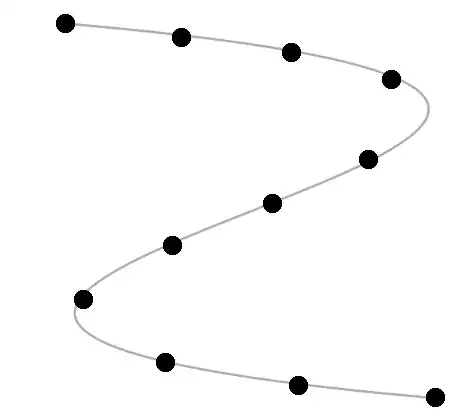
I have to find points (say 10 points) in Bezier curve with 2 control points such that they are at equidistant positions in the curve. Currently I am using the following formula which gives me points but they are not equidistant.

t = ………..from (1/10 to 10/10);
q1 = t * t * t * -1 + t * t *  3 + t * -3 + 1;
q2 = t * t * t *  3 + t * t * -6 + t *  3;
q3 = t * t * t * -3 + t * t *  3;
q4 = t * t * t;

coordinates of a point:

x = q1 * startPointxValue + q2 * controlPoint1xValue + q3 * controlPoint2xValue + q4 * endPointxValue;
y = q1 * startPointyValue + q2 * controlPoint1yValue + q3 * controlPoint2yValue + q4 * endPointyValue;

I tried to use this but due my bad understanding, still unable to correct the values :(. Please help me in finding the values.

attaching sample image of required points (here 11): enter image description here

Kenpachi
  • 153
  • How is distance supposed to be measured? The usual way (chordlengths, in a straight line), or by arclength along the curve. – bubba Mar 05 '13 at 10:30
  • 1
    Just out of curiosity -- why do you want equidistant points? I've been working with Bezier curves for 35 years, and I can't remember any time I ever wanted to sprinkle one with equidistant points. Intriguing. – bubba Mar 05 '13 at 10:40
  • The answer you linked to seems good, to me. It looks easy enough to understand and code. You said you don't see how the control points are used. The "Babylonian method" measures distances between points like $B(t_7)$ and $B(t_8)$. The "B" is the equation of the Bezier curve, as a function of t. So, to get $B(t_7)$, for example, you have to plug $t=t_7$ into your formula for $q1,q2,q3,q4$, and then plug those $q$ values into your formulae for $x$ and $y$. After that's all done, $(x,y) = B(t_7)$. The control points are used to calculate the $B(t)$ values (the points on the curve). – bubba Mar 05 '13 at 10:53
  • @bubba should be arc length distance, so that they look like the distance between every point looks same from next point, okay,, mathematics is REALLY used in daily life, never heard about Bezier during my study of mathematics, i am an iOS developer where i am required to plot milestones at equal distances on a Road (Bezier curve) as shown above :D so i need those coordinates – Kenpachi Mar 05 '13 at 11:07
  • so if my understanding is correct, the method i am using to calculate the coordinates is right, and using Babylonian method I just re-calculate the "t" so that I get correct equidistant coordinates... right? – Kenpachi Mar 05 '13 at 11:14
  • The answer you linked to works with chord lengths (straight line distances). Placing points at equal arclengths is a different problem. That one I have done before. – bubba Mar 05 '13 at 11:18
  • i have attached an image of what is required, please have a look , arclength it is if i am not wrong, kindly correct me if i am. How can I do that if it is arc length?? plz help – Kenpachi Mar 05 '13 at 11:22
  • @bubba There are use to find equidistant point on a bezier curve. One use would be to find how many step a motor has to turn on a CNC milling machine. Since steps are limited in distance let say 1mm per step. It would be good to know if the motor has to step or not to follow the bezier path. – Loïc Faure-Lacroix Sep 18 '17 at 20:51
  • @LoïcFaure-Lacroix -- I'm quite familiar with NC algorithms. The motor places an upper limit (say 1mm) on the length of a step, as you say. But in order for the linear move to stay within tolerance of the curve, you will often want to take a smaller step (less than 1 mm). So, the points won't be equally spaced. And, anyway, the motor step limit applies to chord length, not to arclength. – bubba Sep 19 '17 at 00:38
  • @bubba For the case of smaller step, I put as example that 1mm is the smallest so not possible to do smaller than that. That said thinking of it again, CNCs don't require to have equidistant chord/arclength, Again, using 1mm as a stepping distance, each axis will never be able to step more or less than 1mm. In other words a movement in x or y position is limited to 1,0,-1mm So if you move in x and y direction, the distance will be of 1,41mm. Again, I'm using 1mm because taking a real world example where the smallest stepping distance is 0.005mm doesn't add to simplicity. – Loïc Faure-Lacroix Sep 20 '17 at 15:10

2 Answers2

10

The brute force approach is to just use a polyline approximation. If this is just for graphics, it will certainly be accurate enough. Even for more rigorous applications, it will probably be OK.

Compute a large number of points $n$ along the curve. I'd recommend somewhere in the range $n=50$ to $n=1000$, depending on your accuracy requirements and processor speed. Specifically, let the step-length be $s = 1/n$, and let $t_i = i*s$, and let $P_i = C(t_i)$ be a point on the curve, for $i = 0,1, \ldots , n$. Also, let $c_i = \Vert P_i - P_{i-1} \Vert$ be the $i$-th chord length, and let

$$d_i = \frac{\sum_{j=0}^i c_j}{\sum_{j=0}^n c_j}$$

So, in words, $d_i$ is the fractional distance along the polyline $P_0P_1 \ldots P_n$ at the $i$-th point $P_i$.

Now suppose you want to distribute $m+1$ points $Q_0, \ldots , Q_m$ at equal arclengths along the curve. Here's how you locate the $r$-th point $Q_r$.

Let $d = r/m$. Find $i$ such that $d_{i} \le d \le d_{i+1}$. Then let

$$ u = \frac{d - d_i}{d_{i+1} - d_i} $$

$$ t = t_i + u*s = (i+u)*s$$

$$ Q_r = C(t)$$

Getting all the indexing correct is a chore -- there are lots of opportunities for off-by-one errors. But, other than that, it's straightforward. The basic idea is that distances along the curve can be approximated by distances measured along the polyline $P_0P_1 \ldots P_n$.

You can use your existing code to calculate any point $(x,y) = C(t)$ on the curve.

Here's an implementation in C#:

class Program
{
   static void Main()
   {
      Position endpt0, endpt1, control0, control1;
      endpt0 = new Position(100,100);    control0 = new Position(200,200);
      endpt1 = new Position(100,200);    control1 = new Position(400,200);
      BezierCurve curve = new BezierCurve(endpt0, control0, control1, endpt1);

      // Construct polyline with large number of points
      int n = 1000;
      double s = 1.0/(n-1);
      double[] tt = new double[n];
      Position[] PP = new Position[n];
      double[] cc = new double[n];
      for (int i = 0 ; i < n ; i++) 
      {
         tt[i] = i*s;
         PP[i] = curve.Position(tt[i]);
         if (i > 0) cc[i] = Distance(PP[i], PP[i-1]);
      }

      // Get fractional arclengths along polyline
      double[] dd = new double[n];
      dd[0] = 0;
      for (int i = 1 ; i < n ; i++) dd[i] = dd[i-1] + cc[i];
      for (int i = 1 ; i < n ; i++) dd[i] = dd[i]/dd[n-1];

      // Number of points to place on curve
      int m = 10;
      double step = 1.0/(m-1);
      Position[] QQ = new Position[m];

      for (int r = 0 ; r < m ; r++)
      {
         double d = r*step;
         int i = FindIndex(dd, d);
         double u = (d - dd[i]) / (dd[i+1] - dd[i]);
         double t = (i + u)*s;
         QQ[r] = curve.Position(t);
      }
   }

   // Find index i such that dd[i] < d < dd[i+1]
   public static int FindIndex(double[] dd, double d)
   {
      int i = 0;
      for (int j = 0 ; j < dd.Length ; j++)
      {
         if (d > dd[j]) i = j;
      }
      return i;
   }
}
bubba
  • 44,617
0

As said by Bubba, an option is to flatten the curve (sample it as a polyline) then approximate the curvilinear abscissas by accumulation of chord lengths.

Another option if to solve the ODE

ds / dt = √(x'² + y'²)

for constant increments of s. So we formulate as

dt = √(x'(t)² + y'(t)²) ds

and integrate for example by Runge-Kutta.

Note that the first approach does the same thing, but integrating by a first order method.