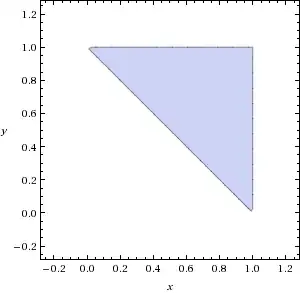
There should not an answer to this question. Choosing randomly two numbers does not tell us any probability distribution. Maybe you meant choose randomly, uniformly and independently, as the edit says.
Only given that it is uniform distribution, their pdfs:
$f_{X} (t) = 0$ if t outside (0,1)
$f_{X} (t) = 1$ if $0\le t \le 1$
$f_{Y} (t) = 0$ if t outside (0,1)
$f_{Y} (t) = 1$ if $0\le t \le 1$
Introduce new random variable Z = X + Y, pdf of Z is convolution of X and Y
$f_{Z}(t) = \int_{-\infty}^\infty f_X(w)f_Y(t-w)dw = \int_{0}^t f_X(w)f_Y(t-w)dw$
Here discuss t
$t<0$: $f_Z(t) = 0$
$0\le t\le1$: $f_Z(t) = t/2$
$1\le t\le2$: $f_Z(t) = 1-t/2$
$t>2$: $f_Z(t) = 0$
Now to get what you want, integrate:
Probability of sum more than 1
$\int_1^\infty f_Z(t)dt = \int_1^2 f_Z(t)dt = 1/2$
Probability of sum less than 1
$\int_{-\infty}^1 f_Z(t)dt = \int_0^1 f_Z(t)dt = 1/2$ or simply use 1-1/2 from last result.