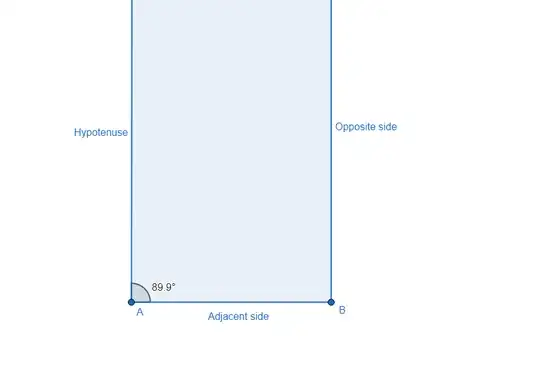
Why the cosine of an angle of 90 degree is equal to zero?
By definition we know that: $$\text{cos } \alpha = \frac{\text{adjacent}}{\text{hypotenuse}}.$$
If we want to apply the definition to the situation in the image below:

we have that: $$\text{cos } 90° = \frac{?}{h} .$$ How can I say that it is equal to $0$ if I don't know anything about the other two sides, or about the other two angles?
I have been able to always find a value, even without the unit circle, in situations like $\text{csc } 90°, \text{sec } 0°$, etc..., But not in the above situation. Why?
Please, can you suggest me anything?
So, I make an addition also based on suggestions provided. My main error was to start to consider the right angle, instead I have to start considering $\theta = \alpha°$, and increse it till $\theta = 90°$, one side become smaller till zero, and the other side become bigger till equal to $h$, therefore $\text{cos } \alpha = \frac{0}{h} = 0$